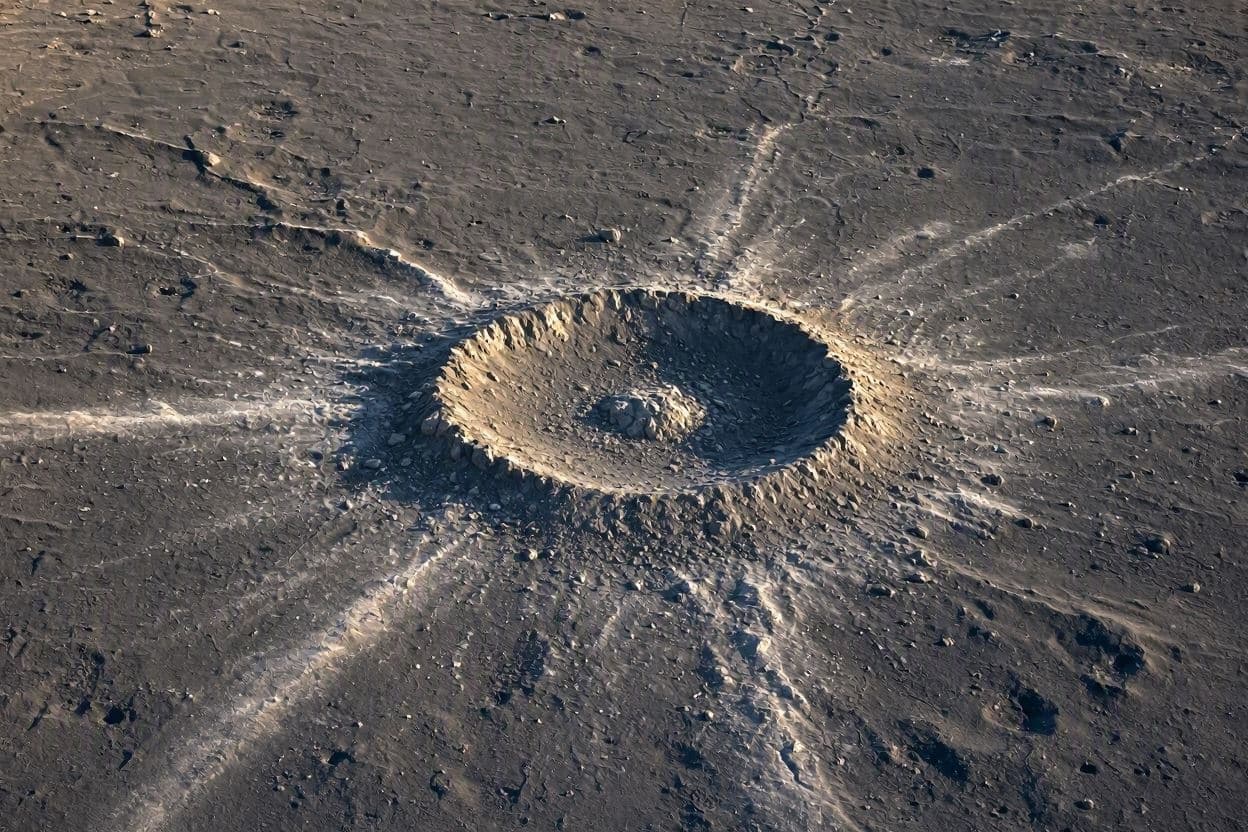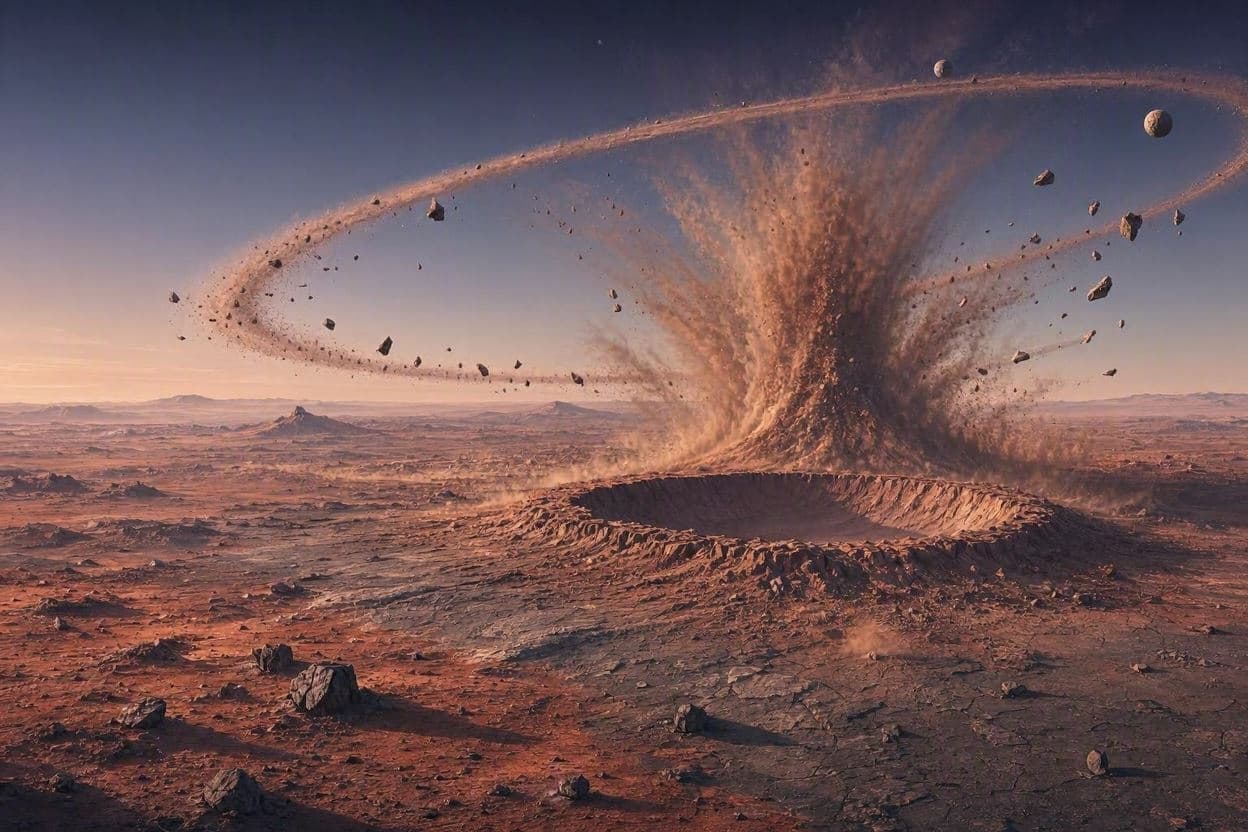
In the silent, rust-colored expanse of Mars, a scar remains from an ancient collision that may hold the key to one of the solar system’s enduring mysteries. The Borealis Basin, a vast depression covering much of the planet’s northern hemisphere, is not just a geological feature but a potential birthplace for Phobos and Deimos, the two small moons that orbit the Red Planet. Recent research suggests that this giant impact, occurring billions of years ago, could have ejected debris into orbit that eventually coalesced into the moons we see today. It is a story written in rock and gravity, waiting to be deciphered.
For decades, scientists have debated whether Phobos and Deimos are captured asteroids or native offspring of Mars. Their irregular shapes and dark surfaces resemble asteroids from the outer belt, leading many to believe they were snared by Martian gravity. However, their nearly circular orbits in the planet’s equatorial plane suggest a more intimate origin. The giant impact hypothesis offers a compelling alternative, proposing that a massive body struck Mars, creating a disk of debris from which the moons formed. This theory aligns with the formation of Earth’s own moon, providing a familiar narrative in a distant context.
The Borealis Basin, with its immense size and elliptical shape, serves as the primary evidence for such a cataclysmic event. An impact of this magnitude would have released enough energy to vaporize rock and launch material into space. Simulations indicate that the resulting debris disk could have given rise to multiple moons, with Phobos and Deimos being the surviving remnants. Over time, gravitational interactions and tidal forces may have caused other moons to crash back into Mars or escape into space, leaving only these two behind.
Phobos, the larger and closer of the two, is slowly spiraling inward toward Mars, destined to either crash into the planet or break apart into a ring system within tens of millions of years. This "doomed" fate adds a layer of urgency to studying its composition and structure. Missions like Japan’s upcoming MMX (Martian Moons eXploration) aim to return samples from Phobos, which could provide definitive chemical evidence linking it to the Martian crust rather than external asteroids. Such data would strongly support the impact theory.
Deimos, farther out and smaller, presents a different puzzle. Its orbit is more distant and less affected by immediate tidal decay, but its origin is likely tied to the same event. Some models suggest that Deimos formed from the outer edges of the debris disk, where material was cooler and less dense. Understanding the relationship between the two moons helps reconstruct the dynamics of the early Martian system, offering insights into planetary formation processes across the solar system.
The implications of this theory extend beyond Mars. If giant impacts are common mechanisms for moon formation, it suggests that many planets may have had complex satellite systems in their youth. Studying Mars provides a unique laboratory for testing these ideas, as its moons are accessible and relatively well-preserved compared to those of gas giants. Each crater and orbital parameter serves as a clue in a cosmic detective story.
Critics of the impact hypothesis point to the lack of direct compositional proof until sample return missions occur. Spectral data from orbiters have shown mixed results, with some features resembling carbonaceous chondrites and others showing signs of Martian weathering. The debate remains open, inviting further exploration and analysis. Science thrives on such uncertainty, driving innovation and deeper inquiry.
In the end, the giant crater of the Borealis Basin may indeed be the cradle of Mars’ moons. It reminds us that violence and creation are often intertwined in the history of our solar system. As we look to the future of Mars exploration, the story of Phobos and Deimos continues to unfold, promising new discoveries about our neighboring world. The red planet keeps its secrets, but slowly, they are being revealed.
AI Image Disclaimer: The visual representations included here are AI-generated illustrations designed to depict Martian landscapes and celestial mechanics, not actual photographs of the Borealis Basin or specific mission simulations.
Sources: ScienceDirect Astronomy & Astrophysics NASA Science
Published by Banx Network. This article is part of the Banx decentralized media programme, powered by the BXE token on the XRP Ledger.