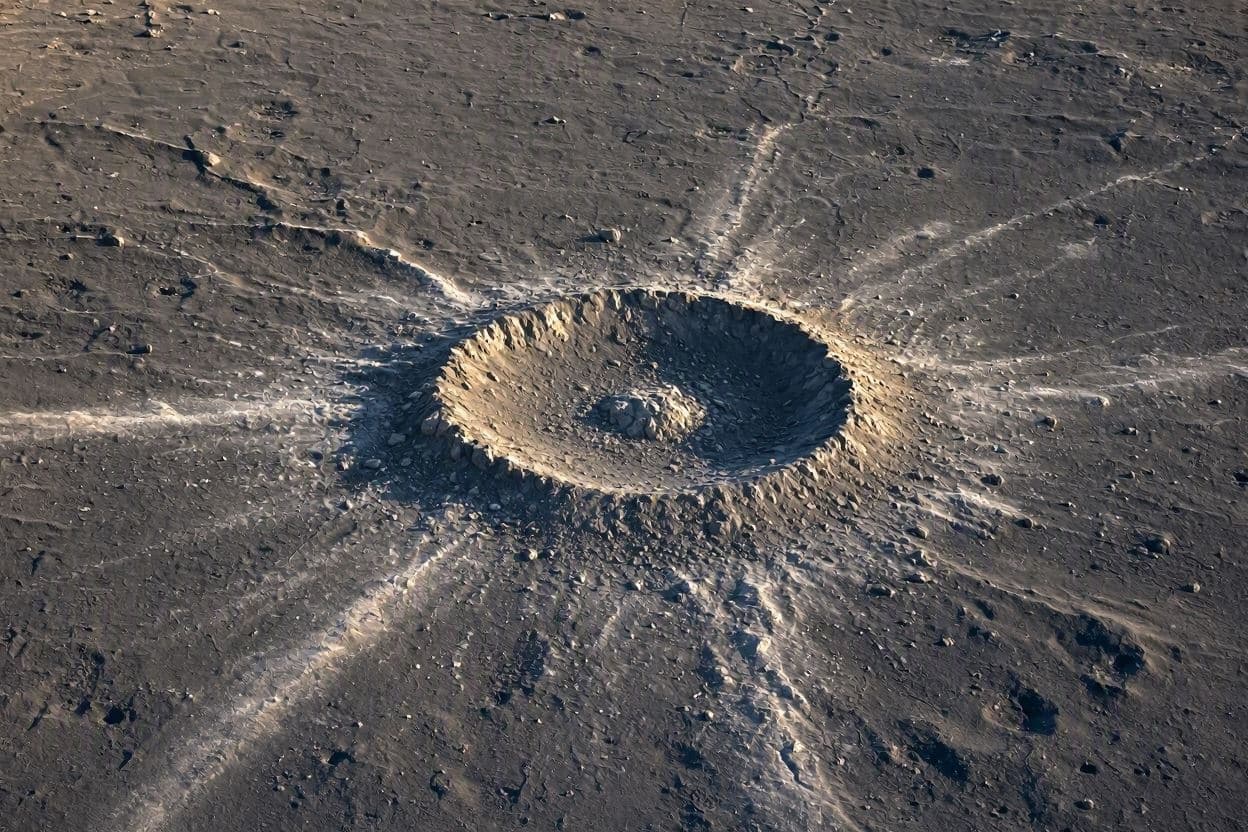
The Moon, often seen as a static and unchanging companion in our night sky, is actually a dynamic world subject to the constant bombardment of space debris. Recently, NASA’s Lunar Reconnaissance Orbiter (LRO) captured images of a significant new impact feature, named McGetchin crater. Formed in the spring of 2024, this crater is notable not just for its freshness but for its size, representing a rare "once-in-a-century" event that offers scientists a unique opportunity to study lunar geology and impact dynamics in real time.
McGetchin crater, located on the Moon’s near side, measures approximately 728 feet (222 meters) across and 141 feet (43 meters) deep. Its formation was likely caused by an asteroid or comet fragment striking the surface with tremendous force. The LRO’s high-resolution cameras detected the change by comparing recent images with older archives, highlighting the bright ejecta blanket that surrounds the fresh crater. This brightness indicates that the underlying material has not yet been darkened by space weathering, a process that occurs over thousands of years.
The discovery is significant because large impacts of this magnitude are relatively rare. Most craters formed today are small, measuring only a few meters across. Finding one of this size allows researchers to calibrate their models of impact frequency and energy distribution. It provides a ground-truth data point for understanding how often such events occur and what kind of objects are currently traversing the inner solar system. This knowledge is crucial for planning future lunar missions and ensuring the safety of astronauts and infrastructure.
Named after Thomas McGetchin, a planetary scientist who made significant contributions to the field, the crater serves as a tribute to his legacy. The naming process follows international guidelines established by the International Astronomical Union, ensuring that features are recognized for their scientific and historical importance. For the scientific community, it is a moment of celebration and reflection, honoring past achievements while looking toward future discoveries.
The timing of the impact, between April and May 2024, was pinpointed through careful analysis of image timestamps. This precision allows scientists to correlate the event with other astronomical observations, such as seismic data from past Apollo missions or telescopic sightings of near-Earth objects. It creates a more complete picture of the lunar environment and its interaction with the broader solar system. Such detailed records are invaluable for long-term monitoring efforts.
For the public, the image of a fresh crater is a reminder of the violence and beauty inherent in space. It challenges the notion of the Moon as a dead world, showing instead that it is actively evolving. The bright rays of ejecta radiating from the impact site are visually striking, resembling a splash of white paint on a dark canvas. These images captivate the imagination and inspire curiosity about the forces that shape our celestial neighbors.
As NASA prepares for the Artemis program, which aims to return humans to the Moon, understanding impact risks becomes increasingly important. Data from craters like McGetchin help engineers design habitats and suits that can withstand potential micrometeoroid strikes. It also informs the selection of landing sites, ensuring that they are safe and scientifically valuable. The LRO continues to play a critical role in this preparatory work, mapping the surface with unprecedented detail.
In the end, the discovery of McGetchin crater is a testament to the power of persistent observation. By keeping a watchful eye on the Moon, scientists can uncover secrets that were hidden in plain sight. It reminds us that even in a familiar sky, there is always something new to learn. The Moon continues to surprise us, one impact at a time.
AI Image Disclaimer: The images accompanying this article are AI-generated artistic interpretations of lunar landscapes and impact events, not actual raw images from the Lunar Reconnaissance Orbiter.
Sources: NASA Science Space.com CBC News
Published by Banx Network. This article is part of the Banx decentralized media programme, powered by the BXE token on the XRP Ledger.