There is a quiet persistence to a military presence that has outlasted its stated purpose. More than fourteen months after National Guard members first appeared on the streets of Washington, D.C., their patrols have become part of the city's daily rhythm—a backdrop to commutes and errands, to the ordinary life of a capital that was never meant to feel like a garrison. This week, a federal appeals court took up the question of whether that presence should continue, and in doing so, it waded into a constitutional debate that touches the very nature of who governs the nation's capital.
The U.S. Court of Appeals for the District of Columbia Circuit heard oral arguments Wednesday on whether President Donald Trump's deployment of the National Guard—initiated in August 2025 as a crime-fighting mission—can lawfully continue . The force, which peaked at about 5,000 troops over the summer, has supported arrest operations, patrolled city streets, and participated in cleanup efforts . It has been extended by the Defense Department until January 2029 .
D.C.'s attorney general has argued that the mobilization is an illegal use of the military for domestic law enforcement . A lower court ruled in November that the deployment was unlawful, finding that while the president has authority to protect federal property and functions, he cannot unilaterally deploy the Guard for general crime control . That ruling was paused pending appeal, allowing the troops to remain in place .
The case turns on the peculiar constitutional status of Washington, D.C. As a federal district rather than a state, it has limited autonomy over its own affairs. The Constitution gives Congress authority over the District, while the Home Rule Act of 1973 allows residents to elect a mayor and council . The city argues that these arrangements still impose restraints on unilateral presidential deployment of the Guard for a mission with no inciting event .
The three-judge panel, composed of appointees of Democratic presidents, appeared to grapple with the district's diminished sovereignty even as it pressed the government on the deployment's scope. Judge Cornelia Pillard noted that the process for requesting Guard support seemed to offer little resistance, describing it as "not much of a speedbump" . The city's lawyer pointed to National Guard troops posted near ballot drop boxes and in residential neighborhoods far from any federal property .
Outside the courthouse, dozens of protesters gathered holding signs reading "Guards Out" and "Free DC" . The deployment has cost taxpayers an estimated $3 million per day, according to the city . Even if D.C. prevails at the appeals court, the Trump administration is expected to seek Supreme Court review, where the president has found deference in previous cases .
The Guard's presence has taken on a sense of permanence—a $292 million contract has been awarded for apartments for task force members . For now, the troops remain, and the city waits for judges to decide whether the capital's streets belong to its residents or to a president who sees them differently.
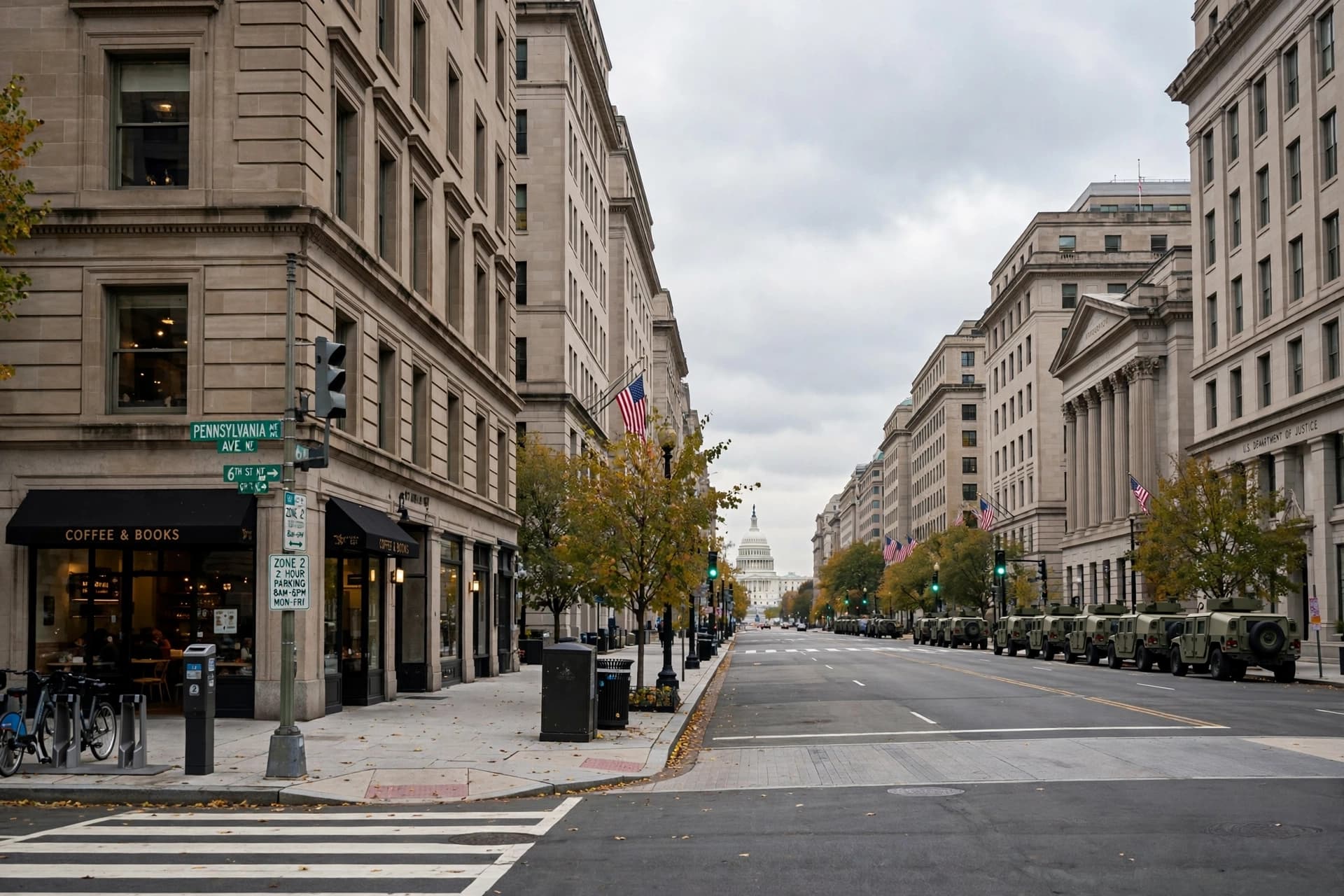
The images in this article are AI-generated and serve illustrative purposes only.
Sources: AP News, Talking Points Memo, The National Desk
Published by Banx Network. This article is part of the Banx decentralized media programme, powered by the BXE token on the XRP Ledger.

.jpg&w=3840&q=75 "Sally Rooney’s Books to Be Withdrawn From UK Sale Over Palestine Action Support")