Some objects in the night sky invite us to look closer not because they are bright, but because they are moving. The Shrimp Nebula, known formally as Sh2-188, is one of those quiet travelers—a faint, sprawling cloud of gas that reveals itself most clearly to those who understand that stillness is often an illusion. On Monday, NASA’s Astronomy Picture of the Day turned its gaze toward this nebula, a portrait of a dying star that refuses to sit still.
Sh2-188 is classified as a planetary nebula, a misleading name for what is actually the shed outer atmosphere of a Sun-like star. What makes this particular nebula remarkable is its size: it spans about half the diameter of the Moon in the night sky, placing it among the larger planetary nebulae visible from Earth. Most nebulae of this type are compact, their glowing shells tightly wrapped around their dying stars. The Shrimp Nebula, by contrast, is expansive, its gas spread across a wide angular field.
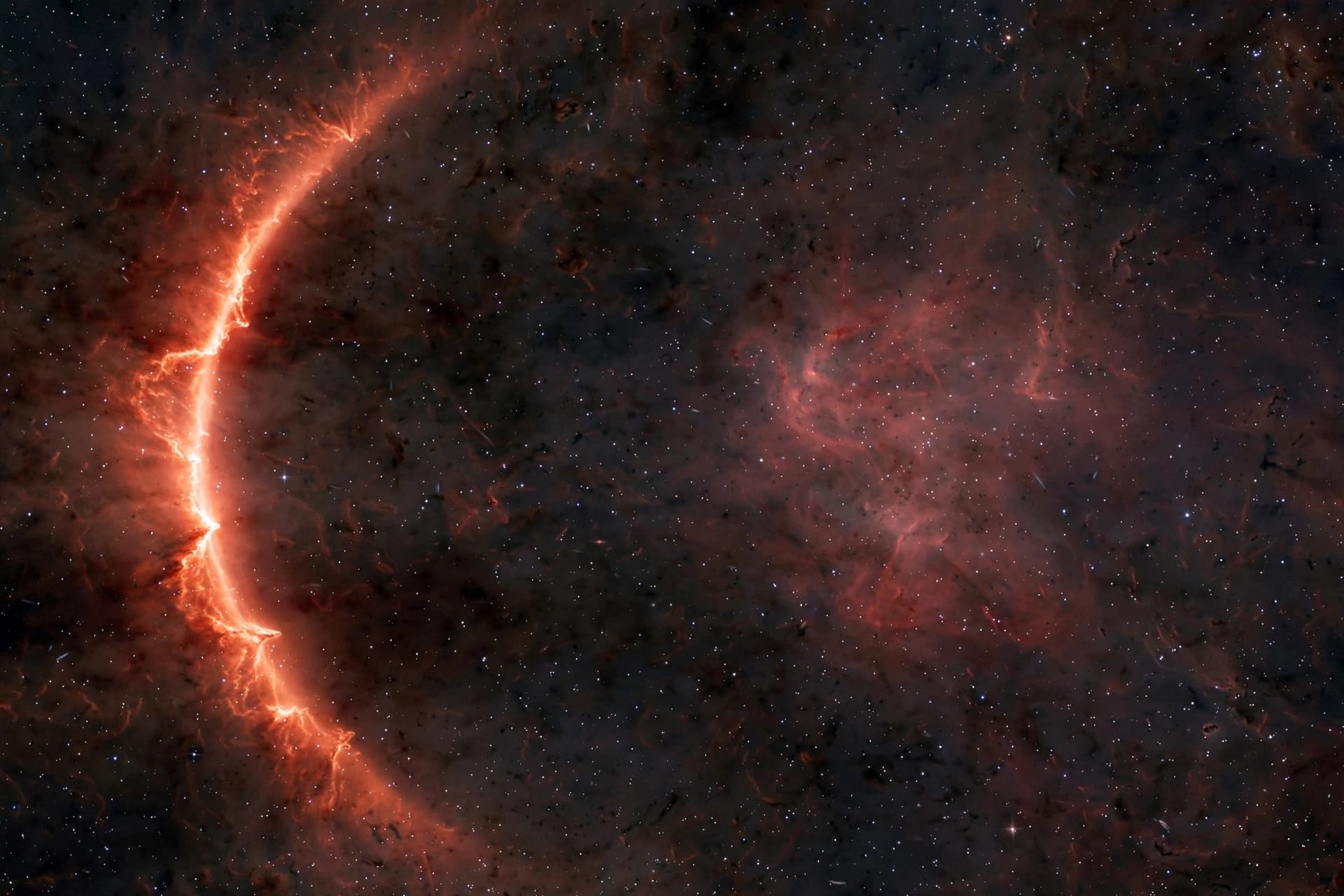
The swirl that gives the nebula its distinctive appearance is likely the result of speed. At its center lies a white dwarf—the leftover core of the star that once existed there—and this remnant is moving unusually fast through interstellar space. As it moves, it creates a bow shock, a curved compression of gas and dust that resembles the wake of a boat plowing through water. This bow shock is most visible on the upper left of the nebula, a bright arc where the white dwarf’s motion compresses and brightens the surrounding material.
The image featured by APOD was captured not by a space telescope but by a backyard telescope in Krakow, Poland. Photographer Pawel Piechnik used filters for hydrogen, sulfur, and oxygen, then digitally adjusted the result to approximate the nebula’s true colors. The fact that such a detailed portrait of a distant dying star can be made from a modest observatory on Earth is a reminder that the cosmos is not the exclusive province of grand institutions. It belongs, in part, to anyone willing to look up.
Planetary nebulae like Sh2-188 are brief events in cosmic time, lasting only tens of thousands of years before their gas disperses into the interstellar medium. They represent a moment of transition: the end of a star’s life, and the beginning of a new chapter for the material it sheds. The white dwarf at the center of the Shrimp Nebula will cool and fade over billions of years, a quiet ember in a vast and mostly empty space.
What the Astronomy Picture of the Day offers, day after day, is not merely a photograph but a perspective. The Shrimp Nebula is not close. It is not bright. It is not, in any ordinary sense, urgent. And yet it is moving, changing, leaving a trail across the sky. It is a reminder that even the slowest-seeming things in the universe are in motion, and that looking carefully is its own form of travel.
AI Image Disclaimer: The illustrations accompanying this article were generated by artificial intelligence and are for illustrative purposes only.
Sources: NASA Science (APOD), Astronet.ru
Published by Banx Network. This article is part of the Banx decentralized media programme, powered by the BXE token on the XRP Ledger.