There is a particular kind of generosity that lives in the naming of things. To give a name is to acknowledge that something exists, that it matters, that it deserves to be remembered. Last week, two student researchers at Chicago’s Field Museum did something quietly extraordinary: they looked at a fossil that had been sitting in a museum collection for years, recognized it as something new, and gave it a name that honored the people who first taught them what it means to be curious.
The fossil in question is approximately 309 million years old, unearthed from Mazon Creek in Illinois, one of North America’s richest Carboniferous fossil sites. It had been discovered years ago by an amateur collector and donated to the Field Museum, where it was initially classified as a known species called Amphibamus grandiceps. For years, it sat in what paleontologists sometimes call a “waste bin taxon”—a catchall category for specimens that appear related but haven’t been examined closely enough to determine their true identity.
That changed when Payton Kohlberg and Allison Sefcovic, two interns in the museum’s Women in Science program, took a closer look. Working in the lab of researcher Arjan Mann, they noticed differences in the fossil’s vertebrae and other anatomical features that distinguished it from the species it had been assigned to. Their findings were published in the Journal of Vertebrate Paleontology, formally establishing a new species: Jeanerpeton mazonensis.
The name is a double tribute. “Jeanerpeton” translates roughly to “Jean’s crawler,” and it honors the mothers of both researchers—who, by a coincidence that feels almost too neat for fiction, are both named Jean. The second part of the name, “mazonensis,” refers to Mazon Creek, the site of the discovery. In a field where species names are often drawn from Greek and Latin roots, this one carries something warmer: a personal history embedded in the scientific record.
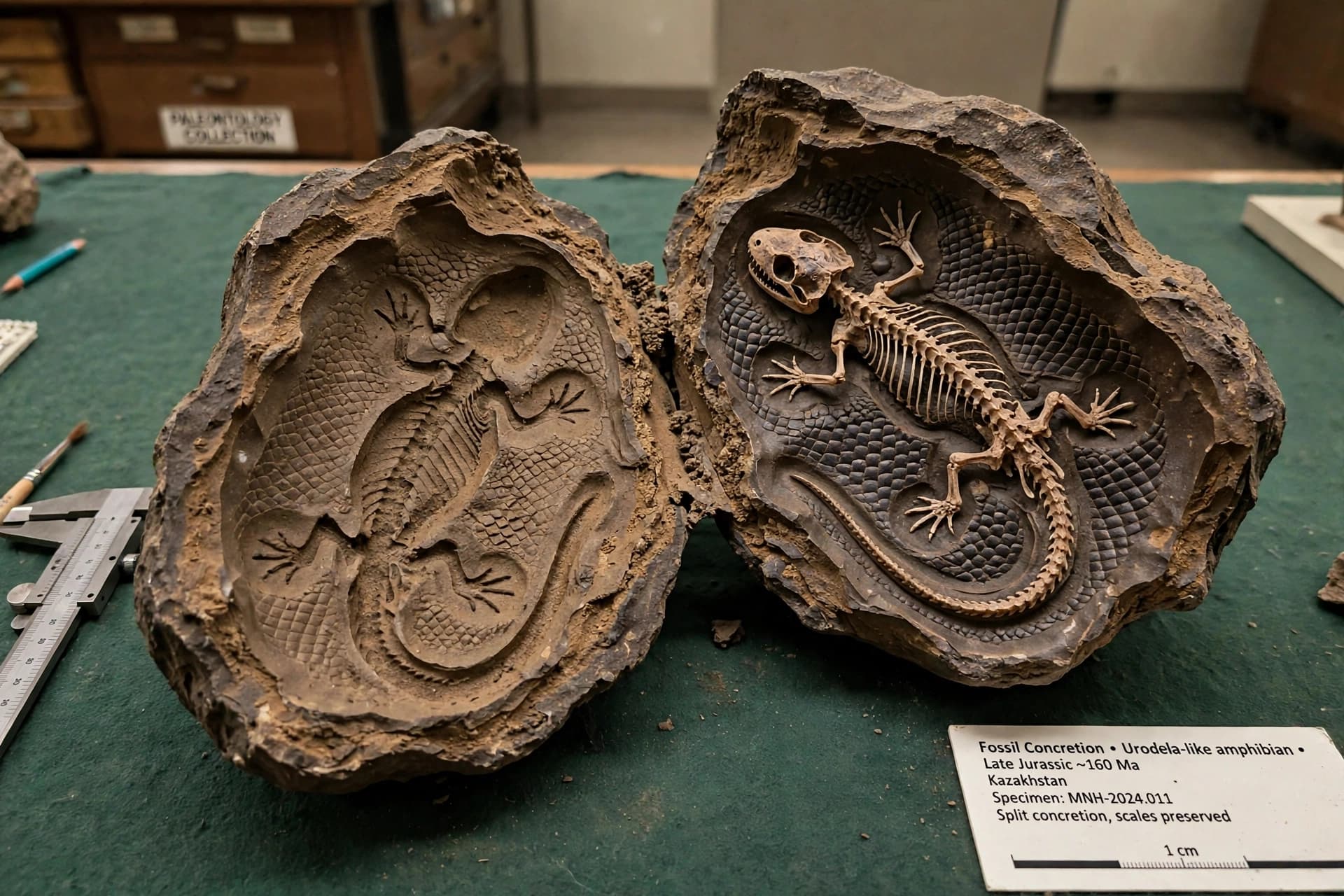
What makes the fossil particularly valuable is its exceptional preservation. Mazon Creek is known for its concretions—hard, siderite nodules that formed around dead organisms in a ancient river delta, protecting soft tissues that would normally decay before fossilization. In the Jeanerpeton specimen, researchers could see scales on its back, tiny “belly ribs” called gastralia, and even impressions of the eyes. “What’s really cool about Mazon Creek is that it preserves all of these unusual details,” Sefcovic said. “You can even see the eye impressions”.
Jeanerpeton was a temnospondyl, an extinct group of four-legged animals that lived before the dinosaurs and included some of the earliest relatives of modern amphibians. It had a squat, salamander-like body and, notably, broad toe pads—a feature seen in living amphibians that grip surfaces, though whether Jeanerpeton used them for climbing remains unknown. The presence of such pads more than 300 million years ago suggests that this adaptation appeared early in the evolutionary history of amphibians.
For Kohlberg and Sefcovic, both early in their scientific careers, the discovery is more than a publication. It is proof that careful observation can yield results even in a collection that has been studied for decades. “Before working in the Mann Lab, I didn’t know much about paleontology,” Kohlberg said. “This experience gave me confidence”. The fossil had been in the museum for years. It took fresh eyes and a willingness to look again.
AI Image Disclaimer: The images in this article were generated by AI and are not photographs of the actual fossil specimen.
Sources: Discover Magazine, Merkur, Infobae, Hi-Tech Mail, MDZ Online
Published by Banx Network. This article is part of the Banx decentralized media programme, powered by the BXE token on the XRP Ledger.