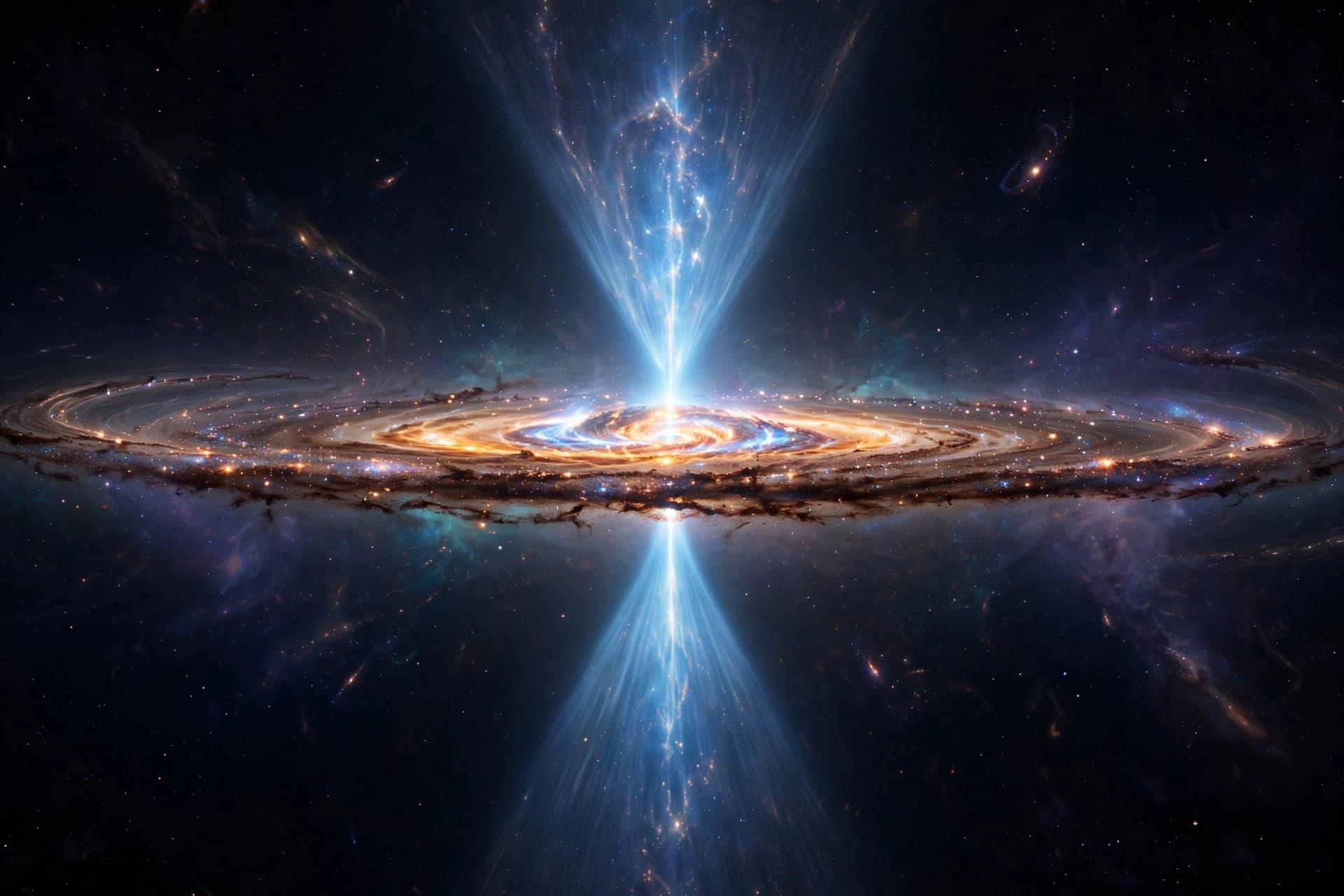
Black holes have long played the villain in the story of cosmic evolution—gravitational monsters that devour everything within reach, snuffing out the gas clouds from which stars are born. The image is not entirely wrong. Active galactic nuclei, the brilliant cores powered by supermassive black holes feeding on surrounding matter, do release enormous energy that can heat and disperse interstellar gas . But a new study suggests the story is more complicated, and perhaps more generative, than that.
Researchers at the Center for Astrophysics at Harvard and Smithsonian used the Very Large Telescope in Chile to examine nine nearby Seyfert galaxies, each hosting an actively accreting supermassive black hole . They employed a three-dimensional diagnostic technique to separate three distinct sources of light: star formation, radiation from the black hole itself, and excitation caused by shock waves moving through the galaxy . What they found was a consistent pattern across all nine galaxies—a pattern that challenges the conventional view of black holes as purely destructive.
Star-forming rings and arcs appeared at distances of roughly 0.8 to 6 kiloparsecs from the galactic centers, equivalent to between 2,600 and 20,000 light-years . These were not random placements. The researchers also observed ionized cones of radiation extending outward from the black hole, and fast shock fronts propagating perpendicular to those cones . The geometry was remarkably consistent, appearing in every galaxy studied. “The most interesting phenomena about shocks is that they always go perpendicular to where the black hole’s injected outflows go,” said lead author Peixin Zhu. “It is very common, and we see it consistently appearing across the whole nine galaxies” .
The mechanism appears to be a feedback cycle. As the black hole accretes material, it ejects some of it back out in the form of jets and winds. These outflows collide with surrounding interstellar gas, creating shocks that compress and energize the material, potentially triggering the collapse that leads to star formation . “Once we resolved them, we could see that they not only accrete things, but they also eject things,” Zhu said. “The injection and accretion are linked with each other” .
The study used Chandra X-ray observations to independently support the interpretation, and detailed theoretical models built by Zhu and her colleagues helped distinguish between the different excitation sources . The findings suggest that the relationship between a supermassive black hole and its host galaxy is not a simple tale of consumption and depletion, but a complex exchange in which destruction and creation are intertwined.
“We’re seeing that black holes are not just consuming material at the centers of galaxies, but they’re actively reshaping their surroundings,” said Lisa Kewley, director of the Center for Astrophysics and Zhu’s advisor. “This work helps us understand a complex feedback cycle that plays an important role in galaxy evolution” . The study, published in The Astrophysical Journal, adds to a growing body of evidence that black holes may be, in some circumstances, engines of star formation rather than merely its adversaries .
For astronomers, the results offer a clearer picture of how galaxies grow and change over cosmic time. If black holes can both suppress and stimulate star formation—depending on the geometry and energy of their outflows—then models of galaxy evolution must account for that duality. The universe, it seems, is less interested in clean categories than in the messy interplay between them.
AI Image Disclaimer: The images in this article were generated by artificial intelligence for illustrative purposes and do not represent actual astronomical observations.
Sources: EurekAlert!, Universe Today, IFLScience, Smithsonian Magazine, The Astrophysical Journal
Published by Banx Network. This article is part of the Banx decentralized media programme, powered by the BXE token on the XRP Ledger.