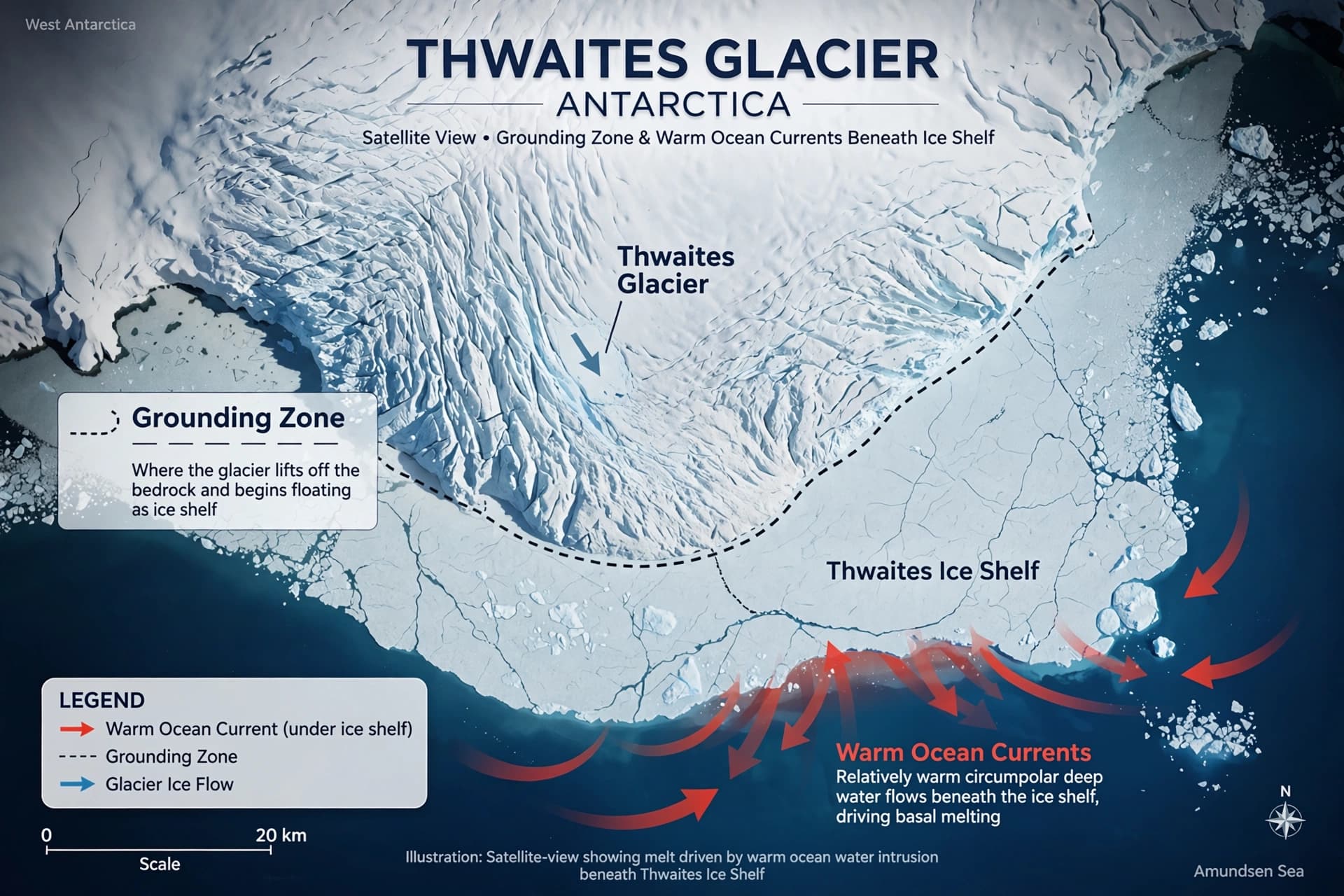
There is a glacier at the bottom of the world that holds a kind of terrible power in its slow collapse. It is called Thwaites, and it is roughly the size of Florida, a vast expanse of ice that has become synonymous with the worst fears of a warming planet. For years, scientists have watched it from space, measuring its retreat, knowing that its fate is tied to coastlines thousands of miles away. What they could not do, until recently, was predict how quickly it might fail.
Two new studies have begun to fill in the missing pieces, and the picture they paint is not comforting. The first, published in Nature Communications, addresses a problem that had long troubled modelers: their simulations could not reproduce the retreat that satellites had already observed. The reason, it turned out, was that they had left out something fundamental about the place where the glacier meets the sea.
That place is called the grounding zone, the boundary where Thwaites' icy underbelly lifts off the seabed and begins to float. It was once treated as a fixed line. But scientists have come to understand that it moves with the tides, bobbing up and down like a slow breath. Each time it lifts, warm ocean water pushes underneath, carving cracks and channels into the ice that allow even more melting. The new model, led by Mattia Poinelli at UCLA, incorporated this dynamic for the first time—and it worked. The simulation matched the satellite record .
With the model calibrated against reality, the researchers could look forward. Their projections suggest that if the climate remains as warm as it is now, Thwaites could contribute about 3 centimeters of sea level rise by the end of the century—roughly double previous estimates . More troubling still, the model indicates that the glacier could become permanently unpinned from the seafloor as early as 2038, with a 60 percent chance of that happening by 2100. Once unpinned, there would be little to hold it back.
The second study, published in Geophysical Research Letters, examined a different question: whether Thwaites and its neighbor, the Pine Island Glacier, could recover if ocean warming were somehow halted or reversed. The answer, for Thwaites, was not encouraging. While Pine Island might regrow ice within a decade under cooler conditions, Thwaites would not. Its outer shelf is too damaged, its structure too compromised . The two glaciers, though similar in size, are not equally resilient.
Together, the studies do not predict the future so much as clarify its terms. Thwaites is not simply melting because the air is warm. It is melting because the ocean is reaching places it should not reach, because the geometry of the seabed allows warm water to intrude, because the glacier's own retreat opens pathways for more. It is a feedback loop, and the new models capture its workings with a fidelity that earlier attempts lacked.
There is a temptation, in reading such findings, to look for a single number, a date, a threshold that tells us exactly when to worry. The science does not offer that. What it offers is a clearer picture of a system in motion, with uncertainties that remain but whose direction is not in doubt. Thwaites will continue to lose ice. The question is how much, and how fast, and what that will mean for the communities that live along the world's coasts.
The glacier is remote, inaccessible, a place of wind and ice and darkness for much of the year. Yet its fate is woven into the lives of people who will never see it, in cities and villages and low-lying islands where the sea is already rising. The new studies do not change that reality. They simply make it harder to look away.
Image note: This article's visual is an AI-generated illustration and does not depict actual satellite or field data.
Sources: Grist, Nature Communications, Geophysical Research Letters, University of California Los Angeles
Published by Banx Network. This article is part of the Banx decentralized media programme, powered by the BXE token on the XRP Ledger.