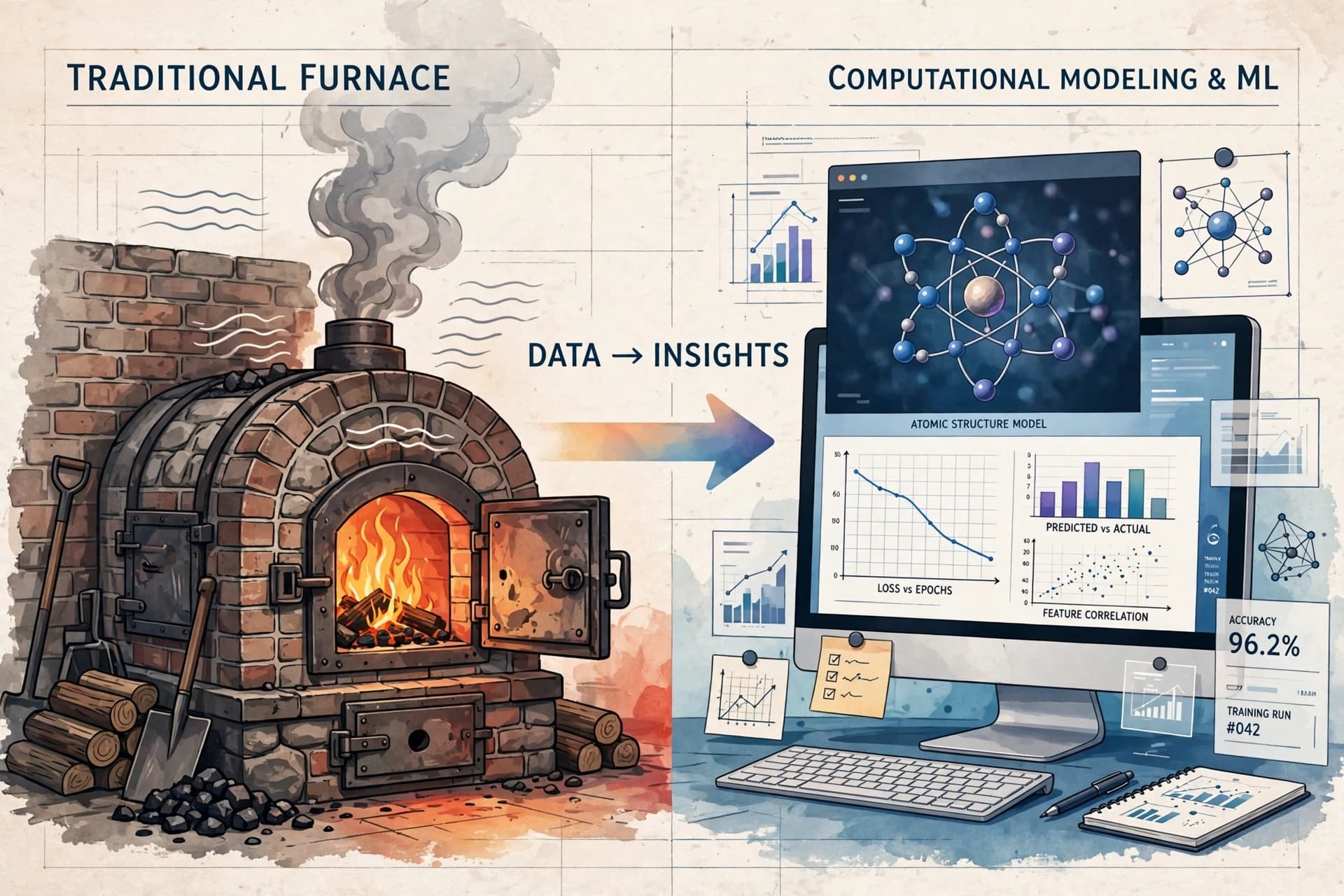
There is a certain romance to the old way of making things: the smith at the forge, the metallurgist with a notebook, the slow accumulation of intuition through failure and repetition. Trial and error built the modern world, one alloy at a time. But the materials we need now—for turbines that run hotter, reactors that endure more, batteries that store longer—are too complex for intuition alone. The search space has grown too vast, the variables too many, the cost of each experiment too high.
High-entropy alloys are a case in point. Unlike traditional alloys, which are built around a single principal element, these materials mix five or more elements in roughly equal proportions. The result is a kind of metallic democracy, where no single element dominates and the collective behavior produces properties that none of the constituents could achieve alone . The concept, first proposed in the early 2000s, opened a design space that is essentially infinite. For every potential application, there are countless combinations to try, countless processing routes to test, countless microstructures to evaluate.
The traditional response to such complexity has been to narrow the search through intuition and limited experiments. But researchers are increasingly turning to a different approach: integrating computational modeling, processing science, and artificial intelligence into a continuous design loop. A recent review in Progress in Materials Science describes this shift as a move beyond trial and error, where first-principles calculations, molecular dynamics simulations, CALPHAD thermodynamic modeling, and machine learning are combined to predict which alloys are worth making before anyone lights a furnace .
The computational tools each operate at different scales. Density functional theory captures the quantum behavior of electrons. Molecular dynamics simulates how atoms move and interact over nanoseconds. CALPHAD predicts which phases will be stable at different temperatures and compositions. Machine learning, trained on data from experiments and simulations, can identify patterns that no human could see across hundreds of dimensions . The challenge, the reviewers note, is coupling these methods together—ensuring that the output of one becomes a meaningful input for the next, and that the entire pipeline remains grounded in physical reality.
Machine learning has been particularly transformative. In one notable study, researchers used a deep learning architecture called Deep Sets to predict the elastic properties of more than 370,000 high-entropy alloy compositions, after training on a database of over 7,000 alloys generated through high-throughput quantum mechanical calculations . The model did not replace experiments; it prioritized which experiments to run. Other groups have used generative adversarial networks—the same technology behind deepfakes—to propose entirely new alloy compositions with desired properties, compressing the design space into something a human can navigate .
The limitations remain real. Data is scarce and uneven, experimental results are expensive to produce, and models trained on small datasets can be confidently wrong. The reviewers are careful to note that computational predictions must be validated experimentally, and that the gap between a promising simulation and a manufacturable material is often wide . Processing matters as much as composition; an alloy that looks perfect on paper may fail in the furnace or the turbine.
What is emerging is not a replacement for the old ways but an acceleration of them. The smith’s intuition is not discarded; it is augmented, given new tools to test hypotheses faster and with more precision. The goal is not to eliminate failure but to fail more intelligently—to learn from simulations what might have taken years of experiments to discover, and to reserve the furnace for the candidates most likely to succeed.
There is something fitting about this. High-entropy alloys are built on the idea that mixing many elements produces something greater than the sum of its parts. The design of these alloys is following the same principle, bringing together computation, processing knowledge, and artificial intelligence into a collaboration that none of them could achieve alone. The forge has not disappeared. It has simply grown quieter, more deliberate, and far more precise.
Image note: This article’s visual is an AI-generated illustration and does not represent actual laboratory or computational output.
Sources: ScienceDirect, ScienceDaily, Npj Computational Materials, Progress in Materials Science, Journal of Alloys and Compounds
Published by Banx Network. This article is part of the Banx decentralized media programme, powered by the BXE token on the XRP Ledger.