There is a particular kind of mystery that hides in plain sight, in one of the most familiar corners of the night sky. The Orion Nebula is visible to the naked eye, a smudge of light in the hunter's sword that has been watched for as long as humans have looked up. Yet within that luminous cloud, astronomers have found a contradiction—a set of observations that seemed to disagree with one another, as if the nebula were telling two different stories about its own age.
The paradox concerns the protoplanetary disks that surround young stars in the Orion Nebula Cluster. These disks, sculpted by the fierce radiation of the region's most massive star, Theta-1 Orionis C1, have been stripped into tadpole-like shapes by a process called external photoevaporation . The problem is one of timing. Given the stars' estimated age of about one million years, that radiation should have destroyed the disks long ago. Yet the disks are still there, eroded but present, as if they had only recently begun to feel the star's full force.
A second puzzle compounds the first. The shell of gas surrounding the nebula is expanding at roughly 13 kilometers per second. Extrapolating backward from that rate suggests the shell is only a few hundred thousand years old—far younger than the stars it contains . Both the disks and the shell appear to have been shaped by a radiation source that has not been powerful enough for long enough to explain what we see.
A team led by Maite Wilhelm at Leiden University has proposed an answer that is both elegant and violent. In a paper published in Astronomy & Astrophysics, they suggest that Theta-1 Ori C1 was not always the massive star we observe today. Instead, it may have formed from the merger of two stars in a binary system, an event triggered by the gravitational interference of a third companion star, Theta-1 Ori C2, which still orbits nearby .
The scenario works like this. Before the merger, the progenitor stars were less massive and far less luminous, emitting only a fraction of the ionizing radiation that Theta-1 Ori C1 produces now. The protoplanetary disks had time to survive, even as they were gently eroded. Then, a few hundred thousand years ago, the binary pair spiraled together and merged, creating a single star of about 33.5 solar masses. Its radiation output surged, and the disks began to evaporate rapidly, taking on the tadpole shapes we see today .
The simulations support the idea, though not without complications. A merger alone would increase the driving force behind the expanding shell by a factor of about thirty, but explaining the observed expansion requires a factor of one hundred . The researchers suspect that cold gas from the evaporating disks, mixing with the hot bubble of the shell, provides the additional push. The scenario also accounts for two other oddities of Theta-1 Ori C1: its tilted magnetic field and a slight excess of nitrogen, both of which are easier to explain if the star formed through a messy merger .
What makes the finding remarkable is not just the solution to a local puzzle, but the implication it carries. As co-author Simon Portegies Zwart noted, this is the first time astronomers have witnessed the consequences of a major stellar collision in our own cosmic neighborhood. Stellar collisions, once imagined as rare and exotic events, may be far more common than previously thought—and they may shape the environments where planets form .
The Orion Nebula, then, is not simply a nursery of stars. It is a place where violence and creation are intertwined, where a collision hundreds of thousands of years ago still echoes in the shapes of disks and the expansion of gas. The paradox is resolved, but the resolution opens a door onto a more turbulent picture of how stars are born. The next time the nebula rises in the winter sky, it may look the same. But our understanding of what we are seeing has shifted, quietly and profoundly.
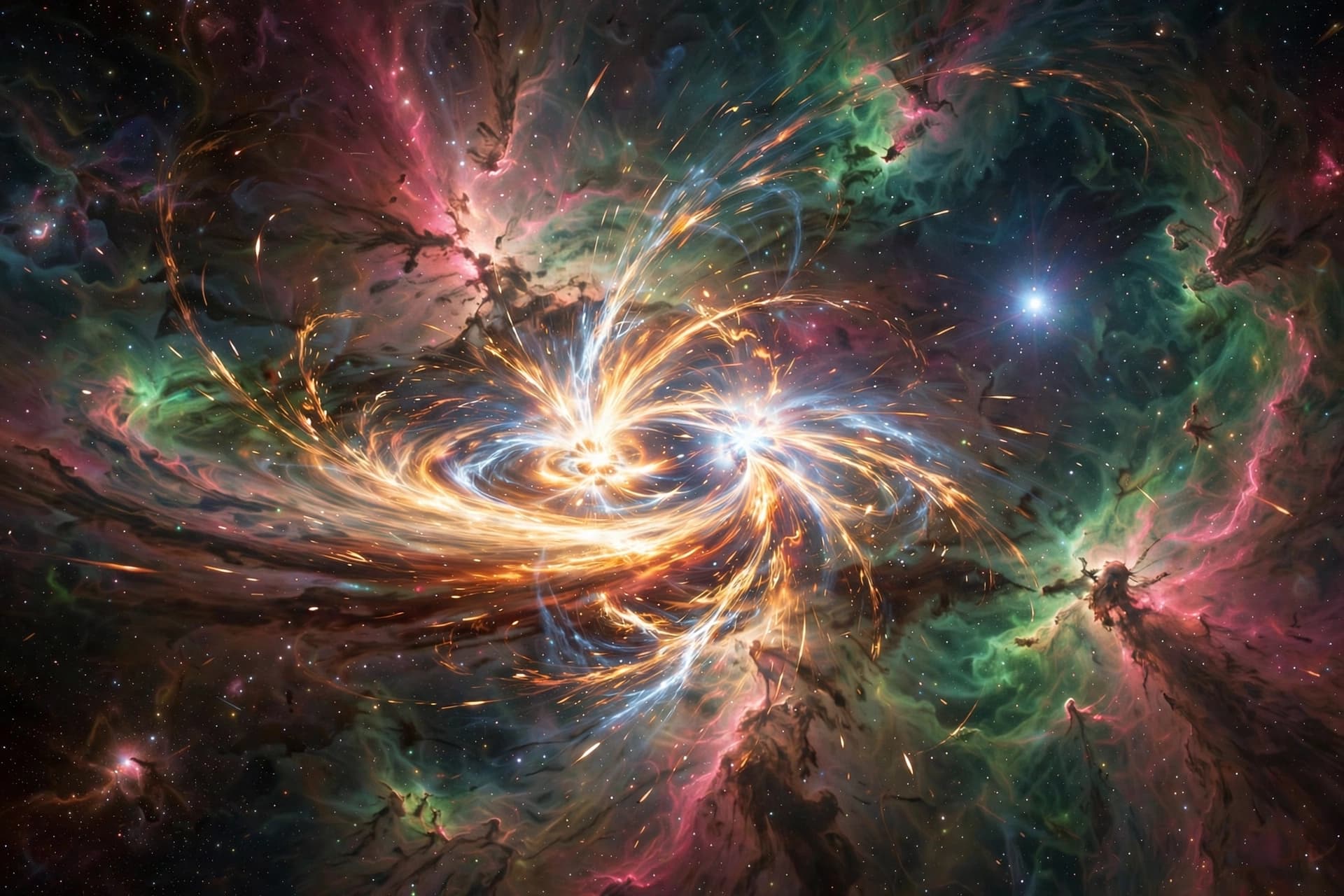
Image note: The visual accompanying this article is an AI-generated illustration and does not represent actual telescope imagery.
Sources: Universe Today, Universiteit Leiden, Astronomy & Astrophysics, IFLScience, Universe Space Tech
Published by Banx Network. This article is part of the Banx decentralized media programme, powered by the BXE token on the XRP Ledger.