Evolution is often imagined as a slow sculptor, working over epochs with a chisel of deep time. But sometimes the chisel moves faster, and a population of living creatures begins to change within the span of a human career—within thirty years, within ten generations, within the memory of a single field notebook. In the barn owls of Switzerland, something like that has been happening, quietly and without fanfare.
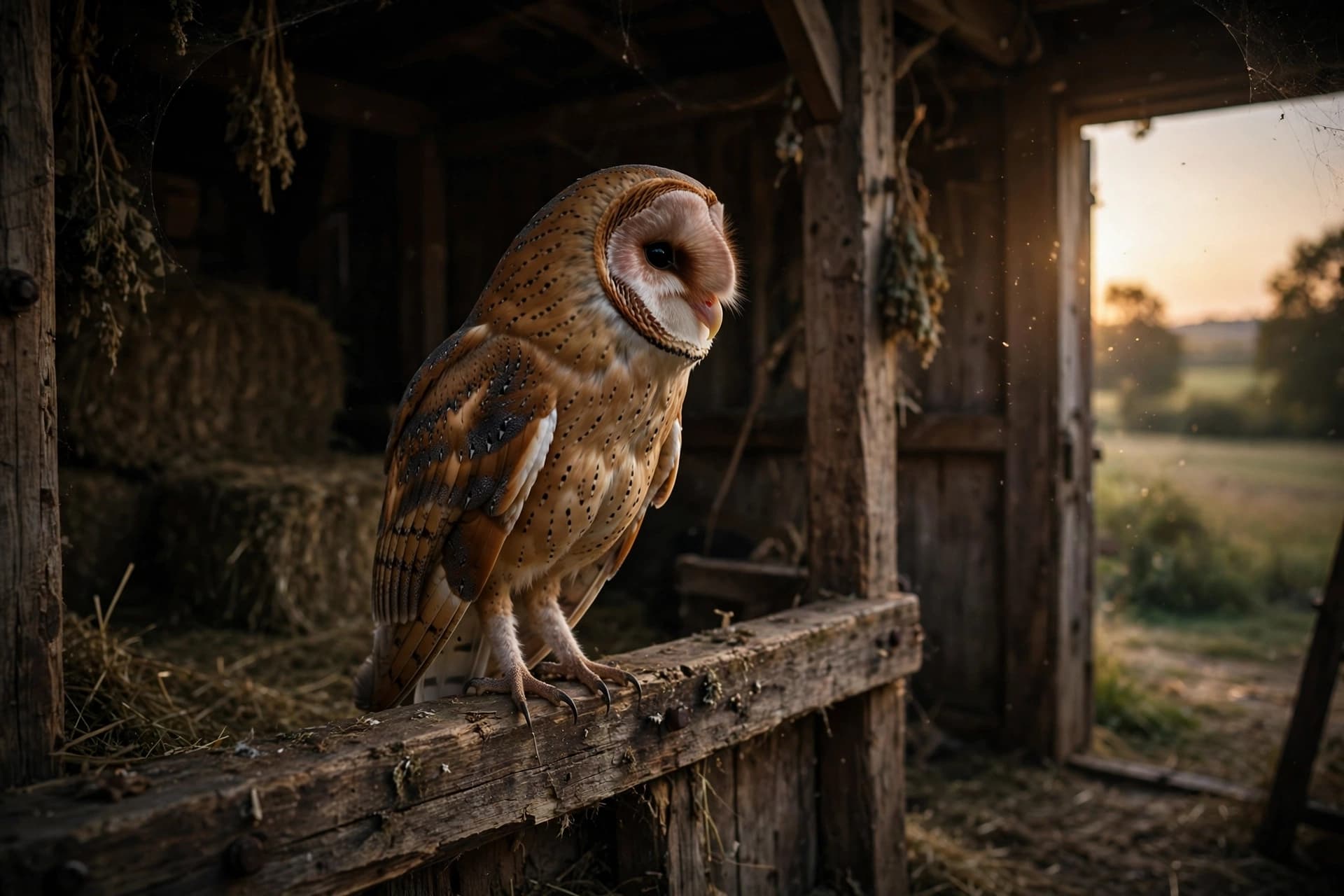
Over the past three decades, researchers at the University of Lausanne have monitored these owls with a patience that is increasingly rare in science. By sequencing the genomes of more than 3,000 birds and analyzing decades of field observations, they found a consistent shift: Swiss barn owls have become more reddish-brown and more heavily spotted . The change is not random drift. At least one genetic variant associated with reddish plumage has become far more common than chance alone could explain, a signature of natural selection operating in the wild .
The findings, published in Nature Communications, do not pretend to offer a tidy explanation for why this is happening. Plumage in barn owls is not merely decorative. White owls use moonlight to their advantage when hunting, while reddish owls tend to feed more on voles than on wood mice . Spotting, meanwhile, has been linked to immunity and the ability to cope with stressors such as food shortages or parasites . A shift toward redder, more spotted birds could reflect changes in prey availability, environmental stress, or both—but the precise ecological driver remains unidentified.
There is also a more subtle possibility. The gene region most strongly implicated, MC1R, is known for its role in pigmentation, but it belongs to a broader system tied to stress responses and aggression . Selection may be acting on one of those traits, with the change in plumage arriving as a visible side effect rather than the primary target. The owl’s color, in other words, might be a signal of something else entirely—a physiological trade-off made legible in feathers.
What makes the study remarkable is not the certainty it provides but the demonstration it offers. It shows that evolution can be observed and measured in a wild population over a human timescale, that the genetic architecture of change can be traced with precision, and that natural selection leaves footprints even in traits as seemingly cosmetic as the shade of a bird’s breast . In an era of rapid environmental change, that capacity for adaptation is not just a scientific curiosity. It is a quiet form of hope.
The barn owl remains a creature of dusk and shadow, its reddish plumage blending into the half-light of a barn or a field edge. What the study suggests is that the twilight itself may be shifting, and the owls are shifting with it—not by choice, but by the slow, relentless arithmetic of survival and reproduction. The question of why remains open, and perhaps that is fitting. The natural world is not obliged to explain itself all at once.
Image note: The accompanying visual is an AI-generated representation and does not depict an actual photograph of the studied owls.
Sources: EurekAlert!, Nature Communications, SWI swissinfo.ch, University of Lausanne
Published by Banx Network. This article is part of the Banx decentralized media programme, powered by the BXE token on the XRP Ledger.