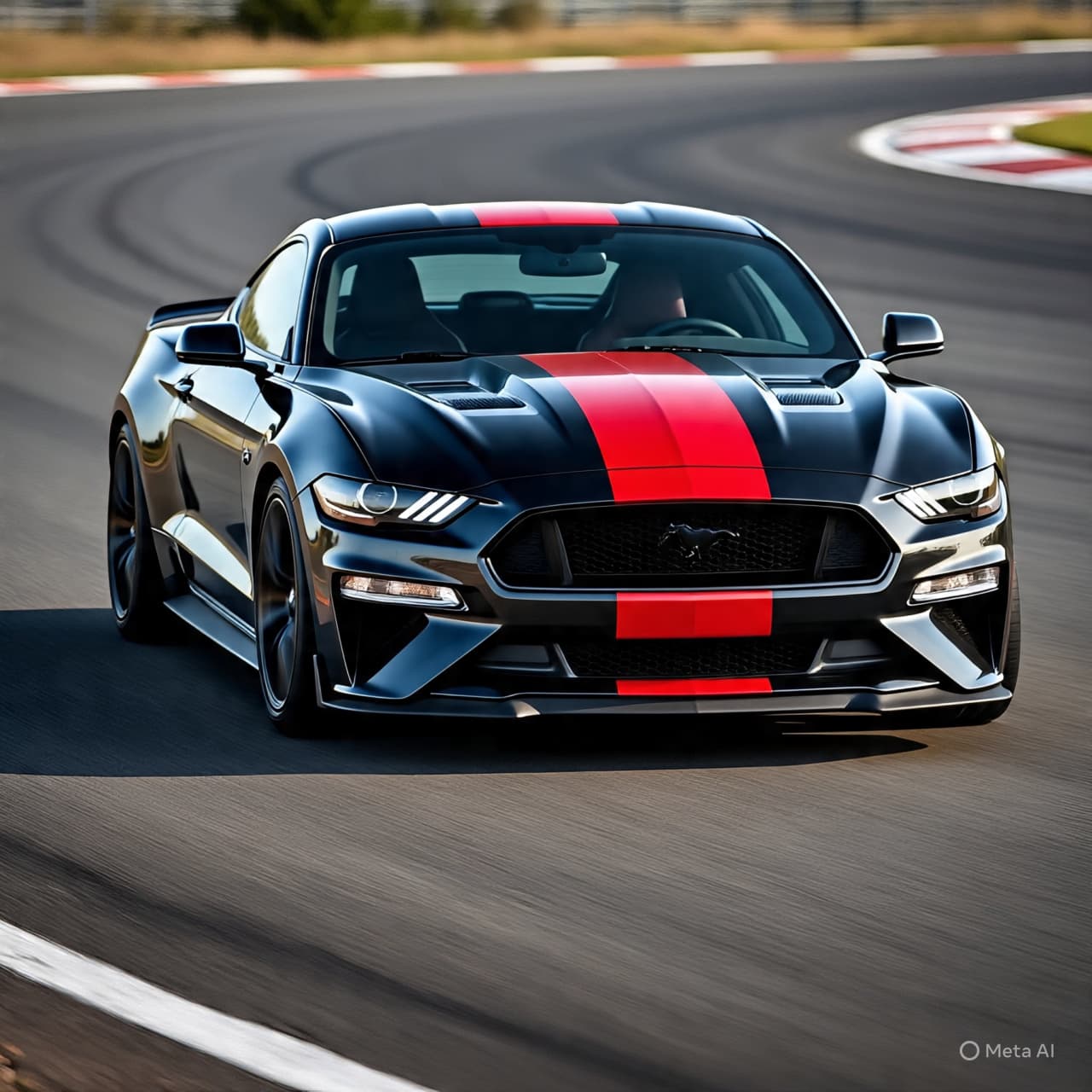
On a cool morning, sunlight drifts across asphalt with the quiet promise of possibility. Two machines sit poised, engines silent but ready — each shaped by decades of evolution, each a testament to a particular kind of automotive temperament. One is the Ford Mustang Dark Horse SC, a car born of American muscle and calibrated for the crucible of the racetrack; the other is the Porsche 911 GT3, a sports car whose heritage is tied to precision, balance, and a whisper of engineering poetry. Though both seek similar horizons, they approach them with different voices and differing philosophies.
The first of their contrasts reveals itself under the long hoods where combustion transforms into motion. The Mustang Dark Horse SC carries a supercharged 5.2-liter V8 — a stout, throaty heart designed to deliver abundant torque and immediate response as the tachometer climbs. Its powerplant, rooted in the “Predator” family, speaks in rich, sonorous tones and embodies a tradition of displacement and force. The Porsche 911 GT3, by contrast, wears a naturally aspirated 4.0-liter flat-six that sings at higher revs, a sculpted melody that reaches toward 9,000 revolutions per minute. It yields less horsepower on paper than the supercharged Mustang, yet the GT3’s voice is one of fluid motion, its engine a cadence as important as its output. In this meeting of torque and grace, one machine asserts its presence through breadth of shove, while the other whispers through revs and balance.
Distance between these cars continues in how their mechanical souls are arranged. The Mustang follows the traditional front-engine layout, placing its muscular heart ahead of the cabin, sending power rearward in a handshake that feels bold and immediate. The Porsche, in keeping with its lineage, carries its engine at the rear, a placement that offers traction and a distinctive kind of balance that has become part of its identity. This difference is not merely geometric; it shapes how each car negotiates corners, how it leans into wind and inertia, and how it replies to a driver’s touch. The Mustang’s configuration gives it a certain forward assertion, while the Porsche’s rear-engine design encourages a sensation of flow, as if speed arrives through alignment rather than force.
Perhaps most telling in their divergence is the way they connect with those behind the wheel. The 911 GT3 remains one of the few modern performance cars to offer a six-speed manual transmission, a choice that invites intimacy and deliberation. Each shift becomes part of the conversation between driver and machine. The Dark Horse SC, committed to a different interpretation of performance, forgoes a manual in favor of a seven-speed dual-clutch transmission, engineered for rapid shifts and consistent lap times. Here, the distinction widens: one car preserves the ritual of engagement, while the other leans into precision and repeatability shaped by contemporary motorsport logic.
These differences, while technical on the surface, gesture toward deeper identities. The Mustang Dark Horse SC reflects a lineage forged on long straights and raw output, where performance is measured in presence as much as numbers. The Porsche 911 GT3 carries a heritage defined by restraint and refinement, where speed reveals itself in corners and composure. Neither seeks to replace the other. Instead, they illustrate how performance can speak in different dialects.
In straightforward terms, the Ford Mustang Dark Horse SC and the Porsche 911 GT3 differ in engine type, engine placement, and transmission philosophy — a supercharged V8 versus a high-revving flat-six, front-engine versus rear-engine layout, and automated precision versus manual engagement.
AI Image Disclaimer
Illustrations were created using AI tools and are not real photographs.
Sources (Media Names Only)
Autoblog evo Yahoo Autos
Published by Banx Network. This article is part of the Banx decentralized media programme, powered by the BXE token on the XRP Ledger.