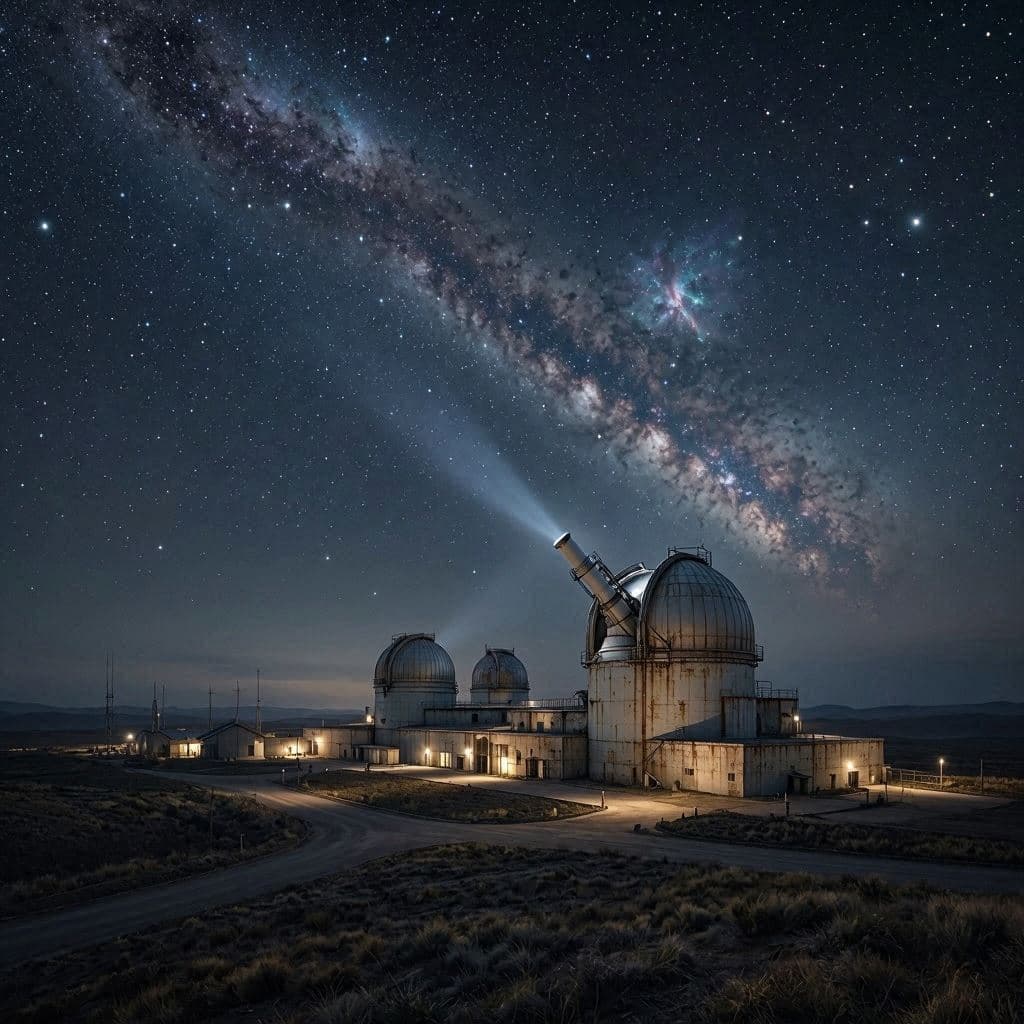
Across the high deserts of Chile, a new era of astronomical observation is beginning to take shape. The Vera C. Rubin Observatory is preparing to capture an unprecedented long-term record of the night sky, transforming astronomy into a continuous cinematic view of the universe.
Body: The Rubin Observatory is designed to conduct a decade-long survey of the sky, repeatedly imaging vast portions of space to detect changes over time. This approach allows scientists to observe dynamic cosmic events with unmatched frequency and scale.
Researchers describe the project as a “movie of the universe,” where each repeated scan contributes a frame in an evolving cosmic time-lapse. This enables the detection of transient phenomena such as supernovae, asteroid movements, and variable stars.
The observatory’s primary instrument, the LSST camera, is one of the largest digital cameras ever constructed, capable of capturing extremely wide-field, high-resolution images of the night sky.
Scientists involved in the project emphasize that this method will significantly expand understanding of dark energy, galaxy formation, and the structure of the universe.
Data collected will be shared with the global scientific community, enabling collaboration across institutions and accelerating discovery in astrophysics.
Experts highlight that the scale of this survey will generate an enormous dataset, requiring advanced computational systems, including artificial intelligence, to process and analyze observations.
The project is widely seen as a milestone in observational astronomy, combining engineering precision with long-term scientific vision.
Closing: As the Rubin Observatory begins full operations, astronomers anticipate a new era of discovery shaped by continuous observation of a changing sky.
AI Image Disclaimer: Some visuals in this article are AI-generated for conceptual editorial use.
Sources: NSF Rubin Observatory, NASA, Nature Astronomy, BBC Science, Scientific American
Published by Banx Network. This article is part of the Banx decentralized media programme, powered by the BXE token on the XRP Ledger.