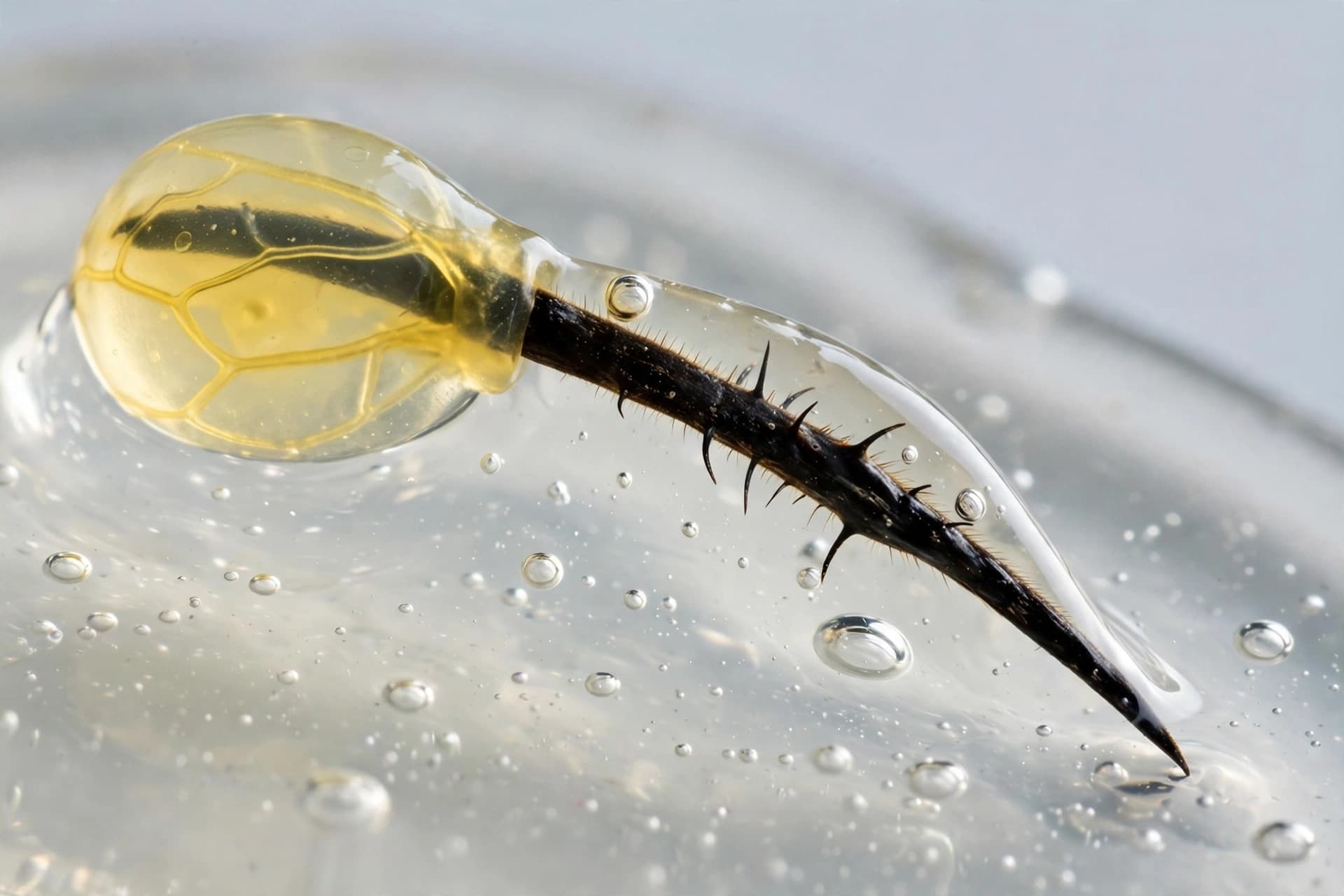
There is a particular efficiency to the honey bee's sting that has long puzzled scientists—a mechanism so precise that it continues to function after the bee itself has flown away to die. When a honey bee stings, it leaves behind its stinger, a tiny apparatus that goes on pumping venom into the target without any connection to the body that created it . For more than a century, biologists have known that this autonomous action involved valves and pumping elements, but the exact mechanics remained hidden. Now, high-speed video has revealed the stinger as a sophisticated double-piston micropump, a design that engineers might one day imitate.
The study, published in the Proceedings of the National Academy of Sciences, was led by Dr. Fiorella Ramirez-Esquivel of Macquarie University in Australia . Using a clear gel that mimics human skin, the researchers recorded honey bee stingers in action for the first time, capturing the pumping mechanism at a level of detail never before achieved . What they found was a system of remarkable elegance: two sharp lancets that slide back and forth on a rail system, each equipped with a flexible valve that inflates and deflates to generate pressure .
The mechanism works like a two-stroke engine. As one lancet moves downward, its valve inflates like a parachute, forming a seal against the pumping chamber wall and pushing venom out while drawing more from the venom sac . On the upstroke, the valve collapses, allowing the other lancet's valve to take over, maintaining a continuous flow of venom . The valves even change shape at the midpoint of the stroke, pushing past each other in a maneuver that ensures the seal is never broken . As Ramirez-Esquivel explained, "The unique geometry of the valves is the key; they act as collapsible pistons and—by pumping in opposite directions—they're able to deliver a continuous flow of venom" .
To confirm their findings, the researchers used microCT scans to create a 3D-printed, scaled-up working model of the pumping chamber and lancets—essentially a small robot that replicated the pumping cycle . The model confirmed the key features observed in the high-speed video, providing independent verification of the mechanism. It is a rare instance of biological research producing a physical model that works, a bridge between observation and engineering.
The findings have implications beyond the biology of bees. Micropumps are essential components in medical devices, microfluidic systems, and drug delivery technologies . The honey bee's design—compact, autonomous, and capable of continuous flow without a central power source—offers a template that engineers might adapt. The study authors note that the stinger's piston mechanism could inspire new approaches to minimally invasive medical tools and lab-on-a-chip devices .
For those who have felt the sharp pain of a bee sting, the research offers a new layer of understanding. The discomfort that lingers after the bee has gone is not an accident of nature but the product of a pump refined by millions of years of evolution, a mechanism that continues its work with quiet determination. The bee dies; the stinger does not. And now, thanks to high-speed cameras and careful observation, we know exactly how it manages to keep going.
AI Image Disclaimer: The imagery in this article is AI-generated and serves an illustrative purpose only.
Sources:
· Phys.org · EurekAlert! · PNAS · Science
Published by Banx Network. This article is part of the Banx decentralized media programme, powered by the BXE token on the XRP Ledger.