In the gentle hush of early February skies, as morning light eased into the day, unseen convulsions were stirring at the heart of our nearest star. There is something quietly dramatic about the Sun, a celestial forge that breathes life into our world yet occasionally whispers — or roars — reminders of its immense power. These past days have felt like a turning chapter in that cosmic conversation, where the Sun’s inner rhythms surged with unusual intensity.
Over the span of a single Earth-bound rotation, the Sun’s turbulent surface erupted with 27 solar flares, each a twisting coil of magnetic energy snapping into brilliant light and particle storms. Among these was an X-class flare — the strongest in years — a blast of energy so potent that it briefly sent radio signals into static over the South Pacific.
Solar flares are more than luminous streaks across the sky unseen. They are the Sun’s way of expressing magnetic tension so great that it snaps like a stretched rubber band. When these magnetic fields release, they let loose cascades of high-energy radiation and particles that pulsate outward through space. Most of these flares danced away from Earth’s trajectory, but their sheer number tells a story of a Sun both restless and alive — more active than many expected for this stage of its 11-year cycle.
For us here on Earth, the effects were subtle yet tangible: brief radio blackouts in some regions, and the promise of heightened auroras as charged particles interact with the magnetic envelope surrounding our planet. The geomagnetic forecast — ever cautious — suggests shimmering curtains of light might unfold nearer the poles in days to come, a quiet reward for those patient enough to watch the night sky.
Yet there was no chaos in the streets, no urgent alarms. Just an extraordinary reminder that we are in orbit around a star whose moods, though sometimes intense, follow patterns as old as time itself. These solar flares, even the strongest in recent cycles, are part of the Sun’s natural rhythm — less threat than testament to the cosmic forces that sculpt our celestial neighborhood.
As scientists refine their models and space weather centers observe every nuance, the story of this flare surge will enrich our understanding of the star we call home. For now, we watch, we learn, and under skies that may soon glow green and purple, we reflect on the profound connection between Earth and that brilliant constant in our sky.
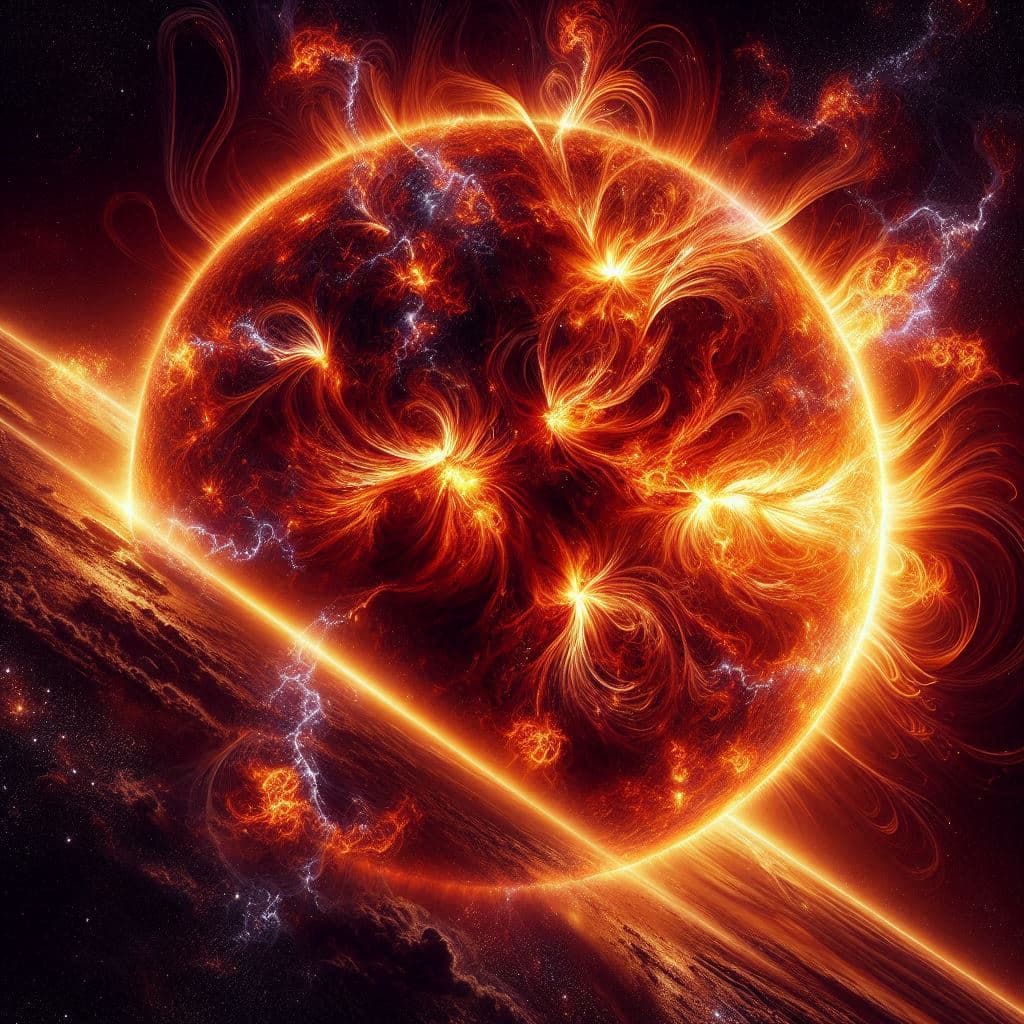
AI Image Disclaimer “Visuals are created with AI tools and are not real photographs.”
Sources Live Science Ground.news Evrimagaci Space.com News9live / NASA reporting
Published by Banx Network. This article is part of the Banx decentralized media programme, powered by the BXE token on the XRP Ledger.