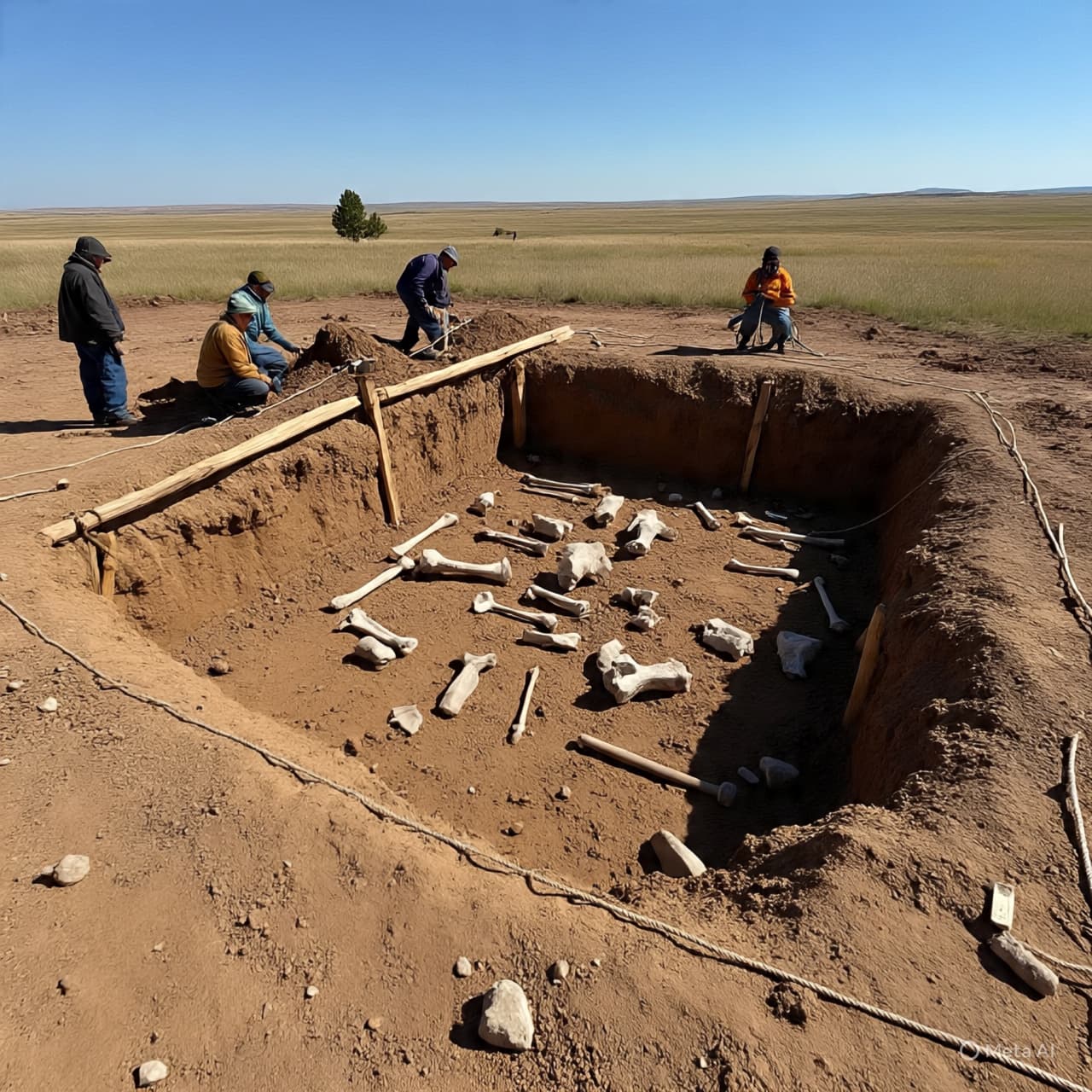
There are places on the prairie where the wind seems to hesitate, as if remembering. Grass bends in long, quiet waves, and beneath that shifting green lies a story paused for more than a thousand years. An abandoned bison hunting site, dating back roughly 1,100 years, has long rested in such silence—its purpose once vivid, then suddenly unclear.
For decades, archaeologists returned to the site with careful hands and patient questions. Why was it left behind? Why did a place once defined by movement—by hoofbeats, by coordinated human effort—fall into stillness? The land offered fragments: stone tools, butchered bone, remnants of hearths. But fragments, like whispers, rarely speak all at once.
The site, believed to have been used by Indigenous hunters on the North American plains, functioned as a communal bison processing ground. Evidence suggests coordinated drives that funneled herds into strategic locations where they could be harvested efficiently. Such hunts were not random acts of pursuit; they were planned with ecological knowledge, seasonal timing, and social cooperation.
Recent studies have begun to clarify what earlier excavations could not fully explain. Advanced radiocarbon dating, isotopic analysis of bones, and sediment examination indicate that the site’s abandonment coincided with environmental shifts—possibly prolonged drought conditions during the Medieval Warm Period. As climate patterns changed, so too did the migratory behavior of bison herds.
Researchers also found signs of intensified use shortly before abandonment: increased bone density layers and repeated butchering marks in concentrated areas. This suggests a final period of heavy reliance, perhaps reflecting resource stress. Communities may have returned frequently as other hunting grounds became less predictable.
The mystery, then, appears less like a sudden disappearance and more like a gradual adaptation. As herds altered their routes and water sources diminished, maintaining the site may no longer have been practical. Mobility—always central to plains cultures—became the answer. People moved with the animals, rather than remaining tethered to a single location.
What emerges from the soil is not a story of failure, but of flexibility. Indigenous societies across the plains demonstrated deep environmental awareness, adjusting subsistence strategies as ecosystems shifted. The abandonment of the site reflects resilience rather than collapse.
The findings also underscore the importance of climate in shaping human history. Long before modern instruments tracked atmospheric changes, communities read the land directly—through grass growth, river flow, and animal movement. When those signals changed, so did settlement patterns.
Archaeologists now believe the 1,100-year-old site represents a snapshot within a larger adaptive network rather than a singular tragedy. Continued research, including collaboration with descendant Indigenous communities, aims to contextualize the site within broader cultural traditions and oral histories.
In steady terms, scientists report that environmental change and shifting bison migration routes offer the most supported explanation for the site’s abandonment. Excavations and laboratory analyses are ongoing, with further findings expected to refine the timeline. The prairie remains quiet, but its story is becoming clearer.
AI Image Disclaimer Images in this article are AI-generated illustrations, meant for concept only.
Source Check (Credible Media Coverage Identified): National Geographic Smithsonian Magazine Science News Live Science The New York Times
Published by Banx Network. This article is part of the Banx decentralized media programme, powered by the BXE token on the XRP Ledger.