Galaxies often appear to us as luminous cities of stars, quietly assembling their brilliance across the dark plains of the universe. Yet at the very heart of many of these glittering metropolises lies something far less gentle — a presence so dense, so commanding, that even light must bow before it. Supermassive black holes, once imagined as silent devourers, are increasingly understood as cosmic regulators, shaping the destiny of the galaxies they inhabit.
In recent years, astronomers studying nearby galaxies have uncovered a subtle but powerful relationship between these central black holes and the pace at which new stars are born. Far from being passive occupants, supermassive black holes appear capable of slowing, and in some cases nearly halting, star formation altogether. It is a paradox that reshapes how we understand cosmic evolution: the most destructive forces in the universe may also serve as agents of restraint.
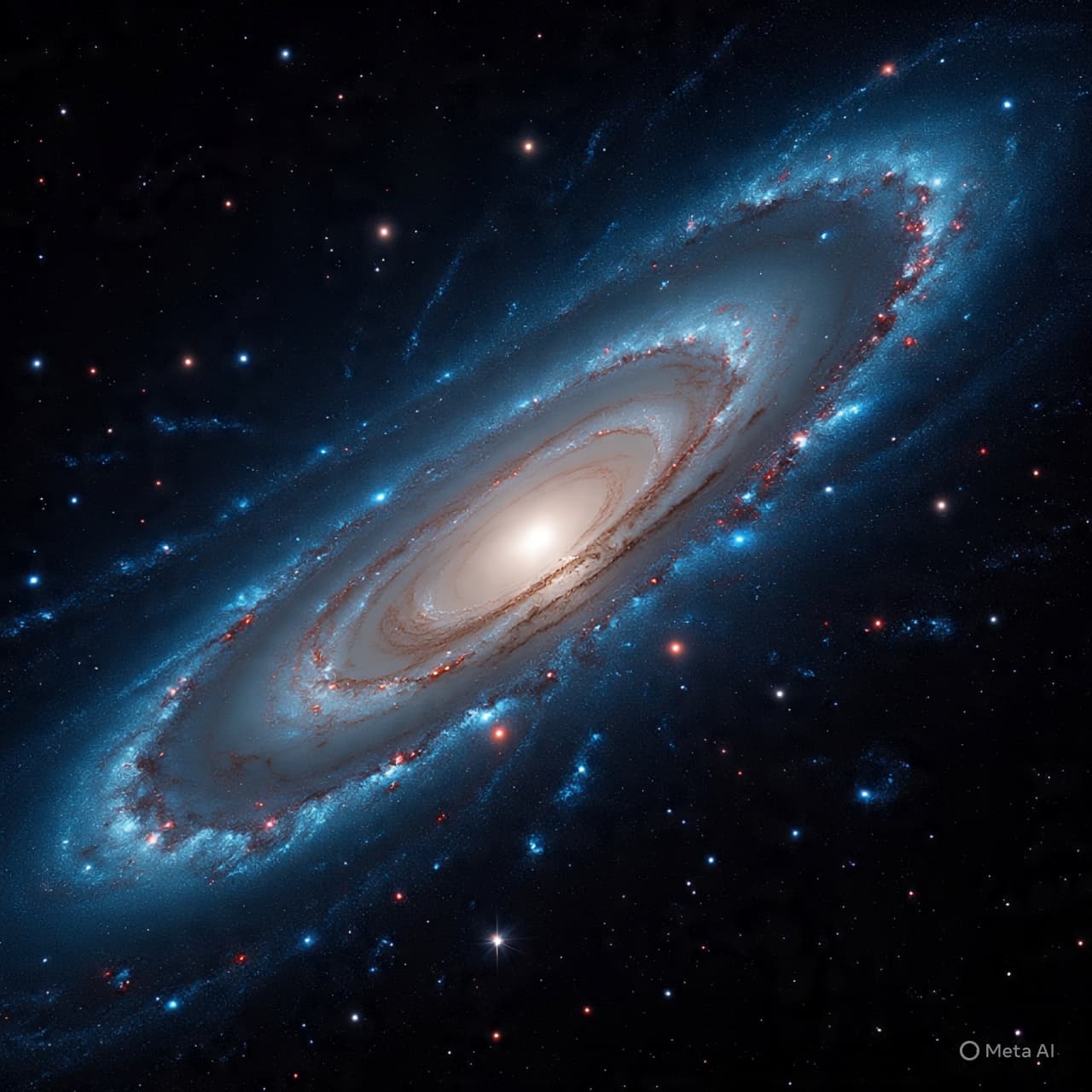
At the centers of galaxies like the resides a supermassive black hole — in our case, Sagittarius A*, containing millions of times the mass of the Sun. When material spirals inward toward such a black hole, it does not simply disappear quietly. The process can ignite extraordinary activity. As gas and dust fall inward, they heat up and release tremendous energy. Some of that energy is blasted outward in the form of radiation and high-speed particle jets.
This outward surge, known as “feedback,” can have profound consequences. The very gas that would otherwise cool and collapse into new stars becomes heated or even expelled from the galaxy’s central regions. Without cold gas, star formation slows. Without star formation, galaxies gradually age, their bright blue hues fading into softer shades of red.
Observations from space-based telescopes and radio arrays have allowed astronomers to map these feedback effects in remarkable detail. In several nearby galaxies, researchers have identified vast outflows of gas streaming away from galactic cores. These winds appear strong enough to deprive galaxies of the raw materials needed to sustain stellar nurseries. Rather than chaotic destruction, it resembles a thermostat — a balancing mechanism preventing galaxies from growing too rapidly or too brightly.
This emerging picture helps answer a long-standing puzzle. For decades, computer simulations of galaxy formation struggled to match what telescopes observed. Without a braking mechanism, simulated galaxies tended to produce far too many stars. By incorporating black hole feedback into their models, scientists found a closer alignment with reality. The presence of supermassive black holes helps explain why many massive galaxies today are relatively quiet and no longer form stars at high rates.
Yet this influence is not constant fury. Many black holes cycle between periods of dormancy and activity. In quieter phases, star formation may proceed with fewer interruptions. Over cosmic time, this interplay between growth and suppression shapes a galaxy’s structure, size, and color. The black hole does not merely consume; it participates in a delicate choreography of cosmic regulation.
For nearby galaxies, this relationship offers a living laboratory. Because they are close enough for detailed study, astronomers can examine how gas flows respond to black hole activity in real time, at least on astronomical scales. Each observation adds nuance to a broader realization: galaxies and their central black holes evolve together, intertwined from birth to maturity.
In the vast theater of the universe, supermassive black holes may still be cosmic predators. But they are predators with purpose — shaping the rhythm of creation itself.
As research continues, scientists are refining their measurements and simulations, seeking to understand when and how strongly black holes intervene in star formation. What emerges is not a tale of simple destruction, but one of balance — a reminder that even in the depths of darkness, there can be an unexpected form of order.
AI Image Disclaimer Visuals are created with AI tools and are not real photographs.
SOURCE CHECK
Credible mainstream and scientific sources covering this topic include:
NASA ESA (European Space Agency) The Astrophysical Journal Nature Astronomy Space.com
Published by Banx Network. This article is part of the Banx decentralized media programme, powered by the BXE token on the XRP Ledger.