The story of life on Earth is often told as a tale of grand transformations—the sudden flourishing of complex creatures, the rise of predators, the conquest of land. Yet beneath these dramatic chapters lies a quieter narrative, one written not in bones or shells but in the patient chemistry of survival. A new study suggests that long before the Cambrian explosion filled the oceans with wondrous new forms, a humble tubular creature had already discovered a strategy that would echo through evolutionary time: making friends with microbes.
Researchers led by Dr. Yongbo Peng of Nanjing University and Dr. Shuhai Xiao of Virginia Tech have found geochemical evidence that an ancient marine animal called Conotubus hemiannulatus may have engaged in chemosymbiosis—a partnership in which bacteria convert chemicals into food for their host . The findings, published in the Proceedings of the National Academy of Sciences, push back the known history of such symbiotic relationships to the Ediacaran period, more than 540 million years ago, before the Cambrian explosion of animal life .
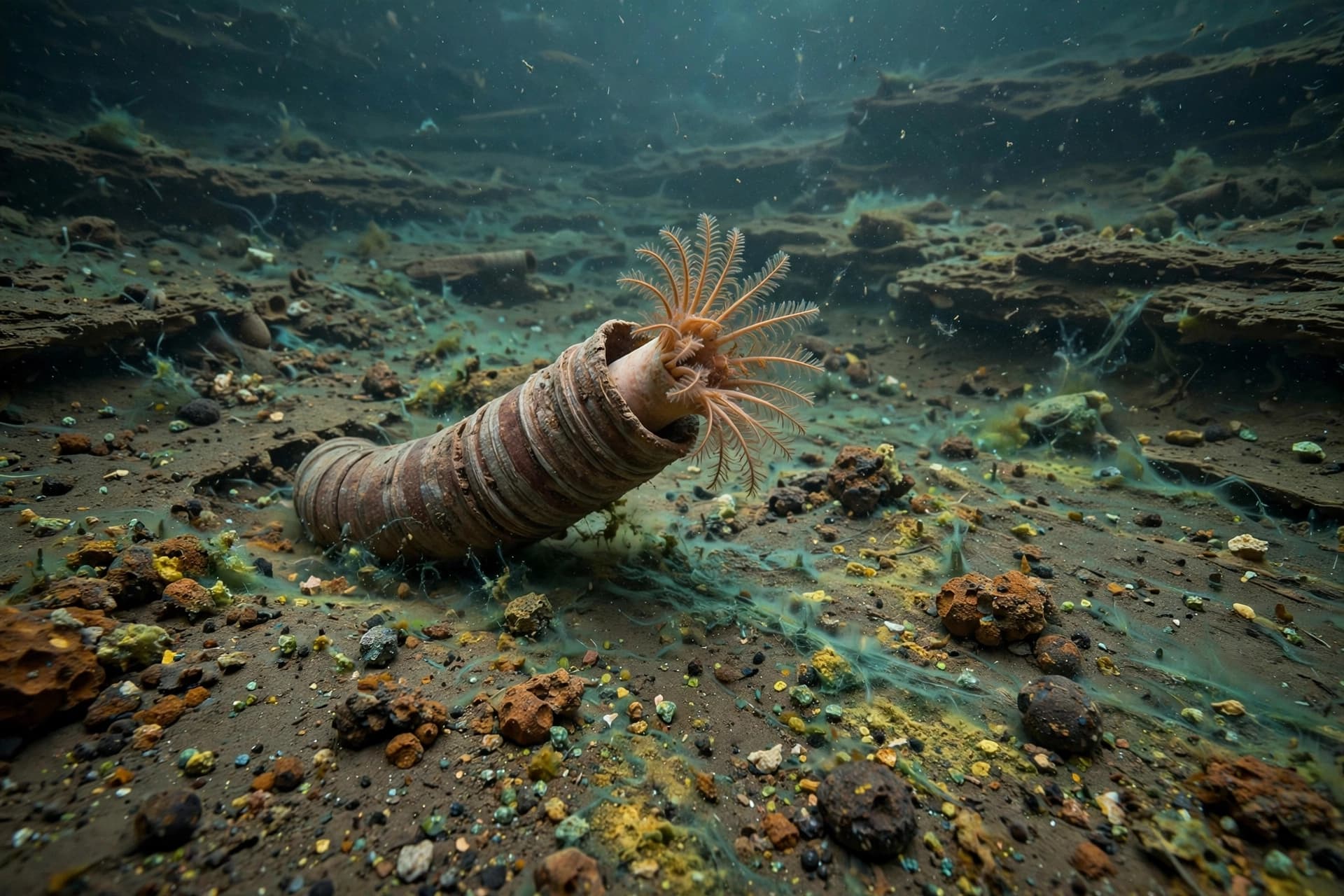
The creature itself was unassuming. Conotubus hemiannulatus lived on the seafloor, its body a slender tube ranging from 3 to 80 millimeters in length, with a funnel-like structure that it likely used for feeding or anchoring . Its fossils, preserved as pyrite in China's Dengying Formation, tell a story not just of the animal itself but of the environment it inhabited—toxic, sulfur-rich waters that would have been lethal to most forms of life.
The key evidence lies in the isotopes. The researchers analyzed molybdenum isotopes in the fossils and found them strongly depleted in molybdenum-98, by more than 4.6 parts per thousand compared to contemporaneous Ediacaran seawater . Such values are otherwise known from modern tube worms at deep-sea cold seeps, where sulfur-oxidizing bacteria live within the animals' tissues and detoxify their surroundings .
The sulfur signatures in the fossils further suggest that Conotubus lived where oxygen and sulfide overlapped, and that bacteria were actively processing sulfur in its habitat . In exchange for shelter, the microbes transformed hydrogen sulfide—a compound toxic to most animals—into usable energy for their host.
"What's significant is that this partnership helped the animal cope with sulfide, which is toxic to most animals," noted co-author Professor David Fike of Washington University in St. Louis . "Today in the environment there are a whole host of organisms that have such partnerships. Previously, we didn't know whether this was a relatively recent evolutionary event or if it emerged all the way back when animals first evolved" .
The research offers a window into a crucial moment in life's history. The Ediacaran period, between 635 and 540 million years ago, witnessed the first appearance of multicellular life. The oceans of that time were not the oxygen-rich waters we know today; they were often anoxic and laden with sulfides that would have posed a formidable barrier to complex life . Chemosymbiosis may have been one of evolution's early solutions—a way for animals to not merely endure toxic conditions but to thrive within them.
The study does not claim to resolve all questions about Conotubus's evolutionary relationships. Its phylogenetic affinity remains uncertain, and scientists still debate whether it belongs to the Cloudinidae family or the broader group of cloudinomorphs . Yet the geochemical evidence for chemosymbiosis stands as the earliest such case supported by fossil data.
The findings will appear in the Proceedings of the National Academy of Sciences. The research was supported by the National Natural Science Foundation of China, the U.S. National Science Foundation, and the University of Missouri .
AI-generated images are used for illustrative purposes only.
Sources: Sci.News, Phys.org, EurekAlert, Washington University in St. Louis, PNAS
Published by Banx Network. This article is part of the Banx decentralized media programme, powered by the BXE token on the XRP Ledger.