There is a kind of architecture in ice. Not the architecture of human hands, but of geological patience—vast buttresses and flying arches of frozen water that hold the weight of continents in place. When one of those buttresses fails, the consequences unfold over centuries, reshaping coastlines and drowning lowlands. A new discovery in the seafloor of Baffin Bay offers a portrait of one such structure, and a warning about the ones that remain.
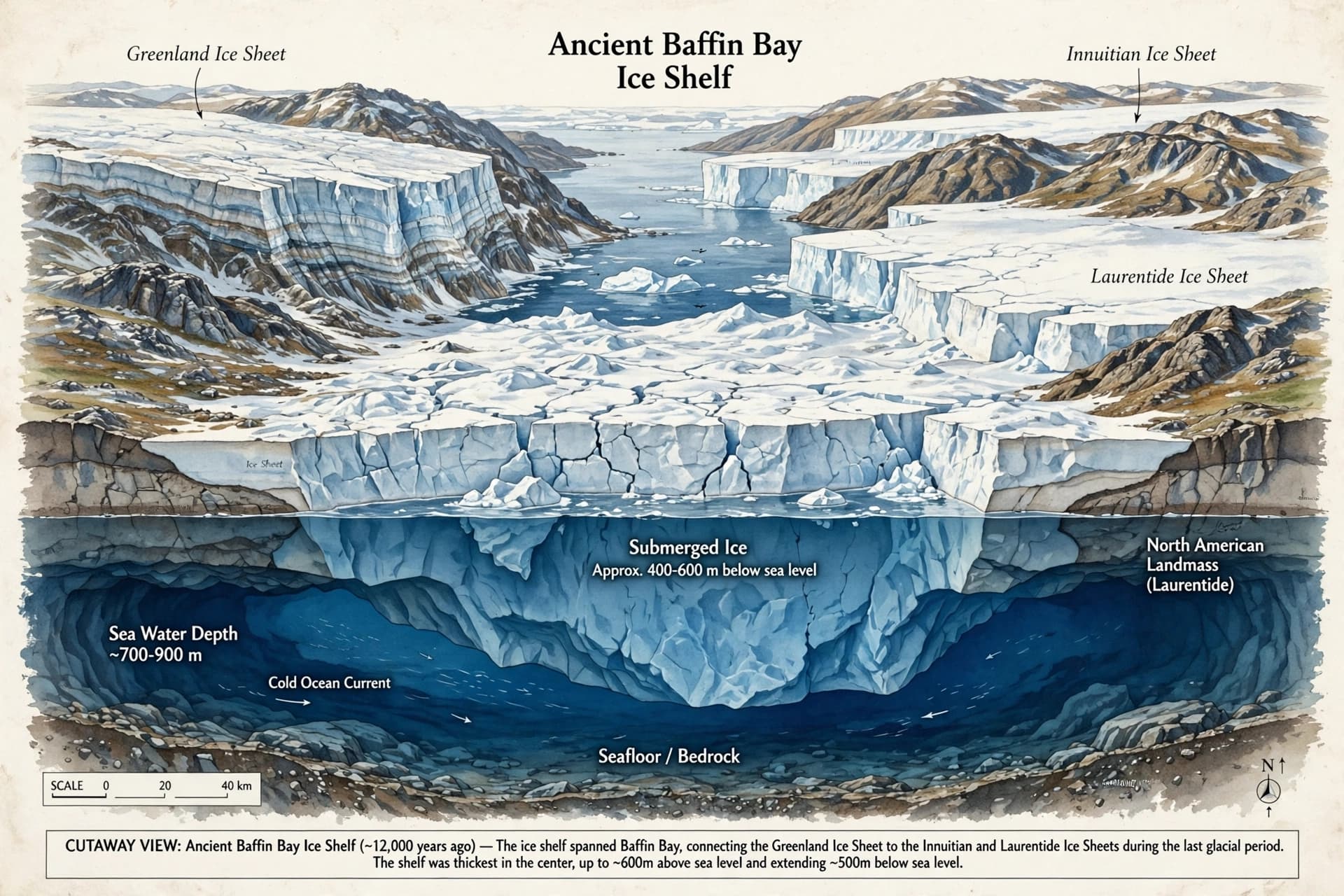
About 20,000 years ago, an enormous floating ice shelf more than a mile thick spanned Baffin Bay, west of Greenland. It held back three major ice sheets—the Greenland to the east, the Innuitian to the north, and the Laurentide to the west—acting as a single shared brace against the flow of land-based ice into the ocean . When it disappeared, the ice sheets behind it destabilized, contributing to hundreds of feet of sea-level rise that helped shape modern coastlines.
The evidence was not what the researchers were looking for. A five-week research cruise in Baffin Bay had set out to collect sediment cores reconstructing what destabilized the Greenland Ice Sheet at the end of the last ice age. Instead, sonar mapping revealed grooves and scars on the continental slope, traces of an ice shelf’s underside scraping the seafloor at depths now over a mile down. The shelf, the team concluded, was at least half a mile thicker than any previously known ice shelf in the Northern Hemisphere .
Sediment cores suggest the shelf disappeared over roughly 500 to 1,000 years. The precise timing remains uncertain, but the implication is clear: an ice shelf roughly the size of key Antarctic shelves today can vanish in a matter of centuries. When it did, the glaciers it had restrained flowed faster into the sea, melted, and raised ocean levels .
The analogy the researchers use is a Gothic cathedral. The ice sheets are the towering structure; the floating ice shelves are the flying buttresses that keep the walls from pushing outward. Remove the buttresses, and the cathedral begins to lean. In Antarctica today, the buttresses are thinning. The question that has haunted glaciologists is how quickly their loss will translate into sea-level rise. The Baffin Bay shelf offers a partial answer: faster than one might hope.
The study, published in Nature Geoscience, does not predict the future. It reconstructs a past in which an ice shelf of Antarctic scale collapsed, and it provides modelers with new data to calibrate their projections. The grooves on the seafloor, the sediment layers, the reconstructed thickness—these are reference points for simulations of how today’s shelves might behave .
There is a quiet gravity to this kind of science. It does not offer solutions or policy prescriptions. It offers something more fundamental: a clearer picture of what has happened before, and therefore what might happen again. The Baffin Bay ice shelf is gone, its cathedral collapsed, its buttresses melted into the sea. What remains are scars on the ocean floor and a lesson written in sediment—that stability, in the world of ice, is not a permanent condition.
Image note: The visual accompanying this article is an AI-generated illustration and does not represent actual seafloor mapping data.
Sources: Columbia University Climate School, EurekAlert!, Nature Geoscience, University of Florida, Scinexx
Published by Banx Network. This article is part of the Banx decentralized media programme, powered by the BXE token on the XRP Ledger.