There is a strange kind of power in the realization that we have changed something we never intended to touch. For billions of years, the Earth has kept a rhythm—glacial cycles governed by the slow, predictable geometry of its orbit, the tilt of its axis, the wobble of its spin. It is a rhythm older than forests, older than bones, older than the continents themselves. And somewhere in the last century, without plan or ceremony, we interrupted it.
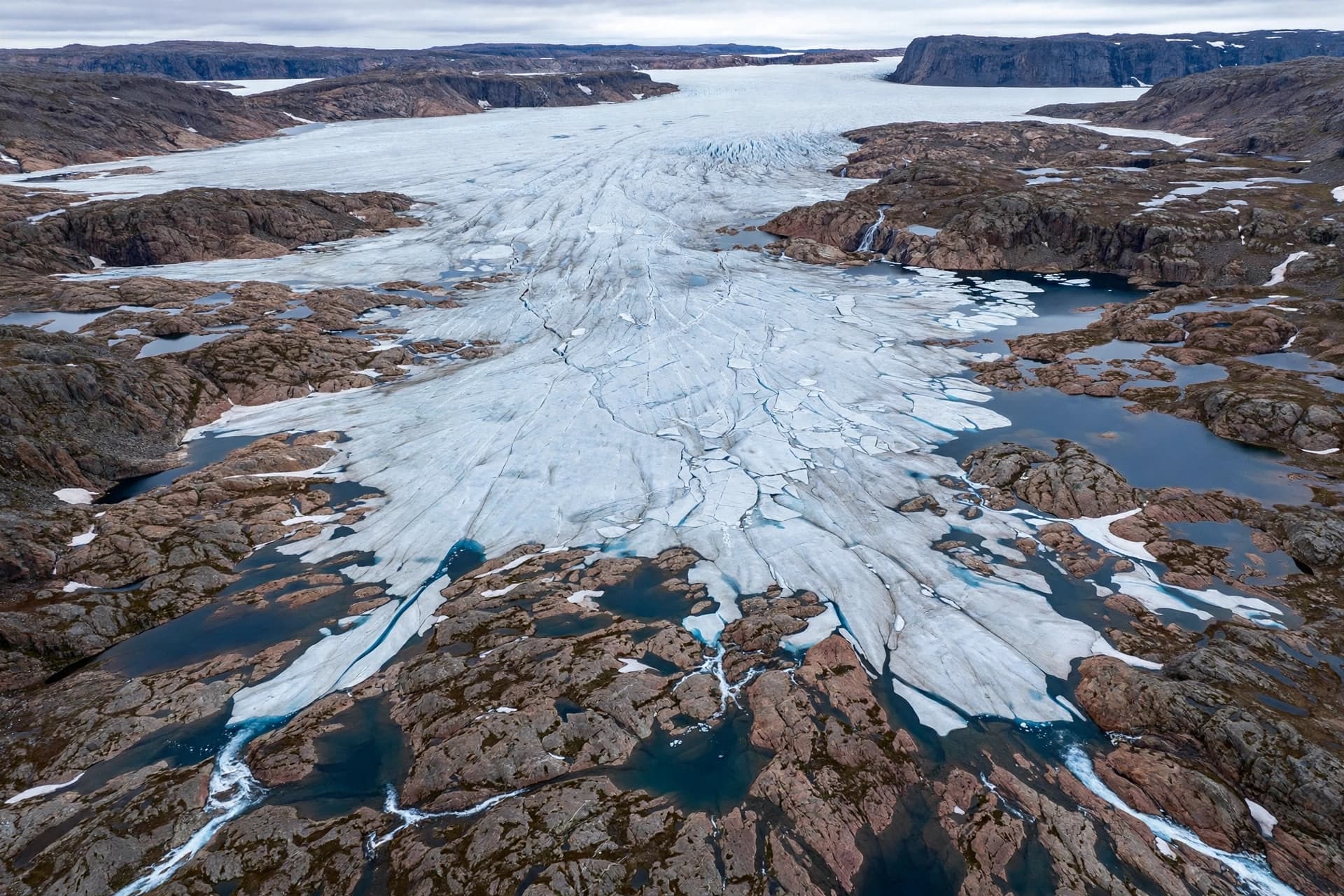
A new study published in the journal Science suggests that the next glacial period was beginning to take shape roughly two thousand years ago. The evidence comes from the Barnes Ice Cap on Baffin Island in Nunavut, Canada, the last remnant of the vast Laurentide Ice Sheet that once covered much of North America. By dating vegetation preserved beneath the thinning ice, researchers reconstructed the glacier's history and found that it had reached its minimum extent about three thousand years ago, then began to expand again around two thousand years ago . That expansion, they argue, marked the onset of the next glaciation.
But the expansion did not continue. By the 1960s, global temperatures had risen enough—largely through greenhouse gas emissions—that the Barnes Ice Cap began losing more ice in summer than it gained in winter. The growth that had signaled a new glacial period reversed, and the next ice age was, in effect, placed on hold . As Nicolás Young, a geochemist at Columbia University and the study's first author, put it, "It was just getting started, everything was normal, the next glaciation was about to happen—and yet it stopped" .
The implications stretch far beyond a single glacier. Climate models suggest the Barnes Ice Cap will likely disappear entirely within the next three hundred years. If it does, the last remnant of the Laurentide Ice Sheet—the anchor of continent-spanning ice for eons—will be gone, potentially altering the dynamics of future glaciations in ways that are not yet fully understood . In a perspective piece accompanying the study, glaciologist Shaun Marcott of the University of Wisconsin-Madison noted that future greenhouse gas emissions could forestall the next ice age for hundreds of thousands of years .
There is a peculiar irony here. The same emissions that are warming the planet and raising sea levels are also, inadvertently, preventing a far colder future. Some might even be tempted to call it a silver lining. But the researchers are careful not to frame it that way. The interruption of a glacial cycle is not a gift; it is a sign of how deeply human activity has reshaped the systems that govern the planet. The ice age that was canceled is not the problem. The problem is the force that canceled it.
The study does not predict exactly what comes next. Glacial cycles unfold over tens of thousands of years, and the models that describe them are still being refined. What the Barnes Ice Cap offers is a record of what has already happened—a timeline written in preserved plants and thinning ice, a story of a rhythm that started to turn and then stopped. The Earth, it seems, is no longer keeping its ancient time.
Image note: The visual accompanying this article is an AI-generated illustration and does not depict actual field research or satellite imagery.
Sources: Science, Columbia University, Gizmodo, NewsBreak
Published by Banx Network. This article is part of the Banx decentralized media programme, powered by the BXE token on the XRP Ledger.