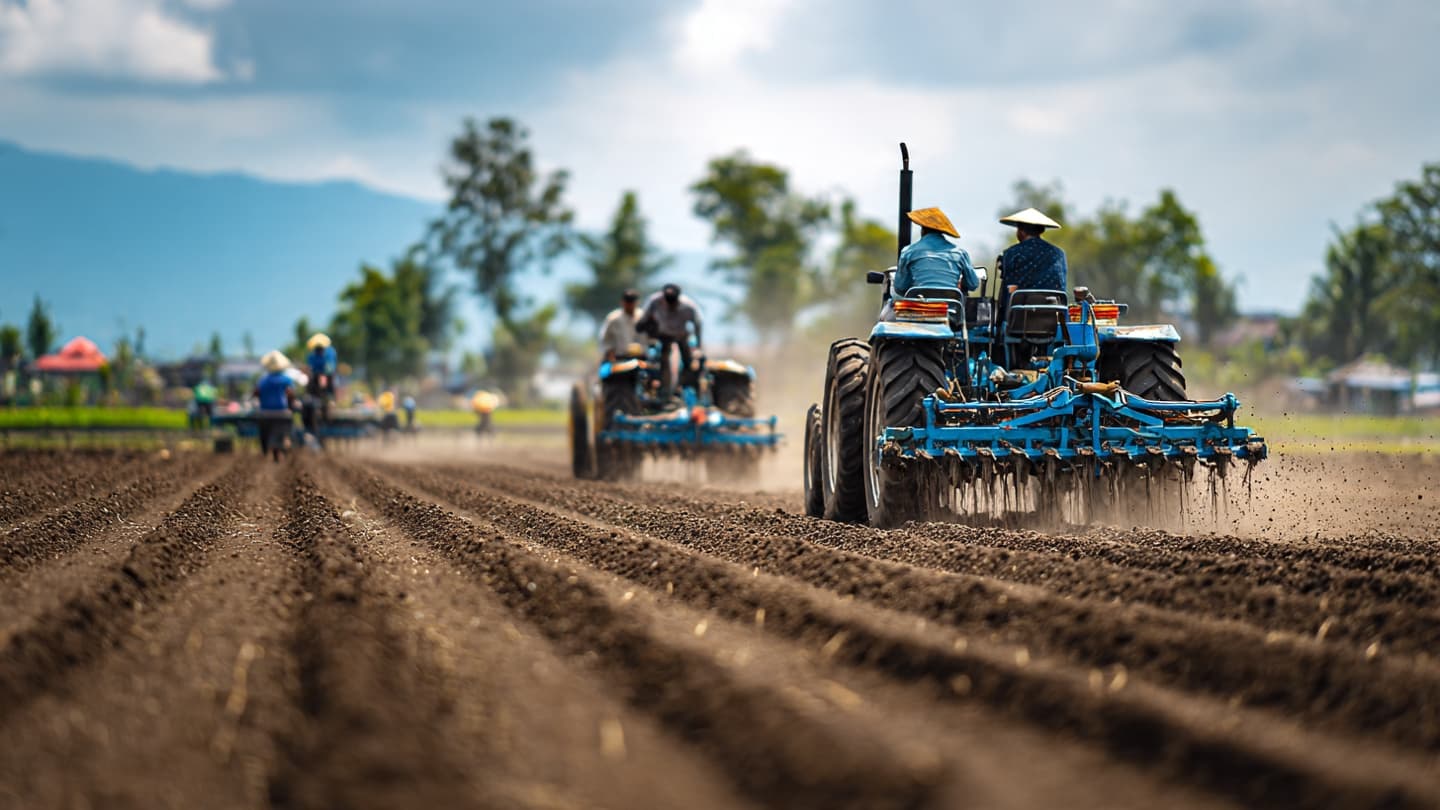
In Sleman, the future of rice farming is being tested in a field that is only a few hectares wide. The landscape may look familiar—rows of young rice, soil, water, and farmers moving between plots—but the method being introduced is designed to make each hectare work more efficiently.
The Sleman government has begun applying the Pertanian Modern Advanced Agricultural System, or PM AAS, to increase rice productivity. The method is being tested through a demonstration plot in Kurahan 3, Margodadi, where agricultural groups are working with government officials to evaluate the approach.
One reason for the experiment is the pressure on agricultural land. Parts of Sleman have experienced reductions in rice-field area as land is used for infrastructure and residential development. With less space available, increasing productivity from existing fields becomes an important part of maintaining agricultural output.
The PM AAS method uses more precise planting arrangements to increase the population of rice plants. According to the Sleman government, the approach can support around one million clumps of plants per hectare while maintaining the light and air circulation needed for healthy growth.
The system also combines planting arrangements with organic fertilizer and more intensive pest management. The idea is not simply to put more plants into the same space, but to create conditions in which greater plant density can still support productive growth.
The demonstration plot in Kurahan 3 covers two hectares and is managed by the Dadi Rukun farmer group, which works across a larger 13-hectare area. Preparation began in early September, including land monitoring, soil preparation, and planting of the Inpari 32 rice variety.
Farmers involved in the demonstration have also received production inputs including seeds, organic fertilizer, silica, NPK fertilizer, urea, and herbicides. The combination allows the method to be evaluated as a complete cultivation system rather than as a single change in planting technique.
Sleman’s program is connected to a broader national effort to expand PM AAS. The Agriculture Ministry has targeted implementation across one million hectares during 2026, with the longer-term objective of improving efficiency and productivity through modern cultivation practices.
For the farmers in Kurahan, the experiment remains grounded in something very practical: how much rice can be produced from the land that remains. As agricultural space becomes more limited, technology offers one possible way to make existing fields more productive. The coming harvest will provide the clearest measure of how well the method performs in Sleman’s own soil and climate.
Image Disclaimer: The illustrations are AI-generated representations of modern rice cultivation and are not photographs of the actual Kurahan 3 demonstration plot or participating farmers.
Sources: ANTARA
Published by Banx Network. This article is part of the Banx decentralized media programme, powered by the BXE token on the XRP Ledger.