There is a particular kind of stillness that comes from looking at a photograph of something impossibly far away. A galaxy that existed before the Earth was formed. A planet's storm system churning in wavelengths our eyes cannot see. An astronaut's window view of a crescent Earth, captured by a human hand. In 2026, the universe offered several such moments, and the instruments we built to watch it delivered images that will linger long after the year has passed.
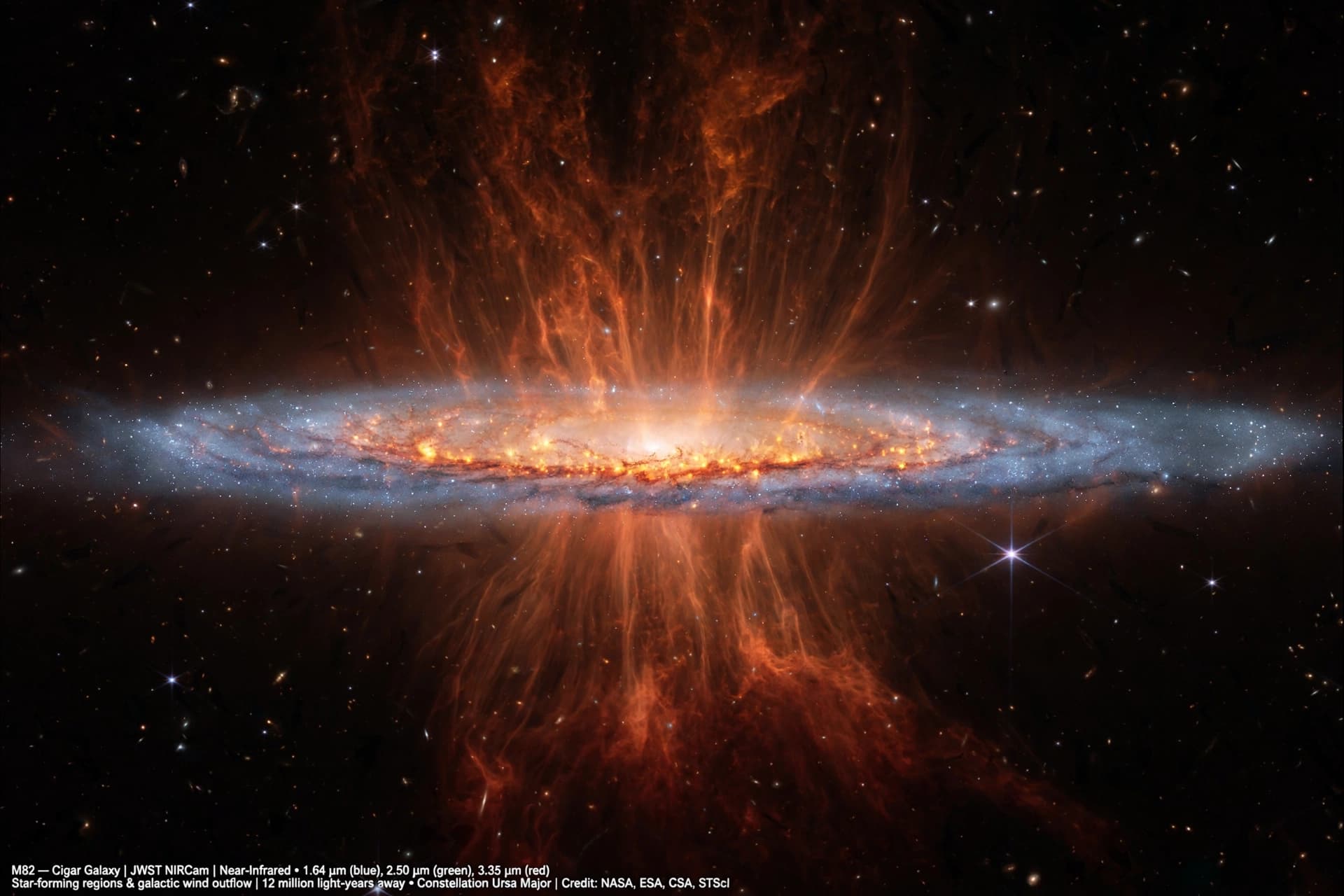
The year began with the James Webb Space Telescope continuing its work in the infrared, revealing structures and processes that had previously been invisible. In March, Webb turned its gaze toward M82, a galaxy twelve million light-years away known for its intense star formation . For the first time, astronomers directly measured the speed of superheated gas escaping from the galaxy's core, a violent outflow driven by supernovae and stellar winds . The image captured not just the galaxy's shape but the physics of its inner turmoil. Later that month, Webb and Hubble observed Saturn together, combining infrared and visible-light data to produce a richer portrait of the gas giant's atmosphere than either telescope could achieve alone .
April brought another kind of image entirely. NASA's Artemis II mission, the first crewed flight beyond low Earth orbit since Apollo, sent four astronauts around the Moon . The crew carried cameras, and the photographs they returned were not merely scientific data but records of human experience. One image showed Earth as a thin crescent, the terminator line separating day from night in sharp relief . Another captured the Moon's far side, with the Orientale basin's concentric rings visible in detail never before seen by human eyes . A third, taken from a camera mounted on Orion's solar array, framed the spacecraft, the Moon, and a crescent Earth in a single shot—a composition that conveyed both the scale of the journey and the smallness of home .
The Artemis II crew also witnessed a total solar eclipse from space, the Moon blocking the Sun for fifty-four minutes and revealing a glowing halo around the dark lunar disk . They photographed the Milky Way from a vantage point no human had occupied in over half a century. And they took a group selfie, because even at the edge of the Earth's gravitational influence, people remain people .
Not every significant image came from deep space. In April, Webb captured the protoplanetary disks Tau 042021 and Oph 163131, swirling clouds of gas and dust around young stars where planets may someday form . The disks appeared as glowing rings against the dark, a reminder that the processes that built our own solar system are still underway elsewhere. Hubble, now in its thirty-sixth year, contributed its own view of the Trifid Nebula, a star-forming region in Sagittarius that has been photographed many times but never quite like this .
The images of 2026 are not merely beautiful. They are evidence of what happens when curiosity is paired with engineering, when the human impulse to look outward is given the tools to do so with precision. The Artemis II photographs will be studied for years, their scientific value only beginning to be understood. The Webb images will be cited in papers and compared with future observations. But their immediate impact is simpler: they make the universe feel a little more present, a little more within reach.
---
AI Image Disclaimer: The visual content in this article was generated by artificial intelligence and is intended for illustrative purposes only.
Sources: NASA, European Space Agency, Canadian Space Agency, RTBF, Nautilus, Gizmodo
Published by Banx Network. This article is part of the Banx decentralized media programme, powered by the BXE token on the XRP Ledger.