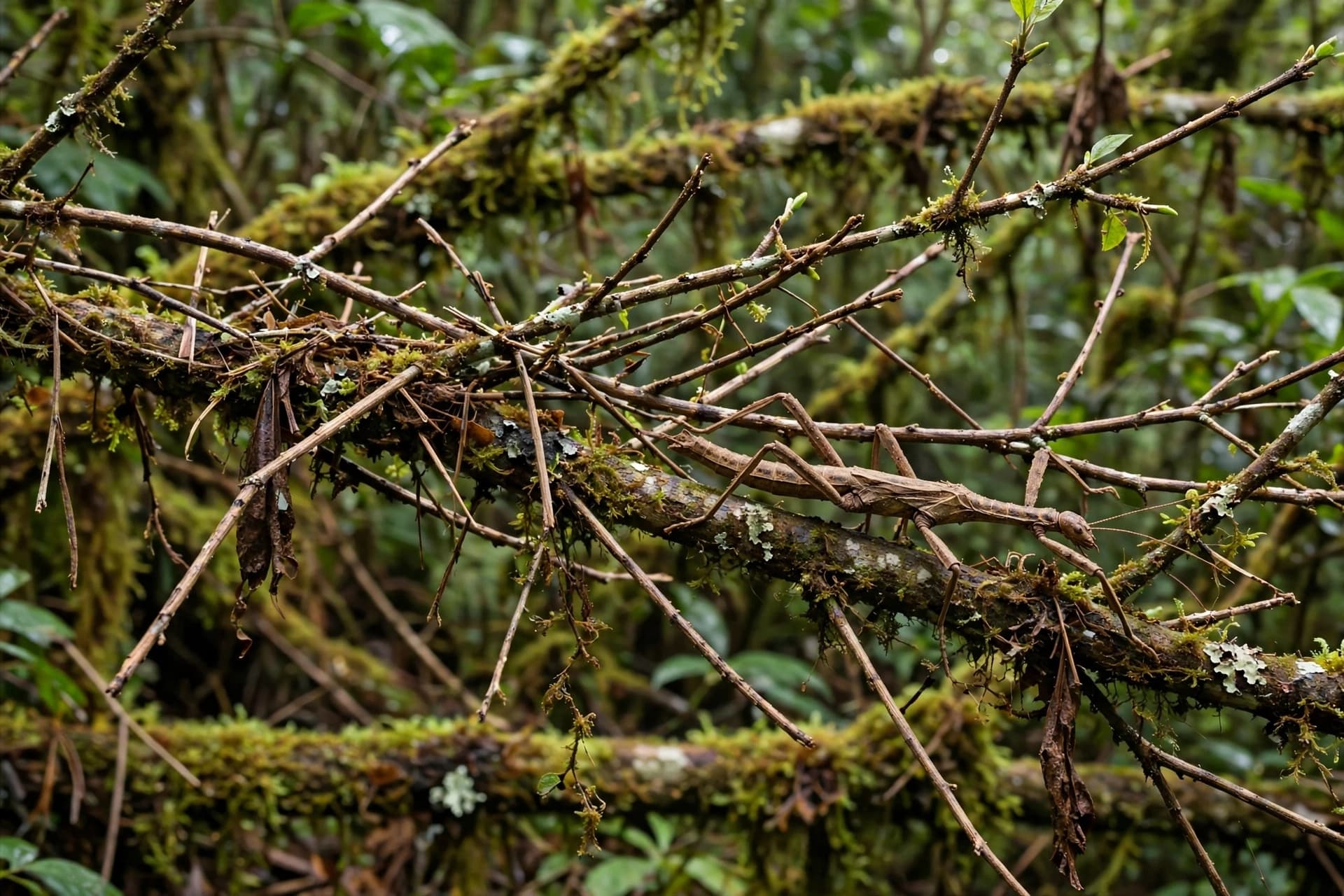
In the rainforests of far north Queensland, where the canopy closes overhead and the light falls in dappled fragments, there are creatures that have perfected the art of disappearing. Stick insects are among the most accomplished. They are twigs that walk, leaves that breathe, brown and green and motionless until they are not. For decades, one large stick insect in particular was seen, photographed, collected, and studied. It was known. It was catalogued. It was, as it turns out, something else entirely.
A new study led by Dr. Braxton Jones at the University of Sydney has revealed that a stick insect long believed to be a single species is actually two. The insect now named Anchiale robusta had been misidentified for decades, its distinct identity hidden behind the assumption that it was simply a variation of a known species . The discovery was made through a combination of DNA analysis, museum specimen examination, field surveys, and citizen science records—a taxonomic detective story that unfolded across decades of collected data .
The confusion was understandable. Stick insects of the genus Anchiale are large, heavy-bodied, and winged, with greenish-brown coloration that mimics twigs and leaves . They are among the most photographed and frequently reported insects on citizen science platforms like iNaturalist, with over a thousand observations recorded . Yet despite this abundance of visual data, the taxonomic distinctions remained unclear until genetic analysis provided a different kind of clarity.
Jones and his colleagues examined 35 specimens of Anchiale from museum collections and recent field collections, subjecting 32 of them to DNA analysis . The results revealed that what had been considered two species was actually five, distributed from northern New South Wales through coastal Queensland and into the tropical north . Anchiale robusta, the species that had fooled scientists for so long, was formally described as distinct—larger than its sister species, with females reaching body lengths of 12 to 16 centimeters .
The study also described a second new species, Anchiale mabiensis, found only in the critically endangered Mabi rainforest on the Atherton Tablelands . As of 2021, only about 1,050 hectares of this rainforest remained, fragmented into patches surrounded by agricultural land . The species appears to be endemic to this threatened ecosystem, making its discovery a matter of conservation urgency. Its eggs are coffee brown, with an unusual structural “lid” that detaches when the insect hatches—a trait not seen in any other stick insect .
The researchers also restored a third species, Anchiale spinicollis, which had been named in 1904 but later cancelled, and identified a probable fourth new species in Cape York that requires additional specimens for confirmation . The revised classification has practical implications as well. One stick insect known to occasionally reach pest-like population levels and defoliate trees turned out to be more than one species, meaning that distinguishing between them could help land managers better understand and respond to future impacts on forestry and agriculture .
For Jones, the findings carry a broader message. “Taxonomy is often a bit like detective work,” he said. “Even among some of Australia‘s most photographed and frequently reported insects, we’re still finding species that have escaped scientific recognition” . The discovery of A. mabiensis, hidden in the remnant patches of a vanishing rainforest, serves as a reminder of what may be lost before it is ever known. As Jones put it, these findings demonstrate the importance of protecting threatened ecosystems and documenting Australia‘s extraordinary biodiversity before we lose species without having even discovered them .
The stick insects of Queensland have been hiding in plain sight, their disguises so effective that even the scientists studying them were deceived. The revelation that one was actually two, and that two were actually five, is a small correction in the grand catalogue of life. But it is also a reminder that the natural world still holds secrets, even in places we think we know well.
AI Image Disclaimer: The images in this article were created with artificial intelligence tools and do not depict actual specimens.
Sources: ScienceAlert, The Guardian, Nautilus, Austral Entomology, University of Sydney
Published by Banx Network. This article is part of the Banx decentralized media programme, powered by the BXE token on the XRP Ledger.