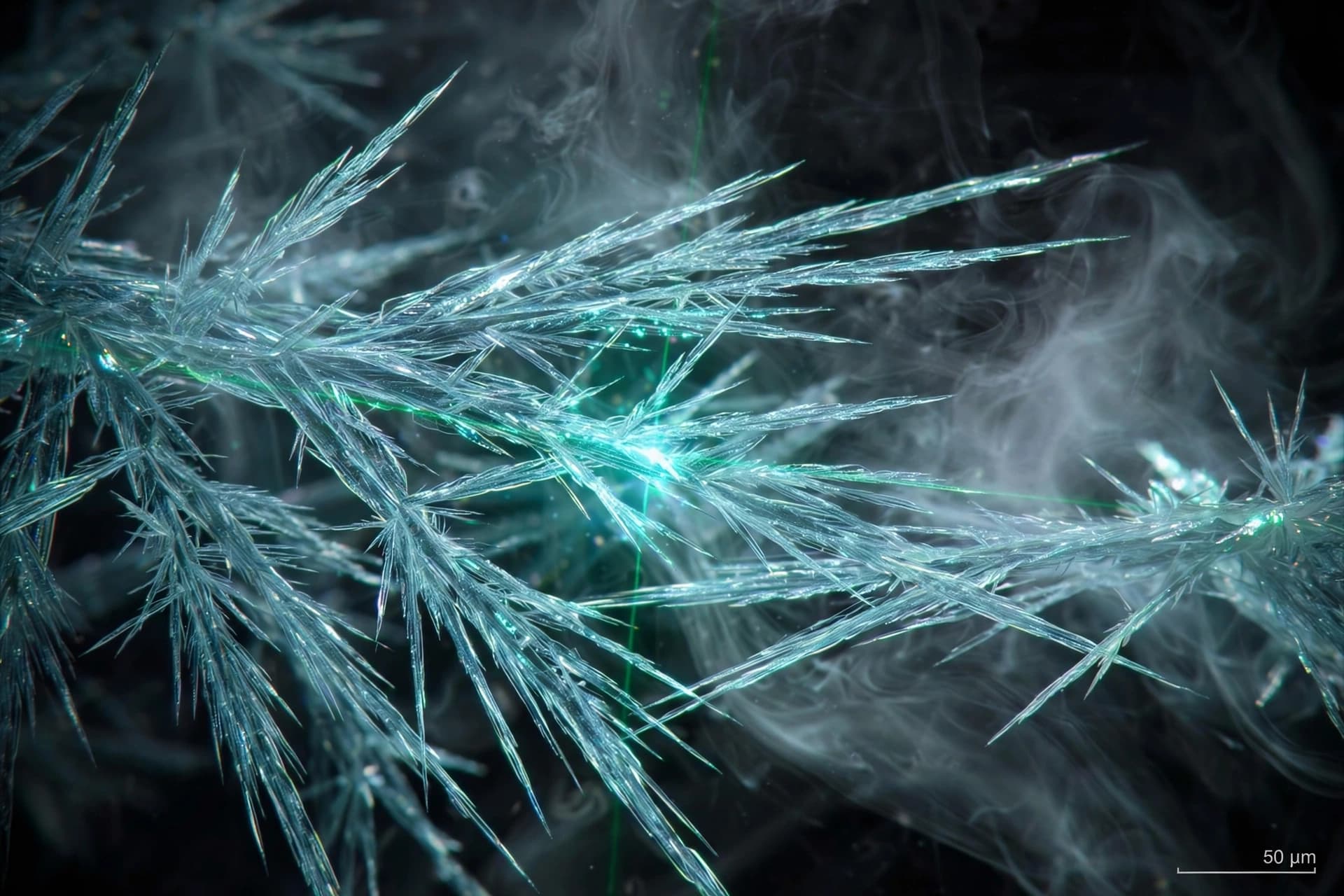
There is a particular kind of wonder in watching something impossibly small respond to the world around it. A crystal, thinner than a human hair, sitting still under a microscope. Then a vapor drifts in—chloroform, a common solvent—and the crystal begins to move. It does not merely twitch or shift. It bends, it changes shape, it may even begin to dissolve at its edges. For scientists at the University of Tokyo, this was not a failure of the experiment but the experiment itself, revealing behaviors that had not been observed before at this scale.
The research, published in the journal Small, examined microscopic crystals of a rhenium complex molecule . These crystals, measured in micrometers—one millionth of a meter—were exposed to chloroform vapor and observed using an extremely powerful laser microscope and X-ray diffraction . What the researchers saw was a phase transition, a structural transformation that occurred as the chloroform migrated into the crystal lattice. Areas containing more than 10,000 molecules moved cooperatively, producing changes that could be seen and measured .
The behaviors varied. Some crystals moved as they absorbed the chloroform, their volume changing and recrystallizing in response . Others underwent what is called deliquescence—absorbing so much chloroform that parts of them dissolved . The lead author, Xiao Ma, described the changes as drastic, with the chloroform migrating into the samples and triggering coordinated movement across thousands of molecules .
This is not merely a curiosity of materials science. The ability of a crystal to respond to a specific vapor by moving or changing structure suggests a pathway toward sensors for volatile organic compounds, a class of pollutants that includes chloroform and other industrial solvents . A material that visibly responds to the presence of a particular vapor could offer a simple, low-cost way to detect environmental contamination or industrial leaks.
The findings also contribute to a growing body of research on dynamic crystals—materials that can move or change shape in response to external stimuli . Unlike conventional actuators that rely on motors or electrical systems, these crystals respond directly to their chemical environment. The movement is driven by the absorption of vapor and the resulting strain within the crystal structure. In this case, the rhenium complex crystals exhibited a phase transition that propagated through the material as the chloroform diffused inward .
Kazuyuki Ishii, the senior author, noted that the research demonstrated a quick and simple approach to fine-tuning the crystals, which might someday power high-tech gadgets . The work is still at the stage of fundamental discovery, but the implications are clear. Understanding how crystals behave when they absorb vapor is a first step toward designing materials that can do so deliberately and usefully.
For now, the crystals sit under microscopes in Tokyo, responding to the faintest breath of chloroform. They move, they change, they sometimes dissolve. And in their small movements, there is a glimpse of how the very small can respond to the world in ways that might one day be put to use.
AI Image Disclaimer: The images in this article are AI-generated and intended for illustrative purposes only.
Sources: University of Tokyo, Small, EurekAlert, Nanowerk
Published by Banx Network. This article is part of the Banx decentralized media programme, powered by the BXE token on the XRP Ledger.