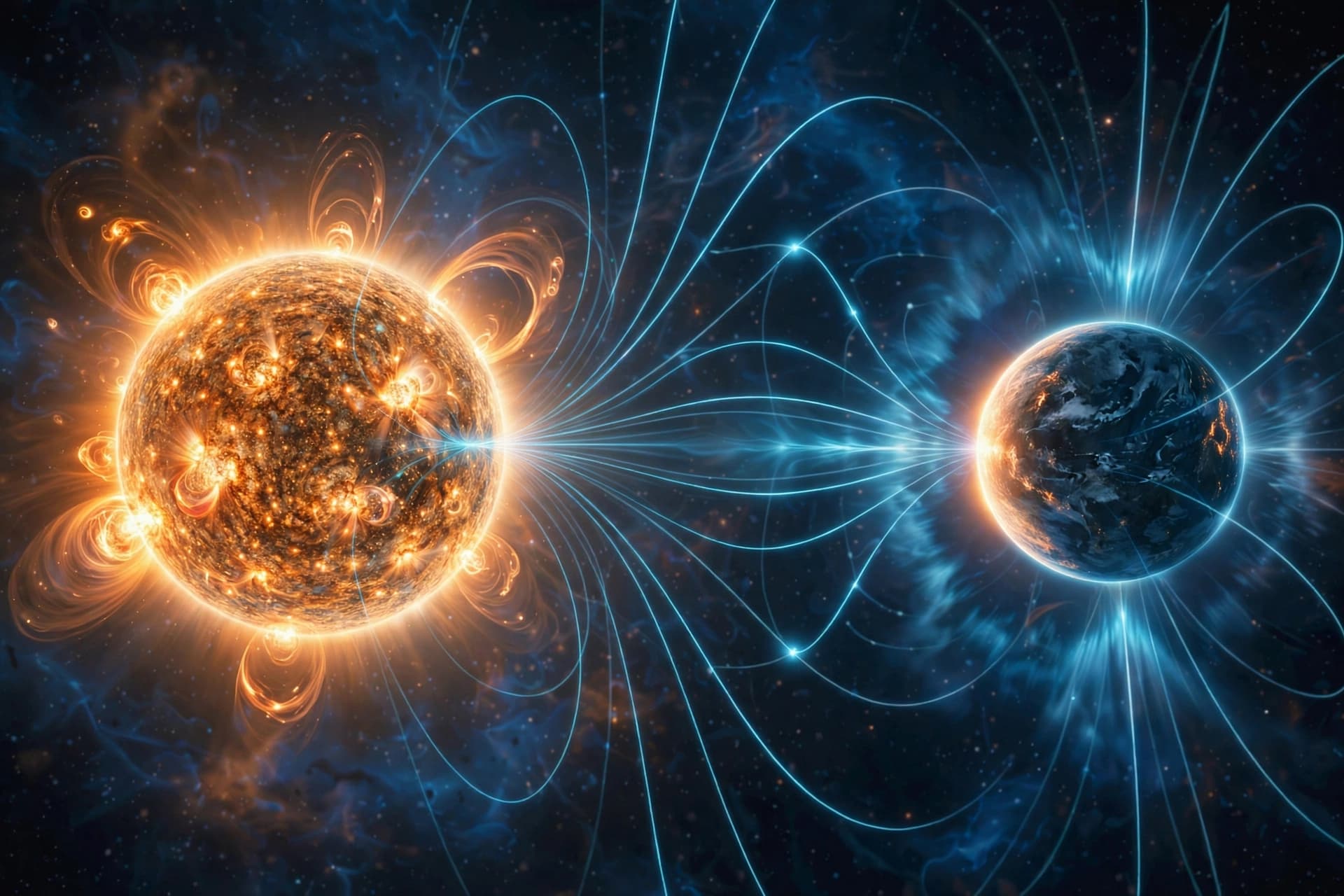
In the calm fold between night and day, when sunlight traces faint gold along the horizon, the universe often whispers its long stories — not in thunderous clamor, but in subtle lines of light that carry with them the history of the stars. Among the myriad suns that light our galaxy, there are neighbors much smaller and dimmer than our own: red dwarf stars. These stellar companions, humble in brightness yet vast in number, are now offering clues to one of the grandest questions of all — how the cosmic ingredients of life itself, like carbon and oxygen, came to be.
Much as a seasoned archivist reads faded ink to uncover ancient narratives, astronomers peered into the light of 32 nearby red dwarf stars, reading the delicate signatures of atoms forged in stellar hearts. Carbon and oxygen — elements that form the backbone of life on Earth and the very air we breathe — were found not just in their ordinary forms, but in rare isotopic varieties. These subtle differences, like nuanced dialects in a familiar language, carry the imprint of the processes that enriched the cosmos over billions of years.
Red dwarfs, among the most common stars in the Milky Way, live extraordinarily long lives. Their extended lifespans allow them to preserve the fingerprints of their chemical evolution in their outer layers, granting scientists a kind of cosmic time capsule. By studying high-resolution spectra — the starlight broken into its constituent colors — researchers were able to detect ratios of carbon and oxygen isotopes that vary according to the stars’ histories. Less chemically enriched stars showed fewer of these rare isotopes, a finding that fits with models of how galaxies evolve chemically over time.
The spectra used for this discovery came from data originally collected for another purpose — a testament to the layered richness of scientific archives. What began as a search for planets transformed into a window on stellar alchemy. In this cosmic detective work, astronomers treated light as both clue and code, deciphering elemental tales that span eons.
These findings are more than technical details about the makeup of distant suns. They speak to a greater narrative about how the universe recycles and renews itself. Stars generate elements through the slow churn of nuclear fusion and, ultimately, through the dramatic breaths of stellar winds and explosions. These elements seed interstellar gas, on whose woven tendrils new stars and planets — and potentially life — are built. Each spectrum is like a sentence in the story of cosmic recycling, and red dwarfs are now helping scientists read the opening chapters.
In straightforward scientific terms, the research team led by Darío González Picos of Leiden University successfully measured the carbon and oxygen isotope ratios in nearby M dwarf stars with unprecedented precision. This work, published in Nature Astronomy, confirms predictions of galactic chemical evolution models and provides a new way to trace the history of element formation in the universe
AI Image Disclaimer
“Visuals are created with AI tools and are not real photographs.”
Sources (Source Check — credible outlets identified):
Nature Astronomy Leiden University Phys.org Universe Today European Southern Observatory (ESO)
Published by Banx Network. This article is part of the Banx decentralized media programme, powered by the BXE token on the XRP Ledger.