There is a particular fragility to youth, whether in a person or a planet. The first hundred million years of a world's life are a time of formation and vulnerability, when the atmosphere is thin, the surface unsettled, and the star above is still learning to control its temper. Most planets we know orbit at comfortable distances, far enough from their star's outbursts to develop in relative peace. But roughly half of all exoplanets discovered so far belong to a different class entirely—the close-in worlds, orbiting their stars in less than ten days, living in a neighborhood where the stellar weather is fierce and unrelenting .
A new discovery from the Max Planck Institute for Solar System Research has revealed something unexpected about these young, close-in planets: they do not simply endure their star's violence. They provoke it. Ekaterina Ilin, a research group leader at the institute, identified the first planet known to trigger radiation bursts from its host star through a magnetic interaction, a phenomenon she describes as "a completely new type of space weather in which a planet brings these stellar storms upon itself" .
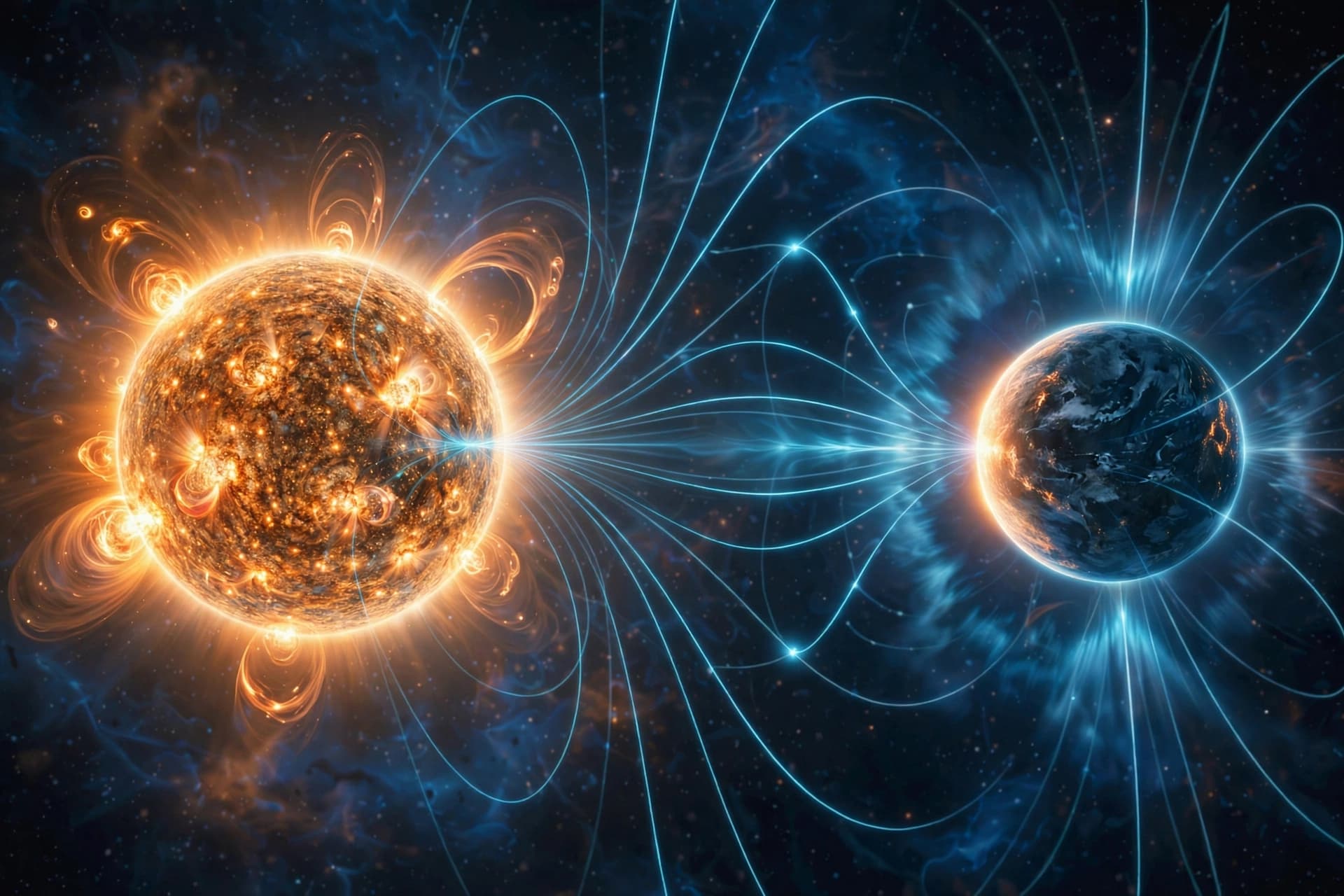
The planet, HIP 67522 b, orbits its young star at an extremely close distance. Because of this proximity, the planet's magnetic field couples into the star's magnetic field, creating a connection that triggers flares on the side of the star facing the planet . These bursts of radiation and particles then backfire on the planet itself, accelerating the loss of its atmosphere. Over millions of years, this self-inflicted stellar bombardment could strip a young world of the very conditions needed for life to emerge .
In our own solar system, solar storms occur as well, but they follow the Sun's internal logic. Earth and its neighbors orbit far enough away that they have no influence on the star's eruptions . The situation for close-in exoplanets is different. Their magnetic fields interact directly with the star's, creating a feedback loop that amplifies the danger. The star's youth makes it particularly active—young stars are known for violent outbursts—and the planet's proximity makes it a target as well as a trigger .
Ilin's research group, called MICS (Magnetic Interactions in Systems with (Sub-)Stellar Companions), aims to understand this phenomenon more deeply and to develop it into a method for detecting planets through their magnetic interactions with their stars . The approach is elegantly counterintuitive: instead of struggling to observe planets obscured by stellar activity, Ilin uses the activity itself as a signal. By analyzing the temporal distribution of flares in data from space telescopes like Kepler and TESS, she identified HIP 67522 b and confirmed its role in triggering the bursts .
The findings add a new dimension to the study of planetary evolution. Close-in planets are common, and many orbit young stars. If magnetic interactions like this are widespread, then the atmospheres of these worlds may be disappearing faster than models predict . The question of whether such planets could ever hold onto their air—and whether life could arise on them—becomes more complicated. The research also opens a new avenue for finding planets, using their magnetic footprints as a detection method for current and future telescopes like PLATO .
For a young planet, the line between a star's warmth and its wrath is thin. The same proximity that keeps it warm also exposes it to the star's storms. And as the new research shows, the planet itself may be the reason those storms are aimed its way.
AI Image Disclaimer: The images accompanying this article are AI-generated and are intended for illustrative purposes only.
Published by Banx Network. This article is part of the Banx decentralized media programme, powered by the BXE token on the XRP Ledger.