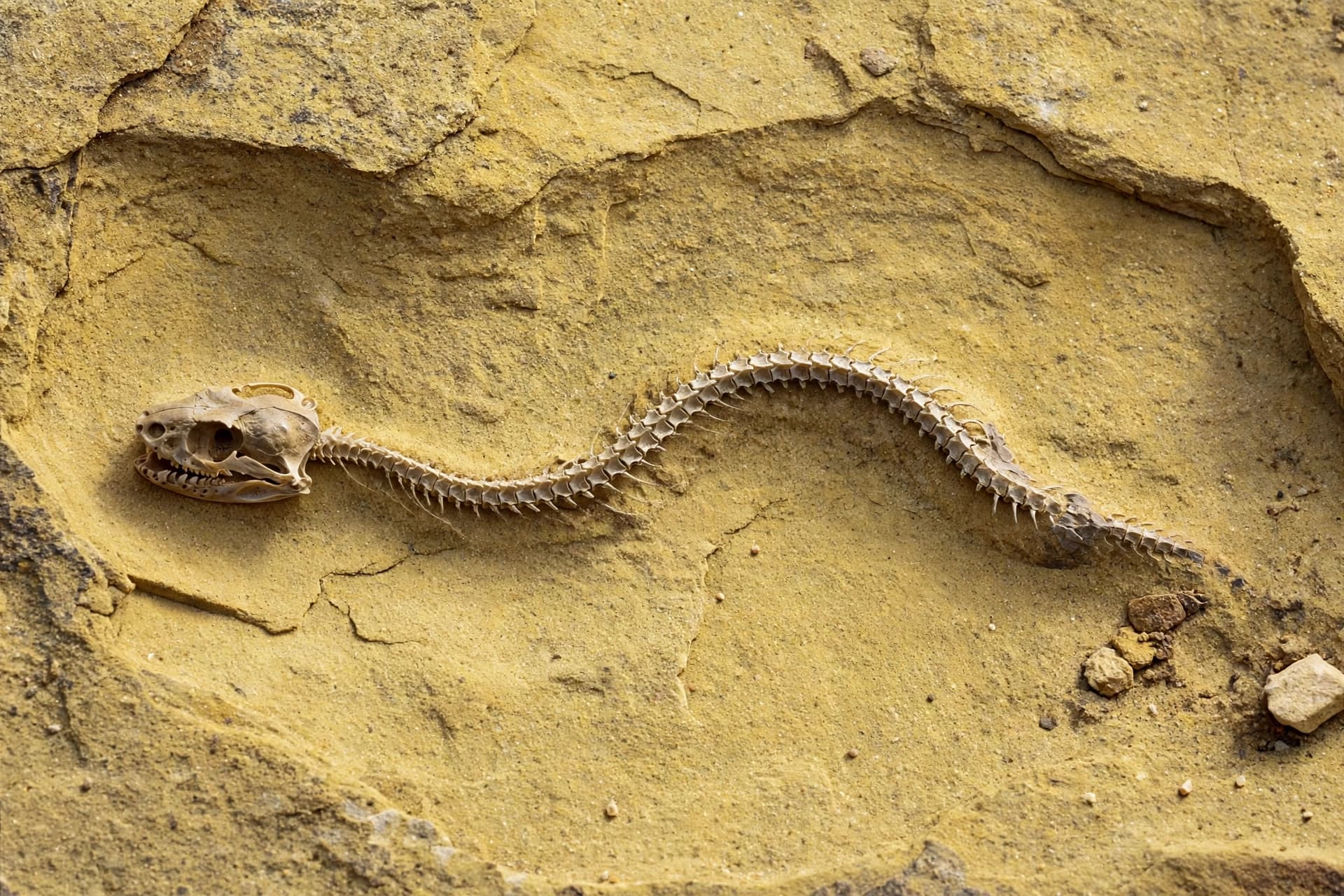
The origin of snakes is one of evolution's more stubborn mysteries—a question of where, when, and from what ancestors these legless, elongated creatures first emerged. Fossils from the Cretaceous period have offered tantalizing clues, but each new find seems to complicate the picture as much as clarify it. Now, a remarkably preserved snake from Brazil, described in the journal Nature, has added a new voice to the conversation. Its anatomy suggests a life underground, and its differences from another ancient snake reveal that early snakes were already diverse in both form and habit .
The fossil, named Tametara mirim, was discovered in 2020 at a quarry in Presidente Prudente, western São Paulo state. It preserves the posterior half of the skull and approximately 103 vertebrae from the front portion of the body, with bones still connected—Brazil's first articulated snake fossil from the Cretaceous . The animal lived roughly 85 to 75 million years ago and measured about 42 centimeters in preserved length. Its species name combines a term meaning "adorned," for its prominent skull crest, with "mirim," meaning small .
High-resolution computed microtomography allowed researchers to examine the skull without destroying it, producing 3D models of bones, cranial nerves, the inner ear, and the internal skull cavity . The skull roof contained compact, overlapping bones resembling those of living burrowing reptiles. The inner ear showed an enlarged vestibular region and simplified semicircular canals, a combination consistent with underground life. The brain endocast revealed short olfactory bulbs, modestly expanded cerebral hemispheres, and a poorly defined optic tectum—a pattern seen in reptiles that rely less on vision .
Yet not every feature fit the burrowing profile. Tametara also had an elongated mid-hindbrain and a large pituitary region, traits more common in surface-dwelling or aquatic species. Different brain regions, it seems, followed different evolutionary paths . The strongest evidence for its underground lifestyle comes from the agreement between independent analyses: forebrain shape and skull microstructure both place Tametara among burrowing forms, with inner-ear anatomy providing supporting, though not conclusive, evidence .
The fossil's significance lies partly in what it reveals about another ancient snake. Dinilysia patagonica, a Cretaceous snake from Argentina, had been proposed as evidence that the ancestral snake was a burrower . But Tametara's anatomy differs sharply from Dinilysia's, suggesting that early snakes had already diversified into different ecological niches. "One fossil species cannot stand in for the ancestral lifestyle of all snakes," the researchers note . The picture that emerges is not of a single origin story but of a radiation—multiple lineages exploring different ways of being a snake.
The question of whether snakes evolved from burrowing, marine, or terrestrial ancestors remains open. A four-legged fossil from the Crato Formation, described in 2015, suggested burrowing origins based on its reduced limbs and elongated body . Other evidence has pointed toward marine ancestry. Tametara does not settle the debate, but it adds a data point: burrowing snakes were already specialized during the age of dinosaurs, and they were not alone in their adaptations .
For a creature that lived and died in the Cretaceous, preserved in sandstone for tens of millions of years, Tametara mirim now speaks across an almost unimaginable span of time. Its bones tell a story not of a single ancestor but of a family tree with many branches, some of which led underground while others pursued different paths. The origin of snakes, it seems, was less a moment than a process—one that this small, adorned fossil helps illuminate.
AI Image Disclaimer: The imagery in this article is AI-generated and serves an illustrative purpose only.
Sources:
· Nature · The Brighter Side of News · University of São Paulo · FAPESP
Published by Banx Network. This article is part of the Banx decentralized media programme, powered by the BXE token on the XRP Ledger.