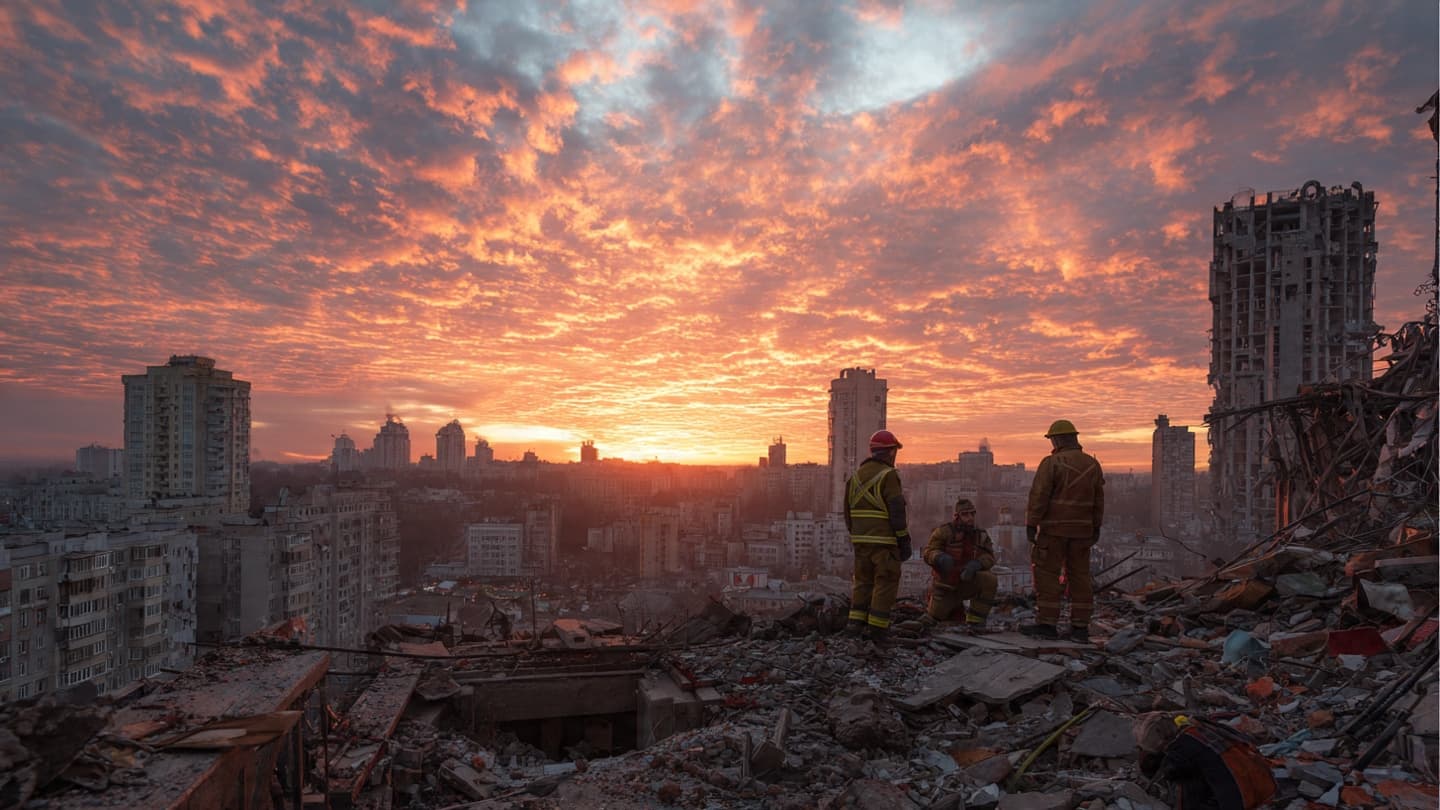
The first light of morning often arrives gently over Kyiv, touching church domes, apartment rooftops, and tree-lined boulevards with a calm that seems almost timeless. Yet in a city shaped by years of war, dawn is frequently preceded by the sound of air raid sirens, reminding residents that even the quietest moments can exist alongside uncertainty.
That familiar rhythm was interrupted once again as Russian forces launched another wave of missile and drone strikes against Kyiv and other parts of Ukraine. Air defense systems were activated through the night, intercepting many incoming threats, while emergency crews responded to damaged buildings and infrastructure. Authorities reported casualties and renewed destruction as residents sought shelter during the attacks.
The latest assault unfolded while military and diplomatic attention extended beyond Ukraine itself. During discussions on European security, NATO's senior military leadership emphasized that any direct attack against the alliance's Baltic members—Estonia, Latvia, or Lithuania—would provoke a collective response. The warning reflected NATO's longstanding commitment to mutual defense, underscoring that any escalation beyond Ukraine would carry far-reaching consequences.
For many across Europe, these parallel developments illustrate two realities unfolding at once. One is immediate and visible in Ukraine, where cities continue repairing homes, hospitals, and public services after repeated attacks. The other is quieter but equally significant, taking place in meeting rooms, command centers, and diplomatic gatherings where governments seek to prevent the conflict from widening.
Kyiv has become a symbol of resilience throughout the war. Even after nights marked by explosions, public transportation resumes, shops reopen, schools continue where possible, and daily life cautiously returns. That persistence reflects the determination of ordinary people who continue balancing routine with preparedness, rebuilding even as new challenges emerge.
Meanwhile, the Baltic nations have continued strengthening their own defenses alongside NATO allies. Additional multinational forces, expanded military exercises, and investments in regional security have become central elements of deterrence. Officials repeatedly stress that the purpose of these measures is not to invite confrontation but to reduce the likelihood of one by demonstrating collective readiness.
Security analysts observe that deterrence often depends as much on clarity as on capability. Public statements by military leaders serve to communicate commitments before crises deepen, reinforcing the principle that predictable responses can help discourage broader conflict. At the same time, diplomatic channels remain important, even during periods of heightened military tension, offering opportunities to manage risks and avoid unintended escalation.
For civilians living closest to the conflict, however, strategic calculations remain secondary to everyday concerns. Families continue repairing damaged homes, checking on neighbors after each alert, and hoping that future mornings will arrive without interruption. Their experiences remind the wider world that geopolitical events are ultimately measured not only through policy decisions but through individual lives shaped by them.
As evening once again settles across Eastern Europe, cities continue their familiar rhythms beneath attentive skies. Aircraft patrol distant airspace, diplomats continue their conversations, and emergency workers remain prepared for another uncertain night. Between vigilance and hope, Europe carries forward with the enduring belief that stability is preserved not only through strength, but also through continued efforts to prevent conflict from reaching beyond its present borders.
AI Image Disclaimer
Illustrations accompanying this article were created using AI as conceptual visualizations and do not depict actual photographs of the reported events.
Sources
• Reuters
• Associated Press
• NATO
• Ukrainian Air Force
• BBC News
Published by Banx Network. This article is part of the Banx decentralized media programme, powered by the BXE token on the XRP Ledger.