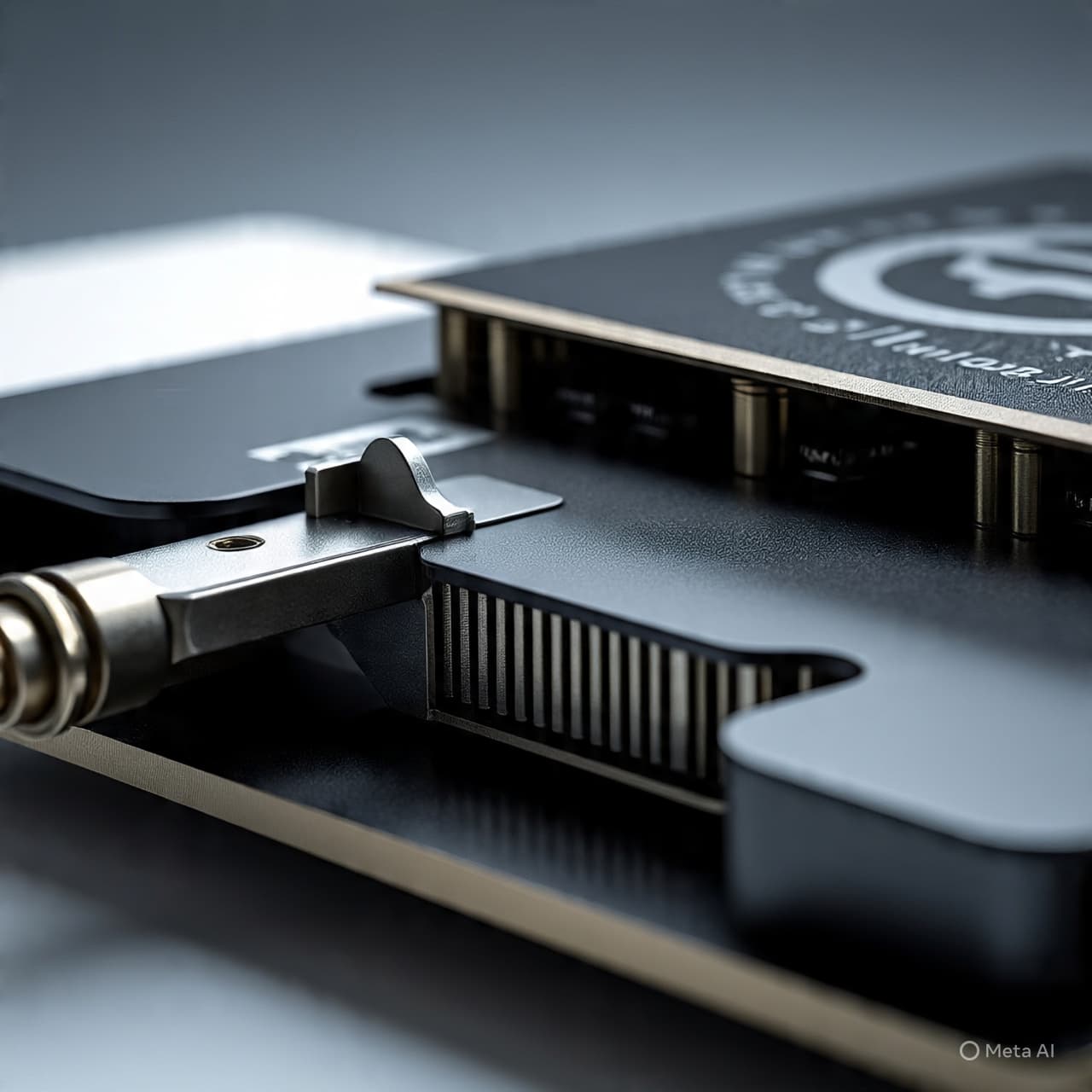
There’s a curious kind of poetry in how even the smallest bits of hardware — a connector no bigger than a child’s fingertip — can become emblematic of larger tensions in technology. Much like a carefully fitted key in a lock, a power connector must sit just so, with each tiny contact point aligned perfectly. When that precision is difficult to achieve, engineers begin to innovate, lest reliability be left to chance.
In a recent teardown of a prebuilt Dell PC, one such innovation emerged not from flashy performance specs, but from a quiet redesign beneath the chassis. The graphics card inside the system — an Nvidia GeForce RTX 5070 Ti — is powered by a 12V‑2×6 GPU power connector that is mechanically locked into place with a robust fitting, a custom solution intended to ensure that high‑current contacts remain secure and stable.
This detail reflects broader concerns over the reliability of newer GPU power standards. For several years, the PC hardware world has watched with a mixture of concern and frustration as connectors introduced to deliver higher wattage — first the 12VHPWR and later the revised 12V‑2×6 — occasionally failed to maintain a solid electrical contact. Partial or loose seating, even by fractions of a millimeter, has been linked to hotspots, overheating, and in documented cases dramatic melting of connectors and cables.
Dell’s choice, reportedly involving a solid metal fitting from supplier Amphenol that keeps the connector from inadvertently loosening, represents a practical response to a real worry. The mechanical lock itself can only be released by deliberate action — a press of a large tab — and the wiring is arranged to minimize sharp bends that have been implicated in connection failures. In doing so, the design attempts to sidestep one of the points of fragility inherent in modern GPU power delivery: ensuring constant, full contact across multiple high‑current pins.
Underlying this engineering choice is a long arc of industry experience. High‑power GPU connectors were originally standardized at 16 pins to deliver up to 600 W of DC power in a single interface. But early adoption revealed that even minor imperfections in seating could concentrate current on a subset of pins, causing excessive resistance and heat. This led to revised standards with hidden sense pins and revised physical layouts, such as the 12V‑2×6 pattern now part of PCIe’s evolving specification.
For users and builders, these details often remain hidden until trouble appears. Yet for manufacturers like Dell, who ship complete systems rather than bare components, reducing the risk of a connector failure is both a reliability and a safety consideration. A mechanically secured power interface, bolted solidly to the card itself, reduces the likelihood that transportation vibration or slight misalignment during assembly could lead to intermittent contact — a failure mode that can compromise even a powerful GPU’s performance or longevity.
At the same time, some industry voices question whether any connector refinement can fully solve what ultimately results from high power densities. Cases have cropped up involving other GPU models where even revised connectors succumbed to overheating under heavy load, especially when combined with adapters rather than native cable interfaces.
In straightforward news terms, reports from teardown analyses indicate that Dell’s current prebuilt PC features a custom mechanical lock on its 12V‑2×6 GPU power connector. The design — reportedly from specialty component maker Amphenol — is intended to ensure that the power interface remains firmly seated, in response to concerns about intermittent contact and overheating seen with high‑current GPU connector standards.
AI Image Disclaimer Visuals are created with AI tools and are not real photographs.
Sources
Tom’s Hardware heise News Minimalist
Published by Banx Network. This article is part of the Banx decentralized media programme, powered by the BXE token on the XRP Ledger.