There is a certain humility that comes from looking at a world that refuses to behave as expected. Astronomers have catalogued thousands of exoplanets, sorting them into categories and sketching their likely conditions with the confidence that comes from patterns. But every so often, a planet looks back through the data and suggests that the categories were too narrow, the assumptions too tidy.
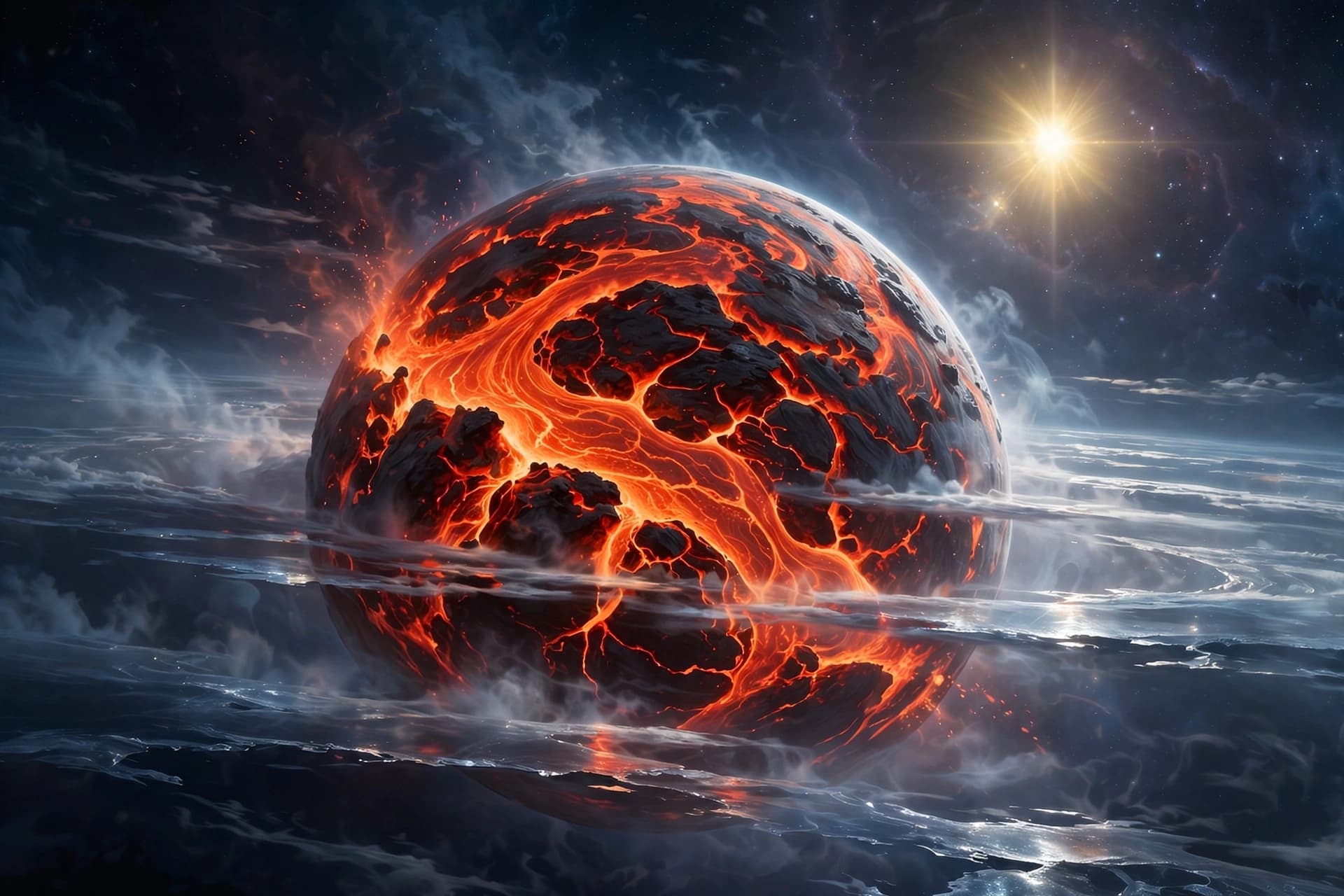
TOI-561 b is such a world. It is a rocky planet orbiting so close to its star that its surface is thought to be an ocean of molten rock, a place where the very idea of an atmosphere seemed improbable . And yet, new analysis of James Webb Space Telescope observations suggests that this lava world is wrapped in a reflective layer of clouds made of vaporized silicate minerals—the same family of compounds that make up quartz and sand .
The observations were gathered over 37 hours, capturing nearly four complete orbits. By measuring how the planet’s brightness and heat changed throughout its orbit—a technique called a phase curve—researchers found that it reflects roughly three-quarters of the starlight that hits it, a reflectivity comparable to Venus . The dayside was cooler than expected for bare rock, and the nightside was not warm enough to account for the difference. Something was reflecting the light away.
Climate simulations suggest that clouds of silicon dioxide and magnesium silicate could form on the planet’s dayside, acting like a sunscreen . By reflecting starlight and keeping the planet cooler, these clouds may help it hold onto an atmosphere that would otherwise be stripped away by the star’s relentless radiation. The finding builds on earlier evidence that TOI-561 b possesses a thick atmosphere, likely replenished by gases released from its molten interior .
What that atmosphere is made of remains unknown. It could be a dense blanket of carbon dioxide, like a far hotter version of Venus, or it could be rich in sulfur dioxide, a gas associated with volcanic activity . The planet’s surface ocean of magma could act as a planet-wide volcano, continuously feeding the atmosphere above it. The researchers are careful not to claim certainty, only possibility.
The discovery challenges a simple expectation: that extreme heat and proximity to a star preclude the existence of clouds and atmosphere. TOI-561 b suggests that even in the most hostile environments, the chemistry of rock and vapor can produce something more complex than a bare, scorched surface. The universe, it seems, is more inventive than our models.
The next question, the researchers say, is whether this atmosphere resembles Venus or something more like an extreme volcanic moon. Observing at longer wavelengths with Webb could offer clues, helping explain how a planet this hot has held onto an atmosphere for billions of years . For now, the lava planet remains a puzzle, but a puzzle with a silver lining—or rather, a silicate one.
Image note: This article’s visual is an AI-generated illustration and does not represent actual telescopic data.
Sources: University of Waterloo, The Astronomical Journal, Phys.org
Published by Banx Network. This article is part of the Banx decentralized media programme, powered by the BXE token on the XRP Ledger.