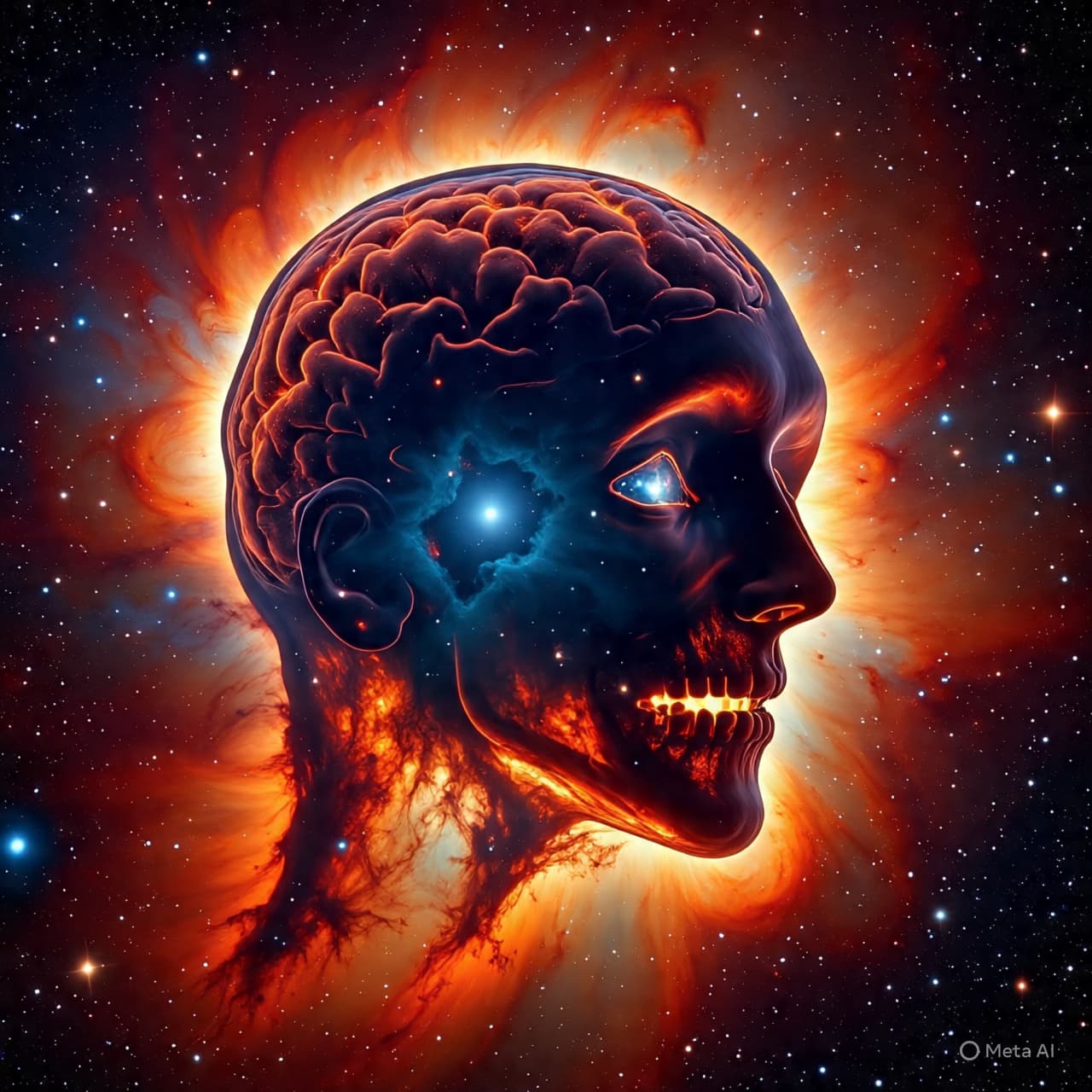
In the vast cosmic gallery, some images take hold not through spectacle alone but through quiet wonder — like a familiar shape glimpsed in an unfamiliar place. The Exposed Cranium Nebula, seen through the sensitive eye of NASA’s James Webb Space Telescope, evokes not just beauty but a sense of connection between human imagination and stellar processes. Drift through space long enough, and shapes begin to speak to us: a cloud of dust and gas resembles a transparent skull, its dusty structures hinting at an exposed brain. Such poetic echoes remind us that the universe, in its grandeur, still whispers in forms we recognize and ponder.
This unusual nebula, officially catalogued as PMR 1, lies in the constellation Vela, thousands of light‑years away. What Webb’s instruments reveal is more than cosmic art — it is a snapshot of a star in its final breaths, shedding layers of material in the twilight of its life. The nebula’s gas and dust combine into broad, softly glowing regions, articulated by dark lanes that trace subtle structures between bright lobes. When seen in different infrared wavelengths, these clouds divulge their hidden depth: stars and even distant galaxies pierce through the thinner regions, while thicker filaments seem almost solid against the blackness of space.
The Near‑Infrared Camera (NIRCam) and Mid‑Infrared Instrument (MIRI) aboard Webb paint distinct but complementary pictures. NIRCam’s sensitivity brings to light countless background stars, creating a celestial tapestry behind the nebula’s own forms. MIRI, attuned to cooler and dustier regions, lights up the glowing shrouds that the dying star once expelled, revealing their layered history like rings in an old tree trunk. This interplay of instruments is akin to seeing a sculpture from two angles at once, each perspective adding texture to the narrative of cosmic evolution.
The patterns we now see were first hinted at by NASA’s retired Spitzer Space Telescope more than a decade ago, but Webb’s sharper resolution deepens the view. The nebula’s central star — entering its end stage — directs twin jets of material outward, carving the gas into lobes that suggest both symmetry and eruption, life and decay woven together in a quiet cosmic dance. Whether this star will ultimately explode as a supernova or fade into a dense white dwarf depends on its mass, a detail still beyond our current grasp. What Webb has captured, however, is a moment in that inevitable transformation.
In gazing at this celestial “cranium,” astronomers and the rest of us are reminded of the deep cycles that govern stars and galaxies. These patterns of creation and dissipation, traced in dust and light across incomprehensible distances, feel unexpectedly intimate when a nebula’s shape reflects back a form we know so well.
Today’s images from NASA’s James Webb Space Telescope extend our understanding of how stars die and nebulae form, offering new detail on PMR 1’s layered structure and the processes shaping it. Webb’s twin instruments continue to enrich our view of stellar evolution, bringing distant cosmic phenomena into focus with unprecedented clarity. As researchers study these views, each nuance contributes to a broader story of how the elements of our universe are born, live, and fade — a story written in gas and dust across the endless canvas of space.
AI Image Disclaimer (Rotated Wording) Visuals are created with AI tools and are not real photographs, intended for representation only.
Sources NASA Space Telescope Science Institute (Newswise) European Space Agency (ESA/Webb) Mirage News NASA image releases and mission feeds
Published by Banx Network. This article is part of the Banx decentralized media programme, powered by the BXE token on the XRP Ledger.