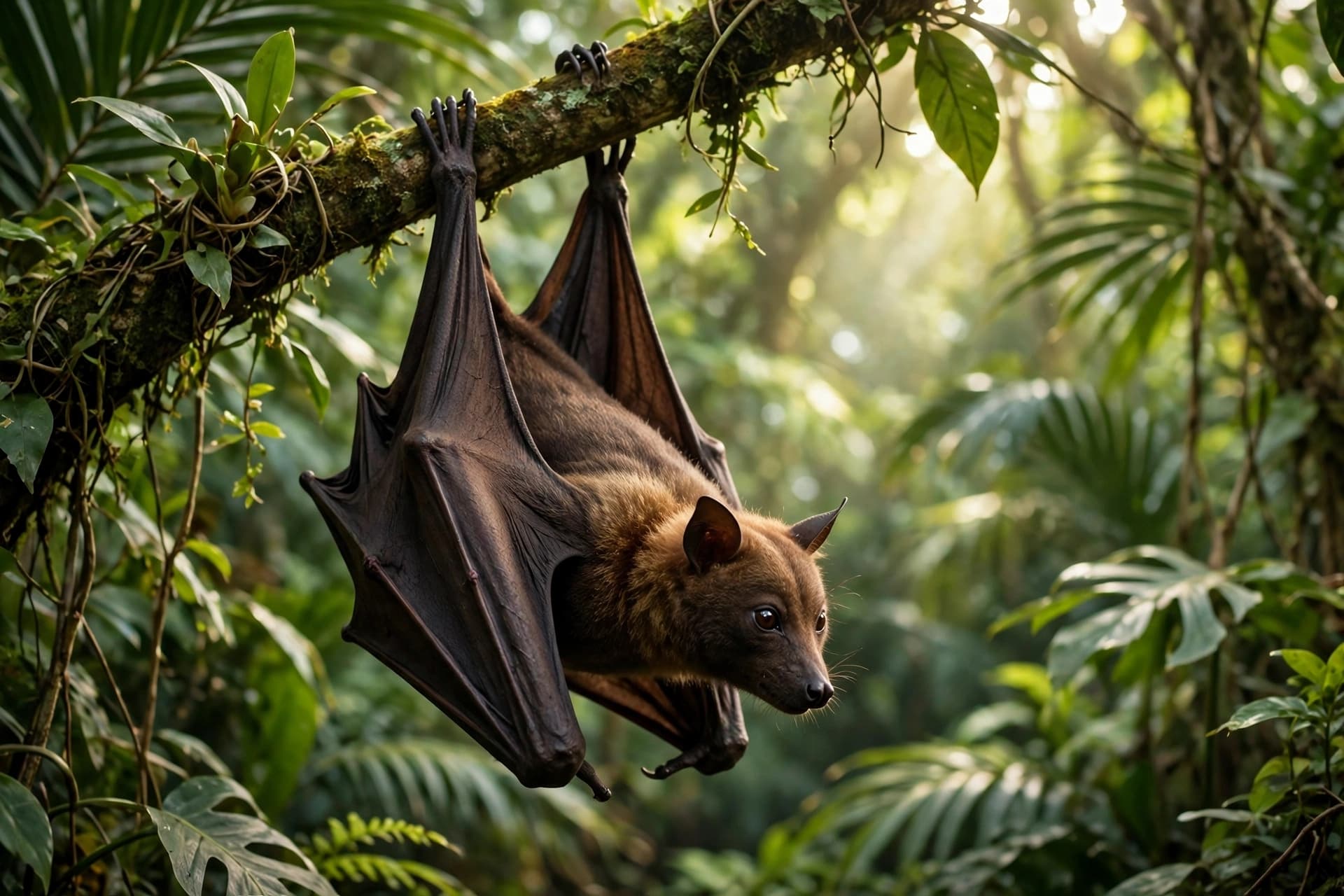
There is a particular sadness in watching something large become small, especially when the change is not natural but imposed. The Malagasy flying fox, a fruit bat with a wingspan that can reach a meter and a half, is one of the world's largest bats. It looks, as one researcher put it, like a German shepherd puppy with five-foot wings. But over the past four decades, these bats have been getting smaller, and a new study suggests that human hunting is the reason.
The discovery began with a comparison. Researchers at the Field Museum in Chicago noticed that preserved flying fox specimens in museum collections seemed larger than the bats they encountered during recent fieldwork in Madagascar. To test whether the difference was real, they measured 121 specimens from nine museums, collected over more than 150 years, logging twelve different features of the skull and teeth . The results were clear: bats collected before the 1980s had skulls about 6 percent longer, on average, than those collected after. The change was so stark that the lead author, Emily Cornelius Ruhs, initially thought there must be a mistake in the analysis .
The timing of the shrinkage lined up with a shift in human behavior. Before the 1980s, flying foxes in Madagascar were mostly hunted on a small scale, to feed a family or a small community. Around that time, people began selling bats at markets and restaurants. Commercial hunting took hold, and the largest bats—the ones that provided the most meat, the most "bang for your buck"—were the ones hunters targeted . If you are the biggest bat in the sky, you are also the easiest target.
The study establishes a correlation, not a definitive causation, and the researchers are careful to say so. Deforestation, climate change, and shifting fruit seasons could all be playing a role in the shrinking, Ruhs noted. But the pattern is difficult to ignore: the drop in size coincides with the commercialization of hunting, and the largest individuals were the ones being removed from the population . Many of the largest bats were also older individuals, which means hunters may be targeting mature, breeding-age animals, a loss that could affect the population's ability to recover.
The population itself has dwindled. There were an estimated 300,000 Malagasy flying foxes in the early 2000s; researchers estimate the number has dropped by two-thirds since then . The shrinking bodies may be a bellwether for a species under stress, a physical manifestation of pressure that has not yet driven the population to collapse but is pushing it in that direction. As one conservation biologist not involved in the study noted, species are adapted to their environments over thousands of years, and changes caused by human pressure may make them less able to respond to environmental, climate, or disease stresses .
For the people of Madagascar, the bats are not merely wildlife. They are a food source, a part of local diets and economies. The researchers acknowledge this, and they do not frame the solution as a simple ban. Instead, they suggest higher levels of protection, particularly at breeding sites, and a more managed approach to harvesting—one that recognizes the needs of the people who depend on the bats while also protecting the species from collapse . The question is not whether humans and flying foxes can coexist, but whether the terms of that coexistence can be renegotiated before the bats become too small, and too few, to matter.
The museum specimens, collected in the 1800s and 1900s, served as a kind of time capsule, a record of what the bats used to be. Without them, the change might have gone unnoticed, a slow diminishment absorbed into the background of a changing world. The study is a reminder that collections are not merely archives of the dead. They are baselines, against which the living can be measured.
Image note: The images in this article were created using artificial intelligence and do not depict the actual bats or museum specimens described.
Sources: Science News, Field Museum, Journal of Mammalogy, New York Post, EurekAlert
Published by Banx Network. This article is part of the Banx decentralized media programme, powered by the BXE token on the XRP Ledger.