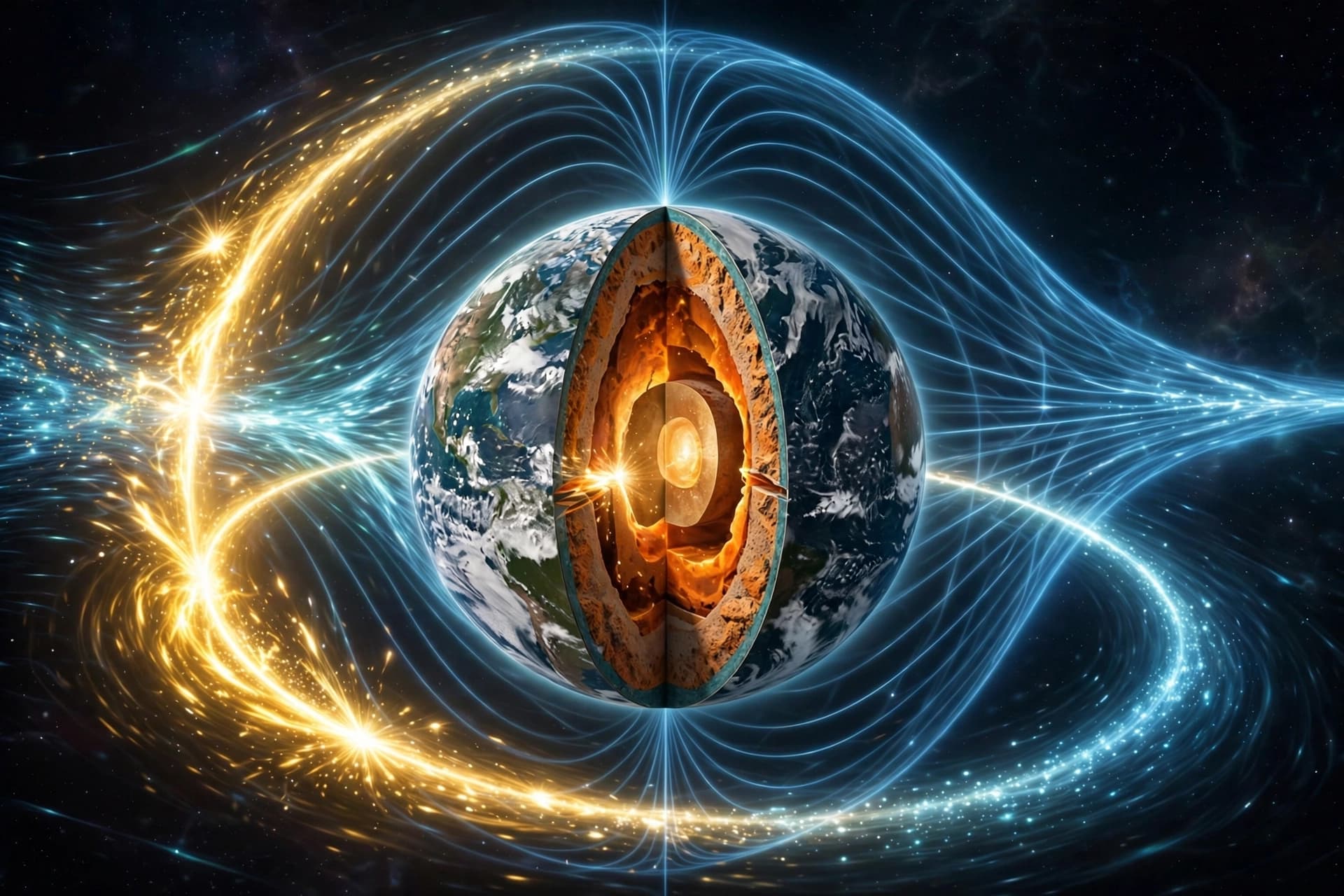
There is a particular comfort in the idea of a barrier, a boundary beyond which the most dangerous things cannot pass. For years, scientists believed that Earth's magnetic field contained such a boundary—an "impenetrable barrier" at the inner edge of the outer Van Allen radiation belt, roughly three Earth-radii from the planet's center, where ultra-relativistic electrons seemed to stop. The region inside was thought to be largely free of these particles, shielded by the complex dynamics of the magnetosphere. But in May 2024, a massive solar storm broke through, and the electrons that appeared inside the barrier were not merely passing through. They were being born there.
The event was the strongest geomagnetic storm in more than two decades. The Japanese satellite Arase, operated by JAXA, was perfectly positioned to observe what happened. It detected a large flux of high-energy electrons moving close to the speed of light, some with energies exceeding three megaelectronvolts—enough to penetrate some satellite shielding . The so-called impenetrable barrier had been breached, and the question was how.
Researchers at Nagoya University, led by Professor Yoshizumi Miyoshi, analyzed the data and found the answer. The electrons were not transported inward from the outer radiation belt, as one hypothesis suggested. They were accelerated locally, right there inside the barrier. The evidence came from a distinct peak in phase space density—a measure of how electrons are distributed by energy and motion—that developed near the barrier boundary and grew stronger over time. Such a growing peak is a signature of local acceleration, not inward transport .
The mechanism was a collaboration between two phenomena. The first was chorus waves, natural electromagnetic waves in Earth's magnetic field that, when converted to audio, sound like birdsong. These waves can transfer energy to electrons when their oscillations match the electrons' spiraling motion around magnetic field lines. The second was the state of the plasmasphere, the region of cool, dense plasma surrounding Earth. The solar storm had eroded the plasmasphere's outer boundary, pushing it unusually close to the planet and leaving the region around the barrier much less densely populated with plasma .
That low-density environment was crucial. Chorus waves can accelerate electrons more efficiently when the plasma is thin. And the plasmasphere did not recover quickly. Typically, it refills within about two days. During the May 2024 storm, it took approximately 4.3 to 4.7 days for the plasma density to return to more than half its pre-storm level in the observed region . That extended window allowed the chorus waves to keep accelerating electrons for days, creating a new population of high-energy particles where none were expected.
The findings, published in Geophysical Research Letters, have implications for space weather forecasting and satellite safety. The inner region of the magnetosphere was once considered relatively protected from extreme electron radiation. The May 2024 event showed that this assumption is not always true. During severe storms, even the barrier can become a source .
Miyoshi framed the discovery in terms of what it means for prediction. "This discovery highlights the need to understand and predict how energetic electrons behave under extreme space weather conditions," he said. "Such knowledge is important for assessing radiation risks to spacecraft and improving future space weather predictions" .
The barrier, it turns out, is not a wall. It is a dynamic boundary, shaped by the balance of forces around it, and that balance can be disrupted. The solar storm did not break the barrier in the sense of punching a hole through it. It changed the conditions that create the barrier in the first place, and in doing so, it turned a region of relative safety into a region of acceleration. The lesson is not that the barrier failed. It is that the barrier was never as simple as it seemed.
Image note: The visuals in this article were generated by artificial intelligence and do not represent actual satellite data or the Arase mission.
Sources: EurekAlert (Nagoya University), Scinexx, Geophysical Research Letters
Published by Banx Network. This article is part of the Banx decentralized media programme, powered by the BXE token on the XRP Ledger.