There is a story we tell about technology and work, and it goes something like this: the machines arrive, and the jobs disappear. It is a tidy story, easy to repeat, and it has the virtue of being sometimes true. But in the orchards of California and Washington, a different story has been unfolding—one in which the machines arrive, and the work changes shape, and the people who know the land remain indispensable.
Researchers at the University of California, Davis, spent three years studying sixteen fruit tree operations and conducting 165 in-depth interviews with workers and growers. Their conclusion, published in the journal New Technology, Work and Employment, challenges the assumption that automation simply replaces farm labor . What they found instead is that automation depends on human knowledge—place-based, experiential, often unspoken—to function in the messy reality of a working orchard.
Consider the yield-counting technology. A tractor can drive down rows, scan trees with a camera, and count buds to forecast how much fruit will come. But the technology tended to overestimate. One farm manager with over a decade of experience adjusted the camera's counts down by 14 percent based on his knowledge of how particular blocks had performed in the past and what recent weather had done to them. His estimates were more accurate than the cameras' .
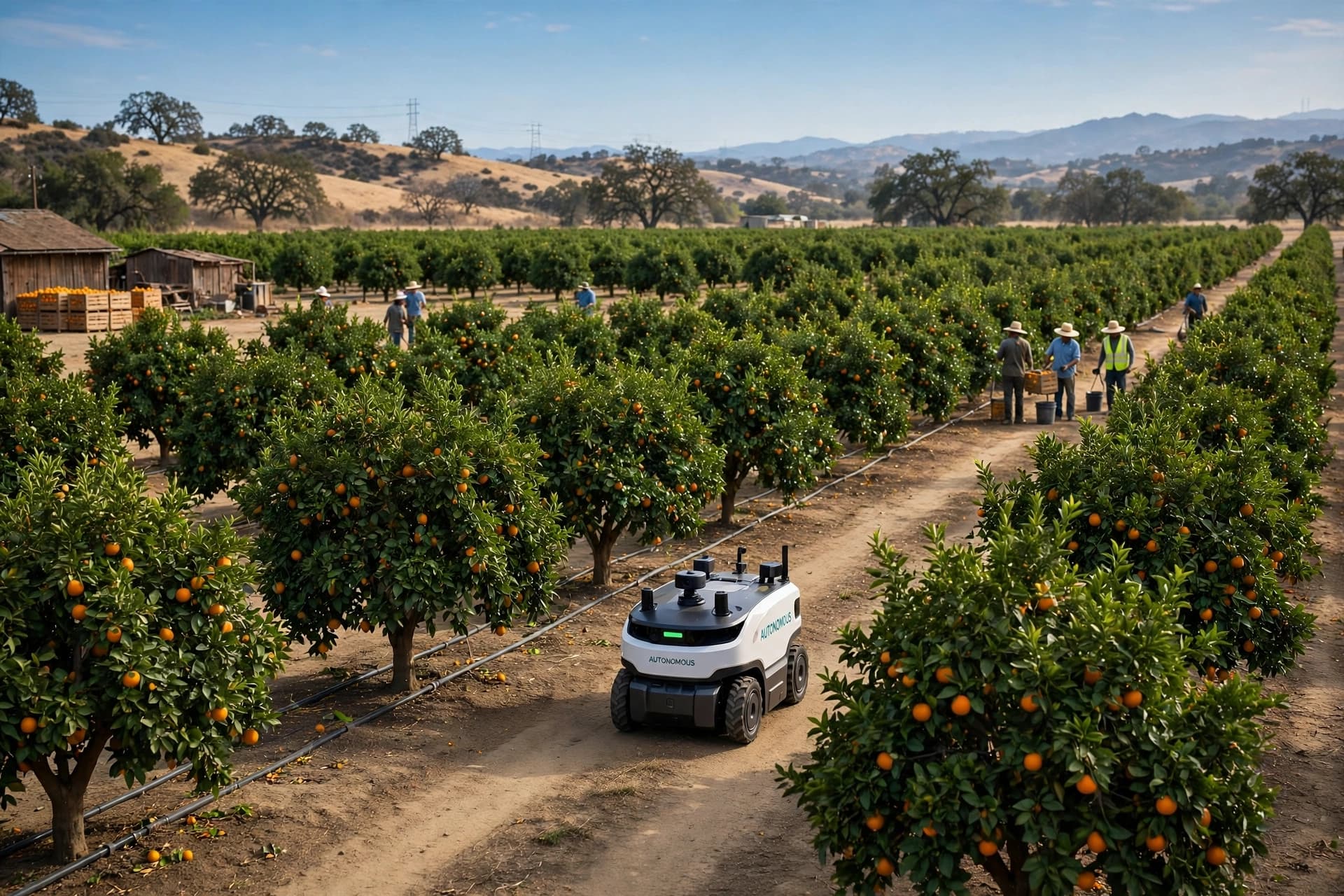
Autonomous harvesters present a similar picture. Many prototypes struggle to match the knowledge required to pick fruit properly—knowing which fruit is ready, how to handle it without bruising, when to leave it for another day. Even as the technology improves, growers and workers interviewed for the study believed humans would still be needed to integrate machines into the production system and work alongside them .
The study also examined how automation is implemented, and found that the process matters as much as the technology. Farms that positioned workers as co-designers in the integration process experienced smoother adoption. At one Washington operation, a committee that included workers and crew leaders piloted three platform models before purchasing. The workers rejected the model management preferred, choosing one with better sightlines and ease of use. The result was a sense of ownership and worker-driven innovations that increased productivity . At a California operation, a lack of consultation led to the eventual abandonment of a platform system because the machines could not navigate the orchard spacing—a problem workers had identified but management ignored .
What emerges from this research is a more nuanced understanding of what automation does to work. It displaces some tasks—heavy lifting, ladder work, repetitive counting—while creating others: supervising machines, troubleshooting software, interpreting data. The transition is not neutral. At one operation, the shift to platforms was managed over three seasons through attrition, with remaining workers moving into higher-paid platform jobs earning 15 to 25 percent more . But the researchers note that such outcomes depend on how farms choose to implement the technology, and that the most precarious workers may bear the costs if implementation is handled poorly.
The story of farm automation, then, is not a story of disappearance. It is a story of negotiation—between what machines can do and what people know, between the efficiencies of technology and the embedded wisdom of those who have worked the land for years. The farm of the future is being negotiated today, in orchards where the cameras are learning to see and the people are learning to work with them.
This article includes AI-generated images for illustrative purposes.
Sources: UC Davis College of Agricultural and Environmental Sciences, New Technology, Work and Employment
Published by Banx Network. This article is part of the Banx decentralized media programme, powered by the BXE token on the XRP Ledger.