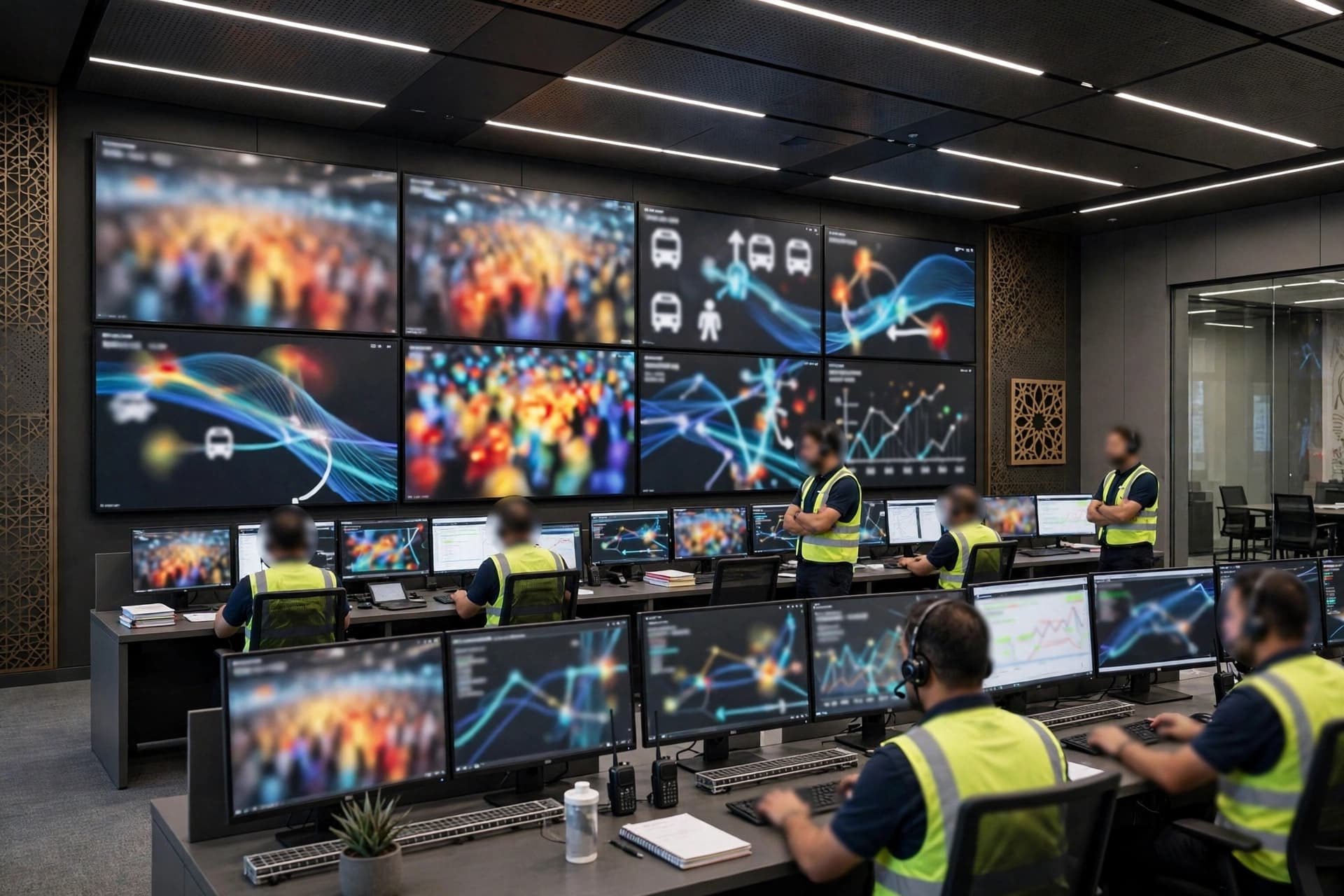
Every large gathering depends on a delicate balance between movement and stillness. People arrive from different countries, follow different schedules, and navigate places that carry deep personal meaning. During pilgrimage in Saudi Arabia, those movements unfold on an extraordinary scale, requiring transportation, medical services, accommodation, and clear guidance to work together. Digital tools are increasingly being used to help coordinate that complexity.
On September 6, 2026, Saudi Arabia's Ministry of Hajj and Umrah described its expanded use of artificial intelligence and data analytics to improve services for Hajj pilgrims and Umrah performers. The ministry said the technology supports planning, decision-making, crowd management, and transport operations, as part of the country's wider Pilgrim Experience Program.
One area of focus is the analysis of movement patterns. By examining data about arrivals, departures, lengths of stay, and visitor demand, planners can prepare for periods when services are likely to be under greater pressure. Predictive analysis may help officials anticipate busy intervals and coordinate staffing or transport arrangements in advance. These forecasts are planning tools, however, rather than guarantees of how people will move on a particular day.
The ministry also reported using algorithms to analyze crowd flows and predict peak periods. It uses data about bus movements to help optimize transport routes between holy sites. These applications address a practical challenge: a delay in one part of the transport network can affect other journeys, especially when many visitors need to move within limited time windows.
For pilgrims seeking information directly, the ministry highlighted Nusuk AI, a service designed to answer questions and provide guidance about Hajj, Umrah, and visits. According to the ministry, the service supports more than 180 languages and includes voice interaction. It reported that Nusuk AI had been used by more than two million users since launch, including 393,000 users during the month before the September announcement.
Another service, Digital Mutawwif, operates through the Nusuk application. The ministry said the AI-powered companion uses location and movement context to help users navigate their journey, find suitable routes, and receive guidance relevant to different stages of the rituals. It can also assist with counting circuits during Tawaf and Sa'i. The ministry reported more than two million uses in one month by over 1.4 million beneficiaries.
The technology operates alongside a wider system of human support and public services. Digital guidance cannot replace emergency assistance, official instructions, or the judgment of personnel responding to changing conditions. Its usefulness depends on the accuracy of location information, the clarity of recommendations, and the ability of visitors to access the service when they need it.
Language accessibility is another important consideration. Pilgrims arrive with different linguistic backgrounds, levels of digital confidence, and familiarity with the sites they are visiting. Multilingual and voice-enabled services can help reduce some communication barriers, but information must still be accurate, easy to understand, and available through reliable devices and networks.
The ministry said Nusuk AI had received the AI Ethics Seal from the Saudi Data and Artificial Intelligence Authority. That recognition reflects an emphasis on responsible technology use, although the practical performance of any service still depends on its implementation, maintenance, and ongoing oversight.
Saudi Arabia's approach demonstrates how AI can be applied to the organization of large-scale public services rather than simply used as a conversational tool. The systems described by the ministry are intended to support planning, transport, navigation, and information access. Their broader value will depend on whether they make journeys safer, clearer, and easier to manage for people arriving from around the world.
On September 6, 2026, the Ministry of Hajj and Umrah reported expanded use of AI for crowd-flow analysis, transport planning, and pilgrim guidance. It also cited usage figures for Nusuk AI and Digital Mutawwif, two services intended to help visitors access information and navigate pilgrimage activities.
### Image Disclaimer
These AI-generated illustrations depict general pilgrimage support services and digital navigation concepts. They are not photographs of actual ministry systems, real pilgrims using specific applications, or official operational scenes.
### Sources
• Saudi Ministry of Hajj and Umrah
• Pilgrim Experience Program
• Saudi Data and Artificial Intelligence Authority
• Nusuk
Published by Banx Network. This article is part of the Banx decentralized media programme, powered by the BXE token on the XRP Ledger.