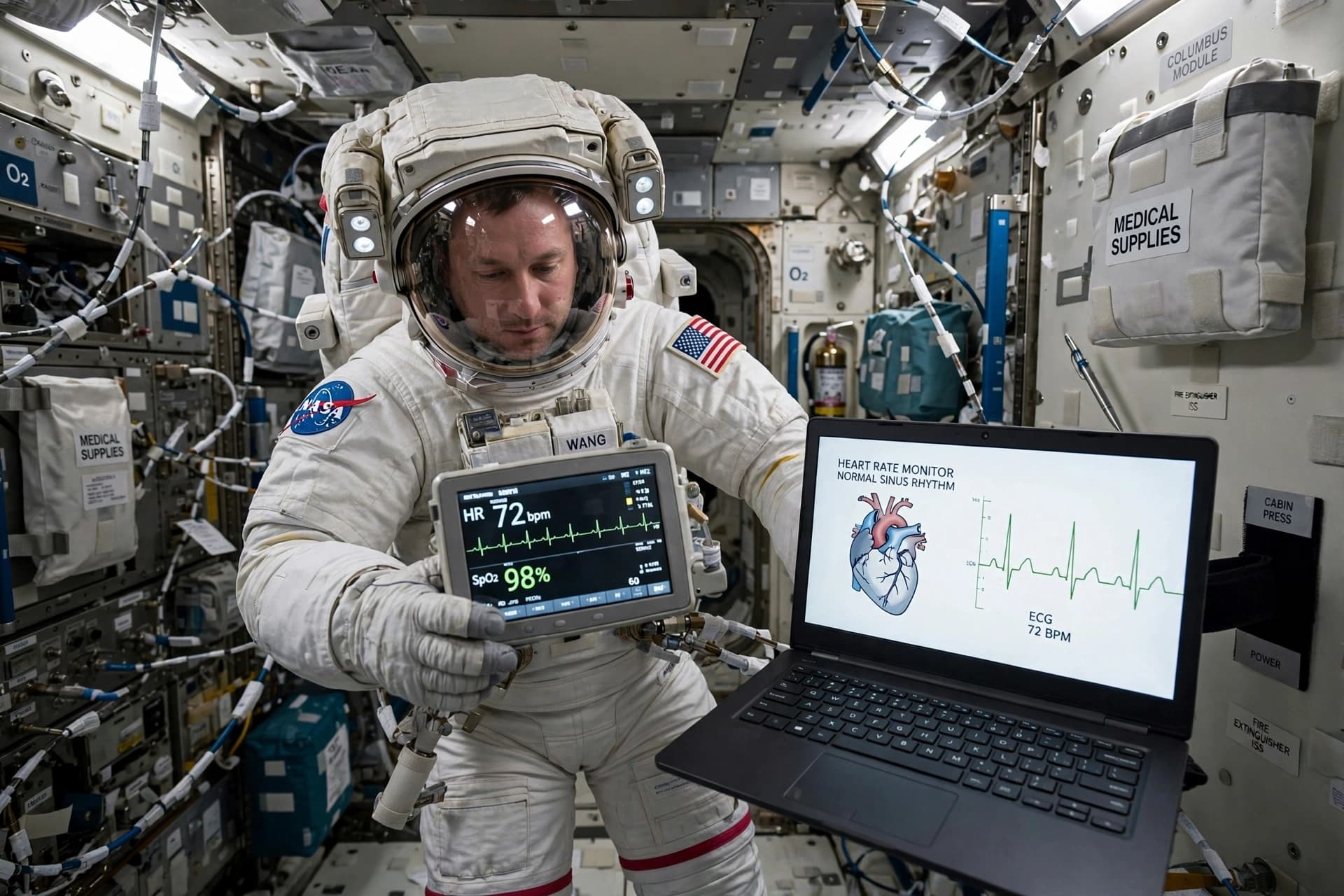
There is a particular kind of quiet that settles over a hospital room when a technician adjusts the ultrasound probe, watching a heart move in shadows of gray and white. For thirteen astronauts circling the Earth at seventeen thousand miles per hour, that same quiet was recreated every few weeks, not in a hospital, but in the weightless confines of the International Space Station. The question beneath those scans was never merely clinical. It was whether the human heart, that most faithful and forgetful of muscles, could remember how to bear weight after half a year of floating.
A new study published in the journal Circulation, led by researchers at Northwestern Medicine, UT Southwestern, and UTHealth Houston, offers a measured and hopeful answer. The team tracked the cardiac function of astronauts during roughly six-month missions aboard the space station, examining how their hearts adapted to microgravity and, crucially, whether they could withstand the gravitational pull of Mars upon arrival. Mars, after all, is not Earth. Its gravity is about one-third as strong, a middle ground that no human body has ever had to negotiate after prolonged spaceflight .
The findings suggest that intense exercise, sustained daily even in orbit, preserves the heart well enough to tolerate that transition. The astronauts followed NASA's Exercise Countermeasures program, working out for up to two hours a day with a blend of endurance and resistance training. Without such effort, the heart atrophies in weightlessness, becoming smaller and stiffer, much like any muscle denied its ordinary labor. Dr. James Thomas, the study's senior author, described the station environment plainly: one floats, gives a small tap against a wall, and glides across the module to greet a colleague .
What the echocardiograms revealed was a story of temporary adjustment rather than permanent harm. In the first two weeks of flight, the astronauts' hearts filled with less blood and pumped less with each beat. But as the mission progressed, those measures gradually returned toward preflight levels. The heart, it seems, is not brittle. It is patient, and with the right discipline, it remembers its rhythm .
The most telling test came after return. Researchers tilted the astronauts twenty-two degrees upward from a lying position, shifting blood toward the lower body to simulate Martian gravity. The astronauts' hearts handled the simulated environment as well as they had handled standing upright on Earth before launch. Dr. Benjamin Levine of UT Southwestern noted that the exercise countermeasures already in place appear sufficient to keep the heart in working order for Mars' gravitational loads .
There is something quietly moving in this. The same workouts that sustain heart health on Earth, the ones prescribed for patients with conditions that make standing difficult, are the ones that may carry human beings across the solar system. The study does not promise that Mars is easy. It suggests only that the body, given careful stewardship, may not be the obstacle we feared .
The research also carries implications closer to home. The exercise regimens studied have already shown benefits for people with postural orthostatic tachycardia syndrome and other conditions involving intolerance to gravity. What is learned in orbit, it turns out, does not stay in orbit. It returns, settles into clinical practice, and helps someone stand up in a kitchen on Earth without dizziness .
For now, the findings offer a measured reason for optimism as space agencies contemplate the long journey to the Red Planet. The heart, it appears, can be persuaded to tolerate another world, provided it is asked to work for the privilege. That is not a guarantee of safe passage, but it is a foundation upon which mission planners can build.
---
AI Image Disclaimer: The images accompanying this article are generated by artificial intelligence and are for illustrative purposes only.
Sources: Northwestern University / EurekAlert, UT Southwestern Medical Center, Circulation, ARY News
Published by Banx Network. This article is part of the Banx decentralized media programme, powered by the BXE token on the XRP Ledger.