There is a particular abstraction that has long governed the study of distant worlds—a necessary simplification, born of distance and dimness, in which planets become circles, atmospheres become uniform shells, and the messy, dynamic reality of weather is reduced to a single average. It is a compromise that has served science well, but it is a compromise nonetheless. And now, for the first time, it has been set aside.
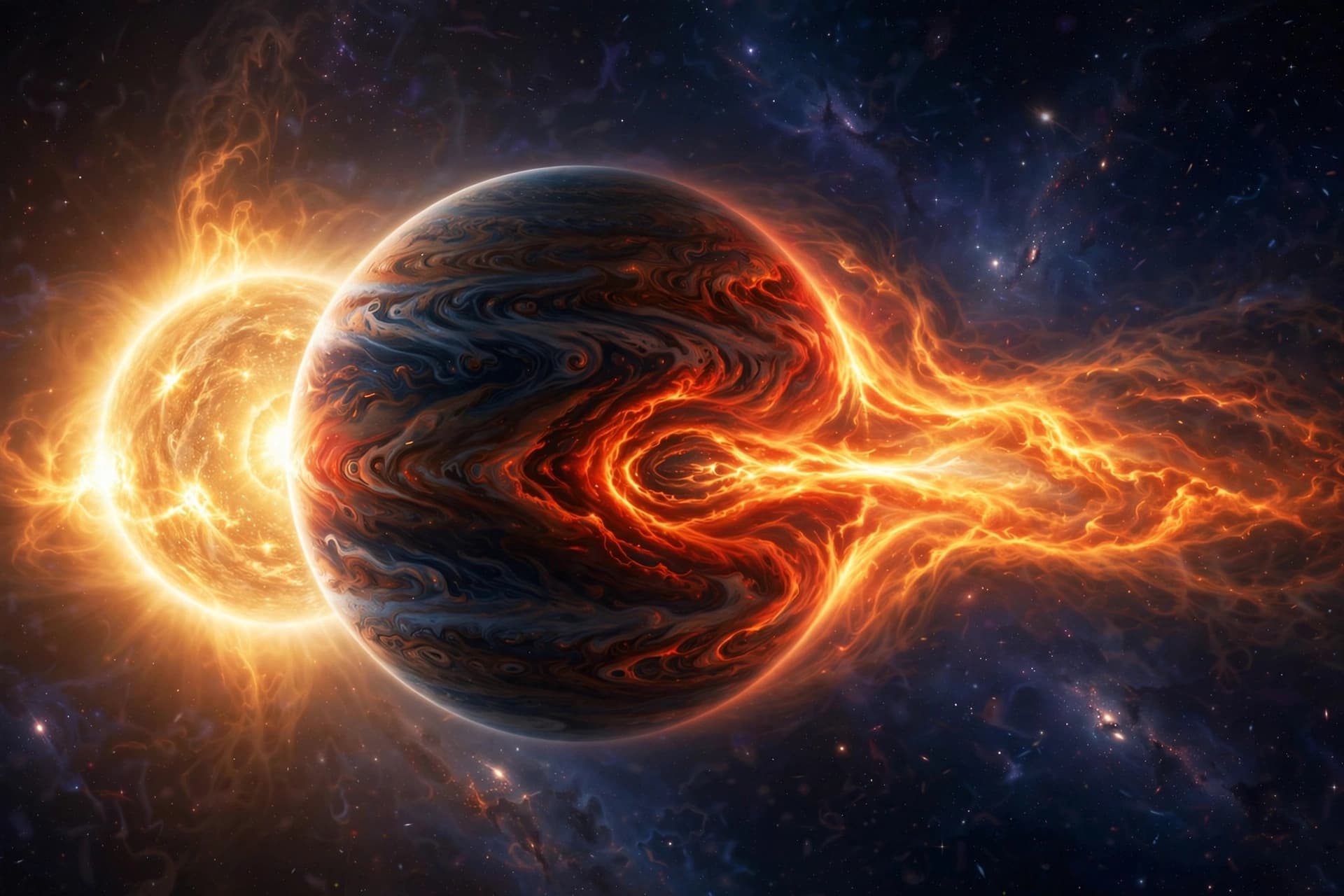
Using NASA's James Webb Space Telescope and a new mapping technique called "transmission strings," a Cornell-led international team has resolved the uneven contours of an exoplanet's atmosphere—not as a circle, but as a slightly egg-shaped form with one side more extended than the other . The planet is WASP-17b, a "hot Jupiter" orbiting a star more than 1,000 light years from Earth, and the finding represents one of the most comprehensive three-dimensional views of an exoplanet's atmosphere among the more than 6,000 confirmed to date .
The technique works by tracking the planet as it crosses in front of its star, capturing the composition of light around the edge of its atmosphere—the limb—from different angles. Traditional modeling extracts a spectrum only as an average across the entire limb, assuming a uniform radius . The new method, as lead author Lili Alderson described it, allows researchers to "go around the edge" and understand where on the ring the features lie .
What they found was a "gem" on the evening side of the planet's equator, where jets of wind transport heat from the permanently illuminated day side toward the permanently shadowed night side, inflating the atmosphere relative to the cooler morning side . The temperature difference between morning and evening matched theoretical predictions almost exactly. Water and carbon dioxide were found to be consistent around the limb, confirming that the planet's chemical composition is broadly uniform even as its shape is not .
The significance of this finding is not merely that WASP-17b is slightly egg-shaped. It is that the technique works—that the theoretical models, which have long predicted these dynamics, can now be tested against real observations. "This is proof of concept that planets are in fact 3D objects," Alderson said, "and that consistently, as they go around their star, what we predict should be happening is happening" . The gap between computational exercise and observational reality has been narrowed.
The path forward is now open for mapping more planets, differentiating conditions across latitudes and taking a first step toward mapping weather-scale patterns in exoplanet climates. The idealized circle, useful as it was, has served its purpose. What replaces it is something more complex and more true: a world with a shape, a weather system, and a dynamic atmosphere that can be observed not as a abstraction but as a place.
AI Image Disclaimer: This article includes AI-generated imagery created for illustrative purposes only.
Sources: Cornell Chronicle, IFLScience
Published by Banx Network. This article is part of the Banx decentralized media programme, powered by the BXE token on the XRP Ledger.