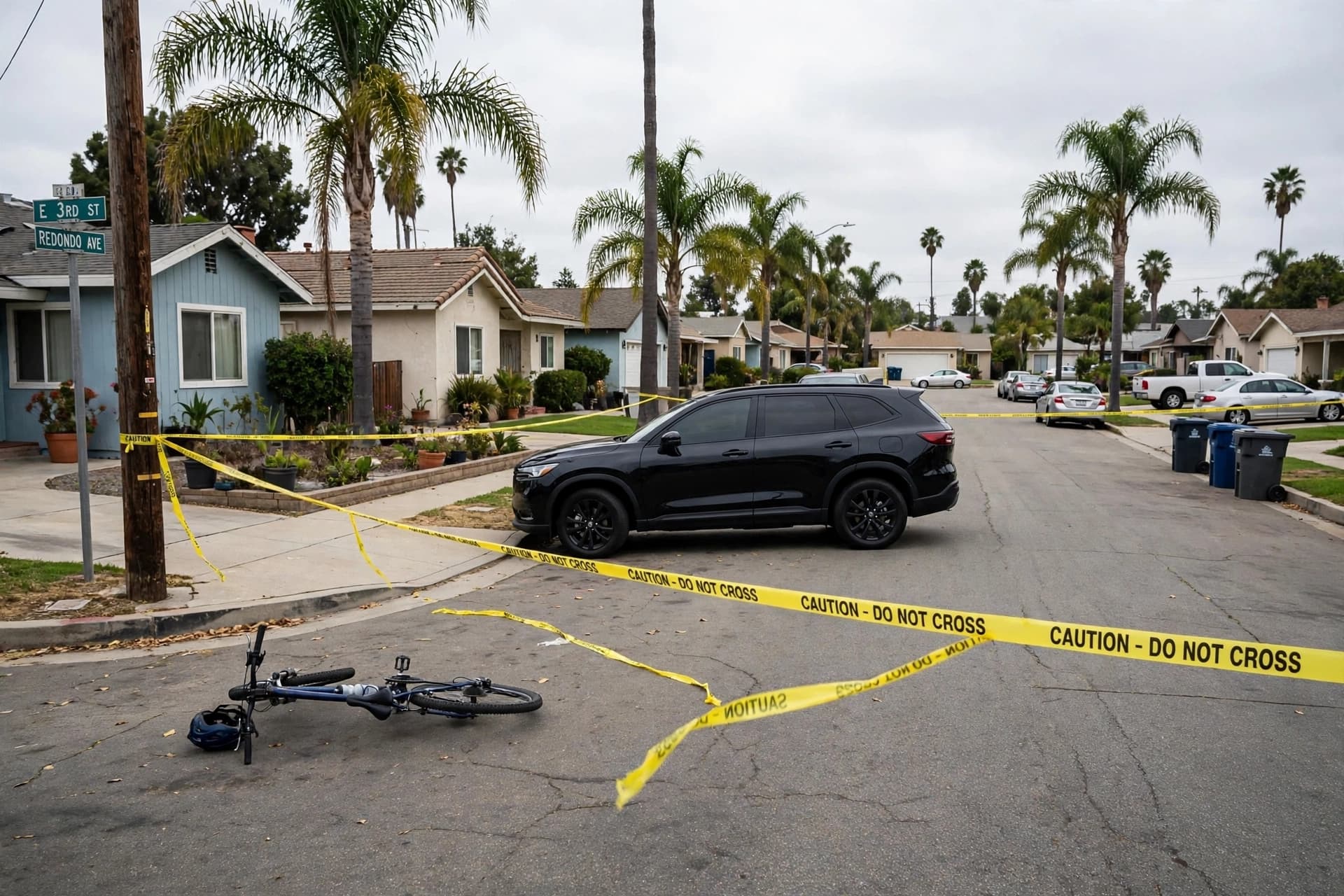
There is a particular weight that video carries when it arrives to contradict an official account, a weight that is not about truth itself but about the space between what is said and what is seen. In Long Beach, California, that space has become the subject of a federal investigation and a public argument. Immigration and Customs Enforcement has denied that its agents struck a bicyclist with a vehicle during an operation last week. Footage obtained by The New York Times shows an SUV driving the wrong way down a one-way street and swerving toward the oncoming cyclist . The man on the bike, Ricardo Gonzalez, is an American citizen. His daughter says he was struck, tased, and pinned to the ground. His arm, by his own account in the video, is broken.
The facts, as they have been reported, are these. On Saturday, October 17, ICE agents were conducting what the agency described as a targeted operation to arrest a "criminal illegal alien" in Long Beach. During the operation, agents encountered Gonzalez. ICE's account is that Gonzalez smashed the mirror of a government vehicle and was arrested; the agency said its officers used "the minimum amount of force" and that "ICE did NOT hit an individual on a bike" . The video, however, does not show the moments before the swerve. It shows the SUV turning toward the cyclist, an officer jumping out with a weapon drawn, and Gonzalez later on the ground, shouting that his arm is broken .
What makes the incident resonate beyond its immediate circumstances is the pattern it echoes. In January, the Trump administration described a U.S. citizen killed by an ICE agent in Minneapolis as having "weaponized her vehicle." Video later revealed no evidence that she had run over the agent. In another January shooting, video contradicted statements from the administration about what had occurred . Each of these cases follows a similar arc: an official account, a video that complicates it, and a public left to weigh the two. The accumulation of such cases does not prove that the account in Long Beach is false. It does establish a context in which skepticism is not cynicism but a reasonable response to a documented pattern.
Long Beach Mayor Rex Richardson has submitted a complaint to the Department of Homeland Security's Office of Inspector General, calling for an independent investigation into the agents' treatment of Gonzalez and the overall operation . Gonzalez had called 911 at one point, according to the mayor, though the details of how the altercation unfolded remain unclear. Gonzalez was taken to a hospital for his injuries. The Long Beach Police Department, which was not involved in immigration enforcement, said its officers were called for backup by ICE, which had reported that vehicles were being vandalized and that a person needed medical attention .
There is a question beneath the dispute that is not legal but human. Gonzalez is a city employee, according to the mayor, a man with a daughter who has spoken publicly about her father's injuries and a family that is now afraid. The video shows him on the ground, in pain, asking for help. Whatever the legal determination about the mirror and the vehicle and the force used, that image is now part of the record, and it will be weighed alongside the official statement that ICE did not hit him. The two accounts cannot both be entirely true, and the work of determining which is closer to the facts will fall to investigators who have not yet reported their findings.
---
Image Disclaimer: The visuals in this article are generated by artificial intelligence and are not actual photographs of the incident or the individuals involved.
Sources: The New York Times, The Seattle Times, Univision, La Opinión
Published by Banx Network. This article is part of the Banx decentralized media programme, powered by the BXE token on the XRP Ledger.