In the soft dusk of human understanding, where questions stretch longer than answers, comes a gentle ripple in our picture of the cosmos a suggestion that space might hold a property more akin to liquid than emptiness. Just as a painter’s brush lingers differently on smooth canvas versus textured cloth, so too might the universe behave in ways that reflect a subtle, unseen resistance.
For decades, the Lambda-CDM model has reigned in cosmology, a framework as elegant and steady as a waltz in three-quarters time. It assumes that dark energy a mysterious, uniform force drives the accelerating expansion of the universe, and that space itself is inert and passive. Yet the latest observations from instruments like the Dark Energy Spectroscopic Instrument show hints of a mismatch, as if the melody of expansion we thought we knew has a deferred beat.
In response, some researchers have offered a thoughtful twist: perhaps space isn’t an empty backdrop but a medium with a property called bulk viscosity. In everyday life, viscosity is the measure of a fluid’s resistance to flow the difference between water gushing from a faucet, and honey slowly oozing from its jar. In this view, space itself might possess a slight, ghostly resistance that gently slows the cosmic stretch, a drag that might help reconcile observations with theory.
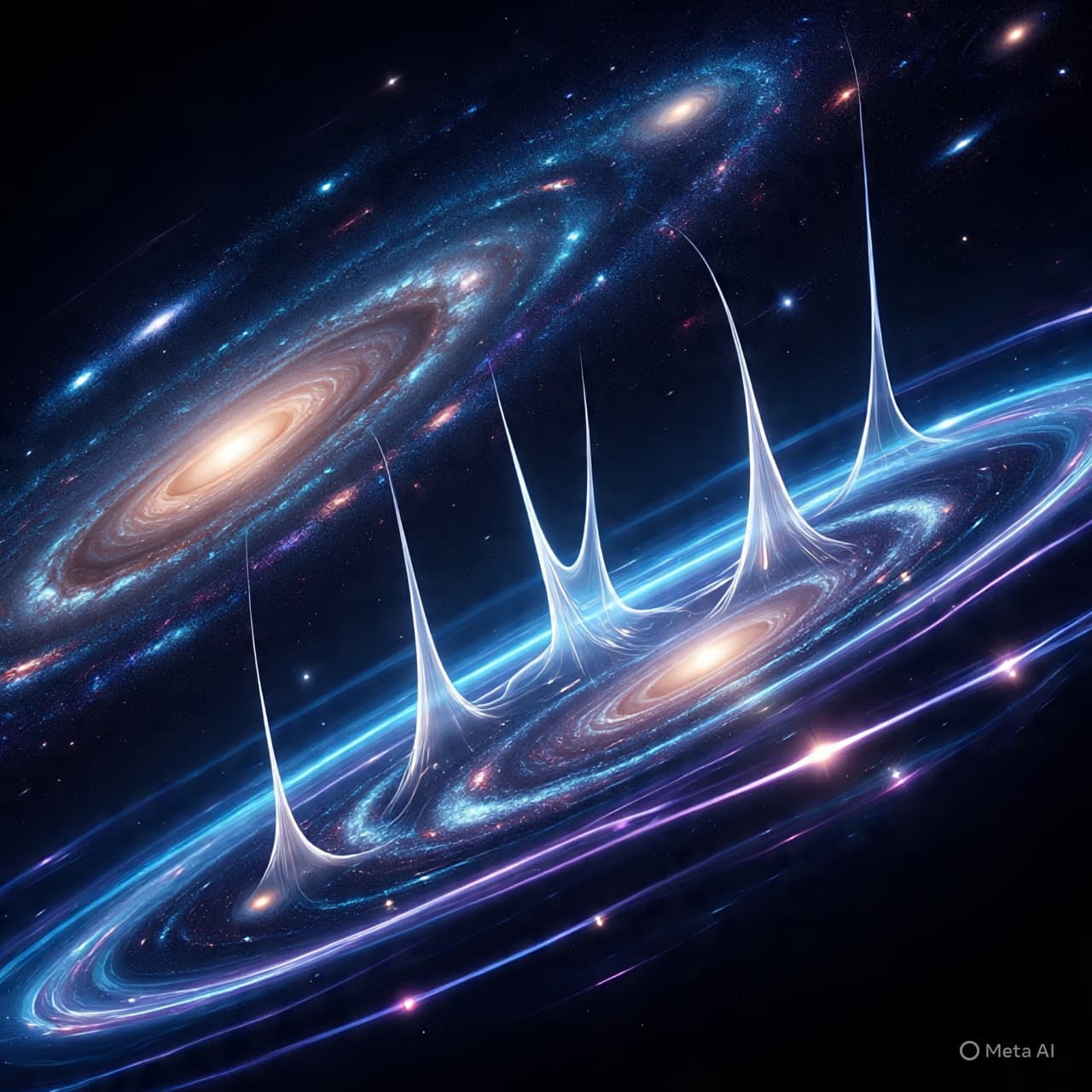
This idea is not a declaration of cosmic certainty, but an invitation to imagine space as more than a silent stage. Theoretical constructs like spatial “phonons” not particles in the conventional sense, but ripples or vibrations of the vacuum emerge in this framework, carrying with them a whisper of resistance that could shape how the vast cosmic tapestry expands.
Meanwhile, other scientists explore alternative ways to understand what pushes the universe apart. Some recent studies propose that our universe isn’t smoothly expanding into uniform nothingness, but rather unfolding in a “lumpy” pattern that doesn’t require dark energy at all. Still others look at exotic theoretical fluids like unparticles that behave very differently from familiar matter and energy.
These lines of inquiry, taken together, reflect a quiet humility at the edge of scientific knowledge. They suggest that our cosmological models are not broken so much as incomplete like an impressionist painting that captures broad strokes well, yet leaves finer details blurred.
In this gentle unfolding, researchers do not yet claim to have rewritten the cosmic score. The sticky-space hypothesis resides in preprint and early analysis, waiting for further observations and careful peer review. What it does offer, however, is a reflective moment: a chance to consider that the universe might be less like a cold vacuum and more like a living sea, whose subtle currents shape the voyage of galaxies across the eons.
AI Image Disclaimer (Rotated Wording) Visuals are created with AI tools and are not real photographs.
Sources Live Science, ScienceDaily, Space.com, Live Science Cosmology section, Live Science DESI coverage.
Published by Banx Network. This article is part of the Banx decentralized media programme, powered by the BXE token on the XRP Ledger.