There is a particular poignancy in a return to Earth after months in orbit—a return that is not simply a landing but a reentry into gravity, into the weight of the body, into the world of weather and ground and the familiar pull of home. On Tuesday, three astronauts—a Frenchman, an American, and a Russian—climbed into their Soyuz spacecraft, undocked from the International Space Station, and began the long fall back to Earth. They had spent eight months in orbit, conducting experiments, maintaining the station, and living in a place that most humans will never see. And now, they were coming home.
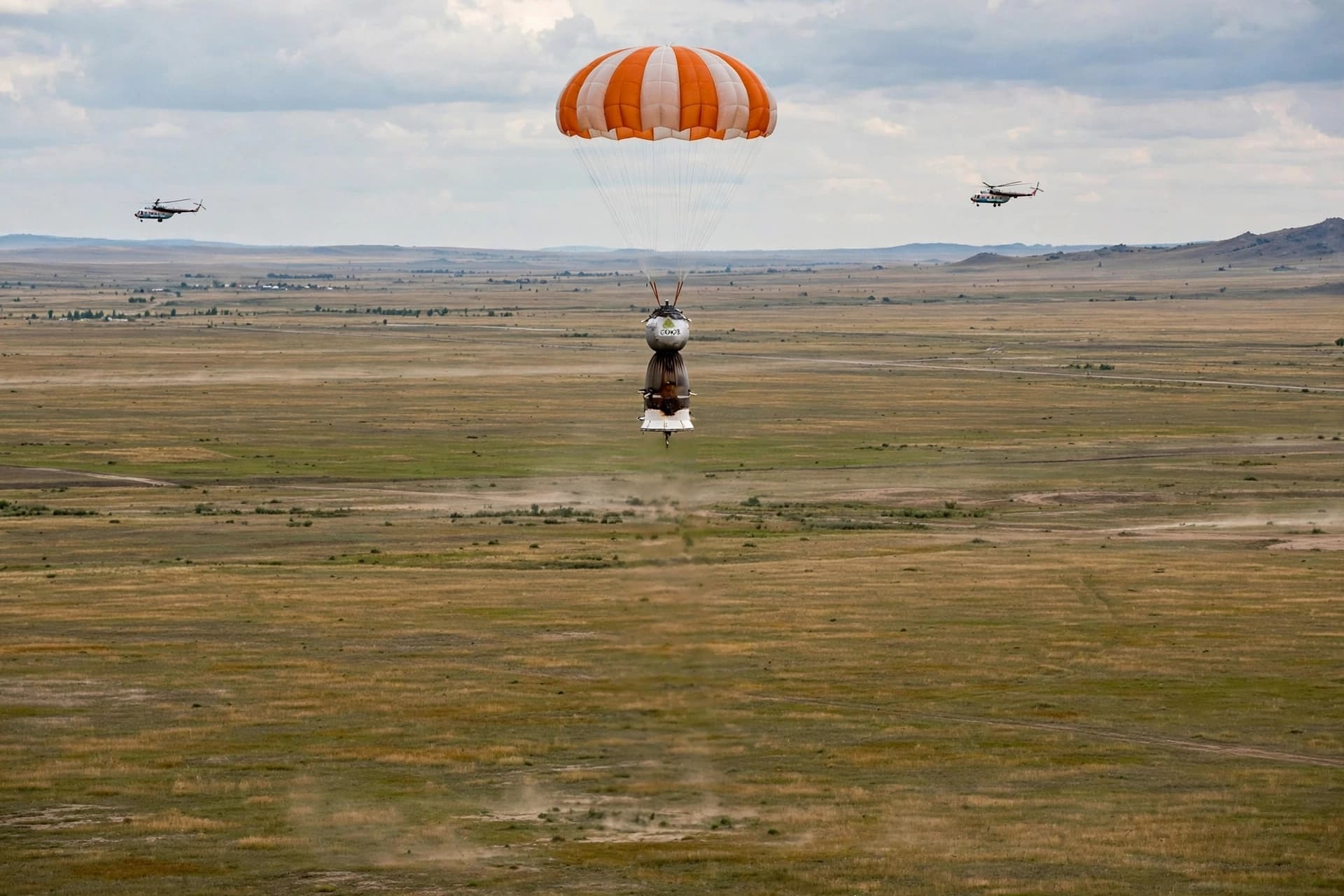
The crew—French astronaut Thomas Pesquet, American astronaut Shane Kimbrough, and Russian cosmonaut Oleg Novitskiy—landed safely on the steppes of Kazakhstan, their capsule descending under a parachute before touching down in the early morning hours. Recovery teams were on hand to extract them from the capsule and carry them to waiting chairs, where they would begin the slow process of readjusting to gravity. They smiled, waved, and gave thumbs up. After eight months, they were back on solid ground.
The mission was notable for its scientific output. Pesquet, on his second long-duration flight, conducted more than 200 experiments, including studies on the effects of microgravity on the human body, plant growth in space, and the behavior of fluids in zero gravity. Kimbrough, a veteran of multiple spaceflights, performed spacewalks to upgrade the station's power systems. Novitskiy, a cosmonaut with decades of experience, oversaw the Russian segment and contributed to experiments on materials science and Earth observation. Together, they represented the continuing cooperation between nations in space—a cooperation that has persisted through geopolitical tensions and that remains one of the most enduring examples of international partnership.
For the astronauts, the return is a transition not just from orbit to Earth but from one way of life to another. In space, they floated, slept in bags attached to walls, and saw the Earth as a blue sphere below them. On Earth, they will feel the weight of their own bodies, the pull of muscles long unused, the disorientation of gravity. The recovery period lasts weeks, and the readjustment can be difficult. But the return is also a homecoming—a chance to see family, to walk in a garden, to feel the sun on their faces. The space station continues without them. A new crew has already arrived. But for these three, the journey is complete.
The landing was a reminder that human spaceflight remains a remarkable thing—a thing that requires the cooperation of nations, the skill of engineers, the courage of astronauts, and the patience of families who wait. The crew is back. The data they collected will be analyzed for years. And the space station, orbiting above us, continues to carry the hopes and the work of those who follow. The astronauts have returned. The work goes on.
AI Image Disclaimer: The visual elements in this article were created using AI generation tools and are intended for illustrative purposes only.
Sources: NASA, European Space Agency, Roscosmos, Reuters
Published by Banx Network. This article is part of the Banx decentralized media programme, powered by the BXE token on the XRP Ledger.