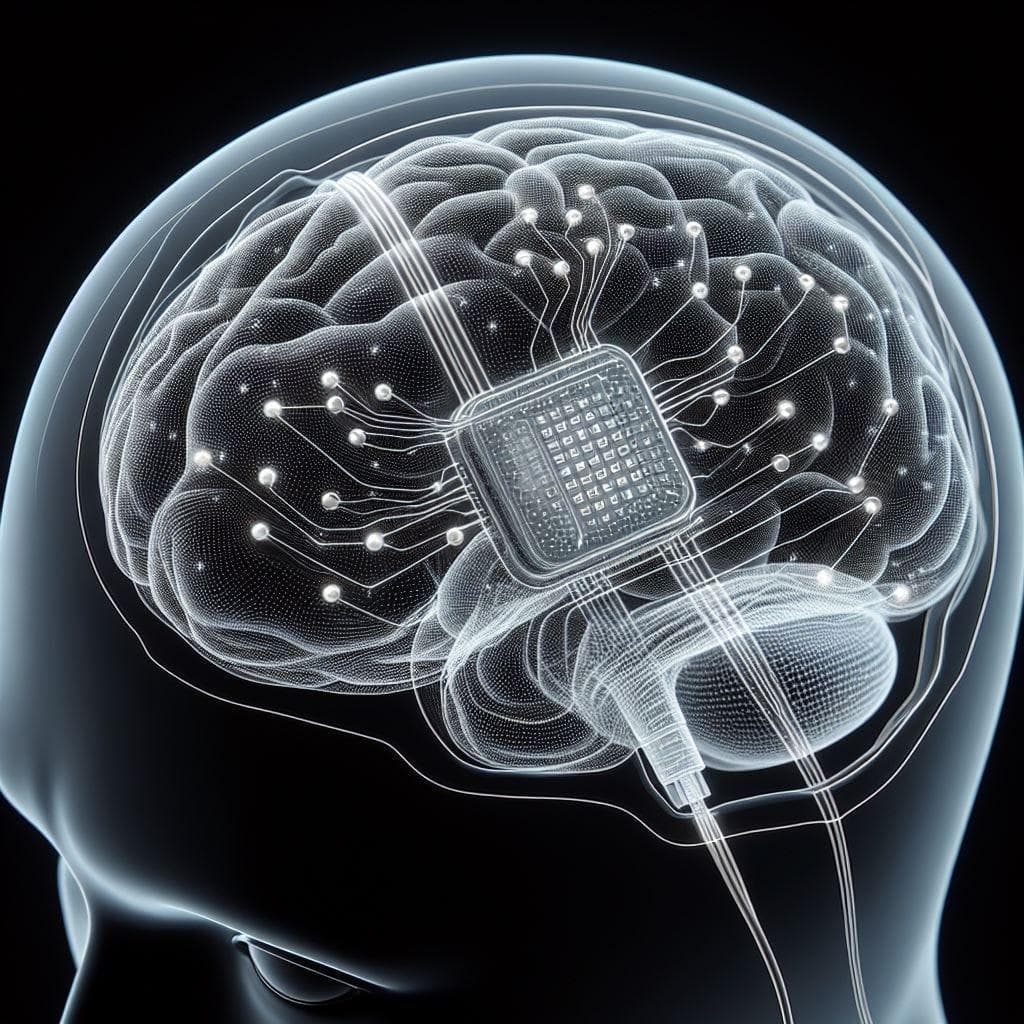
1. When the Human Brain Meets the Machine
For decades, humans have communicated with computers through keyboards, touchscreens, microphones and other physical interfaces.
Every interaction requires some form of movement: typing a sentence, moving a mouse, speaking a command or touching a screen.
Brain-computer interfaces could fundamentally change this relationship.
Instead of relying exclusively on conventional input methods, a BCI records signals associated with brain activity and uses computational systems to translate them into commands for an external device.
Depending on the system, those commands could control a computer cursor, generate speech, move a robotic limb or operate a communication interface.
The potential is particularly significant for people who have lost the ability to speak or move because of neurological injury or disease.
For these individuals, a brain-computer interface could provide a new way to interact with the world without depending on the muscles that can no longer reliably carry out their intentions.
Research is also exploring whether neural interfaces could eventually support applications beyond medical rehabilitation.
However, there is an important distinction between what researchers have demonstrated and what remains speculative.
Today's systems can decode particular patterns of brain activity under defined conditions. They cannot simply read every thought, memory or emotion from anyone's brain.
The technology is advancing, but the human brain remains extraordinarily complex.
The revolution is not about turning people into machines. It is about developing a new communication channel between biological intelligence and digital technology.
2. What Exactly Is a Brain-Computer Interface?
A brain-computer interface is a system that establishes a direct communication pathway between brain activity and an external device.
Most systems follow a sequence of operations.
First, sensors collect signals associated with neural activity. These signals may be electrical measurements from electrodes or other physiological measurements related to brain function.
Second, software processes the signals to identify patterns associated with a particular task.
Third, a decoding algorithm translates those patterns into commands.
Finally, the computer or connected device performs the requested action.
For example, a person might attempt to move a hand. The system identifies patterns associated with the intended movement and uses them to control a cursor or robotic hand.
Speech-focused systems work differently. They analyse neural signals associated with speech production and use trained algorithms to predict the words or sounds the person is attempting to produce.
The device is not necessarily interpreting fully formed thoughts. Many systems depend on the user attempting to speak, move or perform another specific task.
This distinction matters because neural activity is complex, variable and dependent on context.
A successful BCI must distinguish useful signals from background activity and translate them into commands accurately enough to be practical.
Machine learning helps researchers identify patterns that would be difficult to interpret using conventional programming alone.
The result is an interface that can learn to recognise aspects of an individual's neural activity and translate them into useful digital output.
3. The Two Main Approaches: Invasive and Non-Invasive Technology
Brain-computer interfaces generally fall into two broad categories: systems that require implanted electrodes and systems that collect signals without surgery.
Invasive brain-computer interfaces
These systems use electrodes implanted in or placed directly on brain tissue.
Because the sensors are close to the neurons generating the signals, they can collect detailed information about particular patterns of neural activity.
This can make them useful for complex applications, including decoding intended speech and controlling robotic devices.
However, implantation requires surgery and introduces risks such as infection, bleeding, tissue damage and complications associated with long-term device use.
Researchers must also consider how electrodes and surrounding tissue behave over time.
Non-invasive brain-computer interfaces
These systems collect signals from outside the skull, often using electroencephalography (EEG), which measures electrical activity through electrodes placed on the scalp.
They avoid brain surgery and can be more accessible for research and certain consumer applications.
However, the skull and other tissues weaken and distort the signals researchers are trying to measure. This generally makes it more difficult to isolate detailed neural activity.
Some non-invasive approaches investigate alternative methods, including magnetic measurements, functional imaging or ultrasound-based techniques.
Each method has different trade-offs involving signal quality, cost, portability, safety and speed.
There is no single technology that is best for every application.
For someone who needs an implant to restore communication after severe paralysis, the benefits of a highly detailed neural interface might justify the surgical risks.
For someone interested in controlling a simple computer application, a non-invasive system may be more appropriate.
The future of BCIs will probably involve multiple technologies rather than one universal device. [1]
4. Restoring Speech: Giving People Their Voices Back
One of the most powerful applications of brain-computer interfaces is restoring communication to people who can no longer speak.
Conditions such as stroke, amyotrophic lateral sclerosis (ALS) and certain neurological injuries can disrupt the pathways between the brain and the muscles responsible for speech.
A person's ability to think and understand language may remain intact even when they can no longer reliably communicate through speech.
Conventional assistive technologies can help, but some depend on eye movements, small physical movements or slow selection processes.
BCIs offer another possibility.
In a study reported by the US National Institutes of Health in April 2025, researchers demonstrated a brain-to-voice system that translated a participant's attempted speech into audible words.
The participant was a woman who had been unable to speak following a stroke. Her system used implanted electrodes and a deep-learning model to decode neural activity into speech.
The researchers reported decoding rates of up to 90.9 words per minute for a restricted vocabulary of 50 words, and 47.5 words per minute for a larger vocabulary. The system also generated speech in small increments, helping reduce the delay between the participant's attempted speech and the audible output. [2]
These findings demonstrated how machine learning could make neural communication more natural.
Instead of painstakingly selecting individual letters, a person could potentially express complete sentences through a synthesised voice.
The researchers also explored using a recording of the participant's voice from before her stroke, helping the system generate speech that sounded more personal.
This is important because communication is not simply about transferring information.
A person's voice carries elements of their identity, personality and relationships.
Restoring even part of that ability could make a profound difference to someone who has spent years unable to speak.
The technology remains experimental, and results from individual participants cannot automatically be generalised to everyone with paralysis. Nevertheless, the research demonstrates a promising direction for assistive medicine.
5. The 2026 Breakthrough: Restoring Speech and Body Language Together
Human communication involves much more than words.
People gesture, move their faces, raise their eyebrows, nod, wave and use other movements to convey meaning.
These non-verbal signals can communicate emotion, emphasis, agreement and intention.
A brain-computer interface that produces speech but cannot capture any of these other elements may restore some communication while still leaving important aspects of expression unavailable.
In September 2026, researchers reported a significant advance in this area.
A team led by scientists at the University of California, San Francisco, demonstrated a BCI that could decode speech-related activity and upper-body gestures simultaneously in three participants with paralysis. The results were published in Nature Neuroscience. [3]
The system used an implanted electrode array to record neural activity and machine-learning algorithms to translate the signals into digital output.
The resulting commands controlled a personalised virtual avatar, allowing the researchers to explore how a person's intended speech and gestures could be represented together.
The study reported promising performance across several tasks, including the reproduction of gestures and the simultaneous expression of speech and movement.
The researchers reported that the system could reproduce selected gestures with accuracy of up to 82% in certain tests, while performance was lower for some tasks involving simultaneous speech and gestures. [3]
These figures should be understood in the context of an early-stage research study involving a small number of participants, not as evidence that the technology can reproduce every aspect of natural human communication.
Even so, the result represents an important conceptual advance.
It suggests that neural interfaces may eventually support richer communication, combining words and aspects of body language rather than treating speech as an isolated function.
Future systems could potentially control more expressive digital avatars, allowing users to communicate through speech, facial expressions and gestures.
For people whose physical movement is severely restricted, this could offer a more natural way to participate in conversations and social activities.
6. From Paralysis to Independence: Controlling the Physical World
Communication is only one part of the BCI revolution.
Researchers are also investigating how neural signals can control physical devices.
For someone with paralysis, a brain-controlled interface could potentially operate a computer, control a powered wheelchair or direct a robotic arm.
The objective is to bypass damaged communication pathways between the brain and the muscles.
A person who cannot physically move an arm may still produce neural activity associated with intending to move it. A BCI can attempt to decode that activity and use it to control an external device.
The process is technically demanding.
The system must identify the intended action, distinguish it from unintended signals and translate it into movements that are accurate and safe.
A robotic arm must respond smoothly enough to perform useful tasks without becoming difficult to control.
Researchers must also account for delays, changing signal quality and differences between users.
Over time, an effective system could help people carry out activities such as moving objects, operating a computer or interacting with their surroundings.
However, these systems are not yet equivalent to having unrestricted natural movement.
Many remain dependent on research equipment, specialised training and close technical support.
The long-term goal is to make neural control reliable enough for practical everyday use.
If that becomes possible, BCIs could help restore some independence to people who currently rely on others for many routine activities.
7. The First Steps Towards Everyday Use
A technology can work in a laboratory without being ready for everyday life.
Research participants may operate systems under carefully controlled conditions, with technical staff nearby and equipment that is difficult to transport.
For a BCI to become a practical communication tool, it must work in the environments where people actually live.
In July 2026, the NIH reported on research involving a participant with ALS who used an implanted BCI system at home. The system translated neural activity associated with attempted speech into words, supporting communication outside the laboratory. [4]
The study demonstrated that the participant's family could set up the system and help him use it in a real-world setting.
The researchers also reported that the participant could use the interface over extended periods.
This was an important step towards practical deployment.
A device that only functions in a specialised research facility has limited everyday value. A system that can be operated at home has a clearer path towards supporting daily communication.
Nevertheless, this remains early-stage research rather than proof that implanted BCIs are ready for widespread commercial use.
Further work is needed to test more participants, improve reliability, simplify setup and develop smaller, more durable systems.
Researchers must also consider what happens when equipment fails, software needs updating or the user requires technical assistance.
The most successful future systems may not necessarily be the most technologically impressive.
They may be the ones that work consistently, require minimal maintenance and fit naturally into people's lives.
8. Could We Control Computers With Our Thoughts?
The idea of controlling a computer through thought alone has long captured the public imagination.
Imagine opening applications, moving a cursor, writing messages or controlling a digital environment without touching a keyboard.
BCIs are beginning to demonstrate parts of this concept, although the meaning of thought-controlled computing requires careful explanation.
A user might imagine moving a cursor, attempt to speak a sentence or concentrate on a trained mental task. The interface detects the corresponding patterns of brain activity and translates them into commands.
The computer is not necessarily accessing every private thought.
Instead, it is interpreting signals that have been associated with specific intended actions.
Some systems require extensive training, during which the user performs repeated tasks so that algorithms can learn the relationship between neural activity and desired output.
The user may also need to learn how to produce signals that the system can recognise reliably.
This creates a two-way adaptation process: the software learns the user's patterns, and the user learns how to operate the interface.
Future improvements in machine learning could make this process faster and more flexible.
BCIs may eventually support more natural interaction with computers, especially for people who cannot use conventional input devices.
For the wider population, however, the advantages must be weighed against cost, convenience, safety and the capabilities of existing technologies.
A brain implant would need to offer substantial benefits to justify surgery when a keyboard, voice assistant or eye-tracking device may already perform the required task.
The future of thought-controlled computing will depend on whether neural interfaces provide meaningful advantages rather than merely offering a novel way to interact with technology.
9. Artificial Intelligence Is Accelerating the Revolution
Modern brain-computer interfaces depend on more than electrodes and sensors.
Artificial intelligence plays an increasingly important role in interpreting the enormous complexity of neural signals.
The brain contains billions of neurons connected through intricate networks. The electrical activity recorded by an interface represents only a partial view of this activity.
Researchers must identify which patterns correspond to useful intentions and determine how to translate them into reliable commands.
Machine-learning models can be trained on neural recordings collected while a participant attempts particular movements, produces speech or performs another task.
Once trained, the model attempts to identify similar patterns in new recordings.
Deep-learning systems have helped researchers move beyond simple binary commands towards more complex outputs, including words and continuous speech.
AI can also help adapt a decoder as neural signals change over time, although maintaining reliable performance remains a challenge.
The relationship between AI and BCIs is therefore mutually reinforcing.
Better neural interfaces generate data that can support more sophisticated algorithms. Better algorithms can extract more useful information from the signals collected by existing hardware.
Yet AI cannot eliminate the fundamental limitations of the underlying measurements.
If a sensor collects noisy or incomplete information, a more powerful model may still struggle to infer the user's intention reliably.
There is also a risk that an algorithm could produce an incorrect output with unwarranted confidence.
For applications involving communication, movement or medical treatment, reliability is essential.
The objective is not simply to build a model that works in a demonstration. It is to create a system that remains accurate, safe and predictable across real-world conditions.
10. Neuralink and the Commercial Race
Brain-computer interfaces are attracting growing attention from technology companies, researchers and investors.
One of the best-known companies in this field is Neuralink, which is developing an implanted neural interface designed to allow people to interact with computers and potentially control external devices.
Other organisations are pursuing different approaches.
Synchron, for example, has investigated an implanted interface that can access brain signals through a blood vessel, offering a different approach from systems that require electrodes to be placed directly into brain tissue.
Academic research groups and medical technology companies are also exploring new electrode designs, signal-processing methods and less invasive ways to collect useful neural information.
The competition is not simply about building the most advanced implant.
Companies must demonstrate safety, reliability, practical benefits and the ability to support long-term use.
They must also navigate clinical trials, regulatory requirements and the realities of manufacturing medical devices.
The commercial opportunity could eventually include assistive communication, rehabilitation, research tools and specialised human-computer interfaces.
However, promising demonstrations do not guarantee a successful product.
Medical devices must undergo appropriate evaluation, and technologies involving implanted electrodes face particularly demanding safety requirements.
The US Food and Drug Administration has issued guidance covering non-clinical testing and clinical considerations for implanted BCIs intended for people with paralysis or limb loss. [5]
This reflects the seriousness of the challenge.
The commercial winners may be those that solve the practical problems of everyday use rather than those that attract the most attention.
11. Could Brain Implants Eventually Enhance Human Abilities?
Restoring lost function is a different objective from enhancing abilities that a person already possesses.
Medical BCIs aim to help people regain functions that have been impaired by injury or disease.
Human enhancement would involve using neural technology to improve or extend capabilities beyond ordinary functioning.
Potential concepts include faster interaction with digital systems, specialised control of machines or new forms of communication.
More ambitious proposals imagine direct connections between the brain and AI systems that could provide rapid access to external information.
However, these possibilities remain speculative.
A BCI does not automatically increase intelligence simply because it connects the brain to a computer. The brain and computer must still exchange information through a limited interface, and decoding neural activity accurately is difficult.
There is also a difference between accessing information and understanding it.
A person might use an external system to retrieve facts quickly, but that would not necessarily improve reasoning, judgement or creativity.
Future neural technologies could offer specialised benefits in particular settings, but the scale of any enhancement will depend on what scientists can demonstrate experimentally.
It is also possible that non-invasive tools will provide many useful benefits without requiring brain surgery.
Before enhancement becomes a practical industry, researchers will need to answer questions about safety, long-term effects, accessibility and whether the benefits justify the risks.
The possibility of enhancement is fascinating, but it should not be confused with a capability that current BCIs already provide.
12. The Privacy Problem: Who Owns Your Brain Data?
As neural interfaces become more sophisticated, one of the most important questions will concern privacy.
BCIs collect information about brain activity. Depending on the technology and task, that information may reveal patterns associated with movement, attempted speech or other aspects of a person's neurological activity.
Neural data is not automatically a transparent record of every thought.
Nevertheless, it is sensitive information that requires careful handling.
A system could collect far more data than is necessary for a particular function. That information might be stored, transmitted to external servers or used to improve software models.
This creates questions about consent, security and ownership.
Who can access neural recordings? Can a company retain data after a user stops using its device? Can the data be shared with third parties? What happens if the system is hacked?
The answers will depend on the device, its purpose, the relevant laws and the agreements governing its use.
Medical researchers and device developers should follow strong safeguards, including data minimisation, secure storage, controlled access and clear explanations of how information will be used.
Users should have meaningful control over their data wherever possible.
The issue becomes even more important if future interfaces collect neural signals continuously rather than only during specific tasks.
A system designed to decode intended speech should not automatically be granted unrestricted access to unrelated neural recordings.
Protecting neural data will require technical security, appropriate regulation and clear limits on how companies can use the information they collect.
13. Could Brain-Computer Interfaces Be Hacked?
Any connected digital system can create cybersecurity risks.
A BCI that communicates with a computer, smartphone or external device may depend on software, wireless connections, data storage and other systems that could become targets for attackers.
The consequences could be more serious than those associated with a conventional computer.
For a communication interface, an attack might interfere with messages or expose sensitive data.
For a system that controls a robotic device, an attack could potentially disrupt movement or generate unsafe commands.
The exact risks depend on the architecture of the device, the capabilities it controls and the security measures in place.
It is important not to exaggerate what is currently possible. There is no basis for assuming that every BCI can be remotely controlled by an attacker or that hackers can freely extract a person's private thoughts.
Nevertheless, security must be considered from the beginning of development.
Potential safeguards include encrypted communications, strong authentication, secure software updates, careful separation of critical control systems and mechanisms that allow users to stop device operation safely.
Manufacturers also need procedures for reporting vulnerabilities and providing security updates throughout a device's lifetime.
For implanted systems, security measures must be compatible with medical safety and the practical constraints of hardware that may remain in the body for years.
A neural interface should be designed around the principle that protecting the user means protecting both the information the system processes and the physical functions it controls.
14. The Ethical Question: Who Controls the Interface?
BCIs create a new relationship between a person, a device and the organisation that develops the technology.
This relationship raises ethical questions that extend beyond conventional software.
A user may become dependent on a device for communication or mobility. If the company stops supporting it, changes its software or increases its costs, the consequences could be substantial.
Medical systems must therefore consider long-term support, repairability, data portability and what happens when a device reaches the end of its useful life.
Consent is another important issue.
People participating in clinical trials must understand the experimental nature of the technology, its possible risks and the limitations of what it can achieve.
Users should also be able to understand what a system is designed to detect and how its outputs are generated.
There is a further question about responsibility.
If a brain-controlled device makes an incorrect movement, causes damage or produces a misleading communication, responsibility may depend on the circumstances and the contributions of the user, manufacturer, software developer and healthcare provider.
These questions will become more important as BCIs move into wider use.
The technology should be designed to support human autonomy rather than undermine it.
People using neural interfaces must retain meaningful control over when the system operates, what it does and how their information is handled.
15. Will Brain-Computer Interfaces Create a New Digital Divide?
Advanced medical technology can create major benefits while also introducing new inequalities.
Implanted BCIs require specialist medical teams, surgical facilities, follow-up care and technical support.
These requirements may limit access, particularly in regions where specialist healthcare is difficult to obtain.
The cost of devices and long-term maintenance could create additional barriers.
Even if future systems become more affordable, access may depend on healthcare funding, eligibility criteria and the availability of trained professionals.
There is also a risk that enhancement technologies, if they eventually become practical, could be accessible primarily to wealthy individuals or organisations.
This could create a divide between people who can afford specialised neural interfaces and those who cannot.
However, it is too early to predict the scale of such inequalities.
Many BCI applications remain experimental, and future costs will depend on the technologies that prove clinically useful, how they are manufactured and how healthcare systems choose to fund them.
Non-invasive interfaces may offer more accessible options for certain tasks, although they will not necessarily provide the same capabilities as implanted systems.
Governments, healthcare providers and developers will need to consider affordability and equitable access as the field advances.
The benefits of neural technology should not be measured solely by technical performance. Its broader value will also depend on who can use it and whether it improves people's lives.
16. What Happens to Human Identity When Machines Connect to the Brain?
The brain is closely associated with memory, perception, language, emotion and our sense of self.
A technology that interacts directly with neural activity therefore raises questions about identity.
If a person uses an artificial voice generated from neural signals, is the output still their own voice? If a brain-controlled robotic limb moves according to their intentions, does it become incorporated into their sense of bodily control?
These are not entirely new questions.
People already adapt to artificial limbs, assistive devices and digital tools. Neural interfaces could deepen this relationship by allowing more direct interaction between the nervous system and technology.
For people with paralysis, an effective BCI could help restore a sense of agency by allowing them to carry out actions that were previously impossible.
But outcomes will vary between individuals and technologies.
A device might feel natural after extensive use, or it might remain an external tool that requires concentration and effort.
The ethical challenge is to recognise that users will have different needs and experiences.
Researchers should evaluate not only whether a device works technically, but also how it affects comfort, independence, self-expression and quality of life.
The goal should be to give people more control over their lives, not to impose a particular idea of what a technologically enhanced human should be.
17. Can We Decode Inner Speech?
One of the most intriguing areas of BCI research is the attempt to decode inner speech: words that a person experiences internally without speaking them aloud.
This differs from systems that decode attempted speech, where the user tries to produce words through the normal speech system even if the muscles cannot carry out the action.
In September 2025, the NIH reported research exploring whether neural interfaces could decode inner speech in real time. The work investigated how brain signals associated with internally imagined language might support future communication systems. [6]
This could eventually be useful for people who find it difficult to produce even the attempted movements required by some existing speech BCIs.
However, decoding inner speech presents difficult scientific and ethical challenges.
Researchers must distinguish the neural patterns associated with an intended communication task from other forms of internal mental activity.
They must also avoid assuming that every imagined word corresponds to a clear, measurable signal.
The technology is not a universal mind-reading system. It relies on particular signals, trained models and experimental conditions.
As research advances, developers will need to establish clear boundaries around when inner speech is recorded and how decoded information is used.
A person who deliberately activates a communication interface should not automatically lose privacy over unrelated thoughts.
Any practical inner-speech technology must combine technical performance with strong safeguards for user autonomy and consent.
18. Could Neural Interfaces Connect Directly to Artificial Intelligence?
Artificial intelligence can already process language, images, audio and other forms of information.
Brain-computer interfaces could provide an additional route for people to interact with these systems.
For example, a user might operate an AI assistant through a neural interface instead of speaking or typing. An assistant could then return information through a conventional display, audio output or another suitable interface.
For people with severe physical disabilities, this could make digital tools easier to access.
More ambitious ideas involve two-way systems that both decode neural activity and deliver carefully controlled signals to the nervous system.
Such systems raise additional scientific and medical challenges. Recording brain activity is different from stimulating neural tissue, and stimulation can have complex effects that depend on the location, pattern and intensity of the signals.
Researchers have already investigated neural stimulation for specific medical applications, but that does not mean the brain can be safely connected to an AI system in the unrestricted way imagined in science fiction.
A useful AI-connected BCI would need reliable decoding, safe output channels, clear user control and rigorous testing.
It would also need to avoid overwhelming users with information or creating an interface that is difficult to understand.
The most practical near-term applications may involve using AI to make existing assistive technologies more responsive and easier to operate.
Direct neural integration with advanced AI remains a longer-term possibility, not an established capability.
19. What Could Brain-Computer Interfaces Look Like by 2030?
The next several years could bring meaningful advances in clinical BCI research, although the pace of progress remains uncertain.
Several developments are plausible.
More natural speech restoration. Researchers may improve the speed, accuracy and expressiveness of neural speech systems, making it easier for some people with paralysis to communicate in everyday settings.
Better real-world reliability. Smaller hardware, improved software and simpler setup could help move systems beyond highly controlled laboratory environments.
More expressive digital communication. BCIs that combine speech and gestures could support virtual avatars and other communication tools that better reflect a person's intended expression.
Improved decoding algorithms. Machine learning may help systems adapt to changes in neural signals and reduce the amount of training required, although this will need to be demonstrated in practical use.
New clinical applications. Researchers may continue exploring interfaces for motor control, communication and other carefully defined medical needs.
However, widespread consumer brain implants by 2030 should not be treated as inevitable.
Surgery, long-term safety, manufacturing, regulation, affordability and user acceptance all present substantial barriers.
The most important advances may be measured in lives improved rather than in the number of people using futuristic devices.
For someone who has been unable to communicate reliably for years, a system that enables a meaningful conversation at home could be more transformative than a consumer gadget that lets a healthy person perform a routine computer task in a novel way.
20. Three Possible Futures for the Mind-Machine Revolution Future One: A Medical Breakthrough
Brain-computer interfaces become increasingly reliable for specific clinical applications.
People with severe paralysis gain access to more natural communication tools, and selected systems help restore control over external devices.
Healthcare providers develop better support systems, while researchers continue improving safety and performance.
In this future, BCIs become valuable specialised medical technologies that improve independence for people who need them.
Future Two: A Connected Human-Computer Interface
Neural interfaces become more capable and begin to integrate with digital assistants, accessibility tools and specialised computing environments.
Some applications may remain implanted and medically focused, while others use non-invasive technologies.
People interact with computers in new ways, although conventional keyboards, touchscreens and voice interfaces remain useful.
In this future, BCIs become one component of a broader ecosystem of human-computer interaction.
Future Three: A World of Neural Inequality and Privacy Concerns
The technology advances, but access remains uneven and commercial incentives outpace effective safeguards.
Some users benefit from powerful interfaces, while others face high costs or limited healthcare access.
Questions emerge over data ownership, long-term device support, consent and the use of neural technology for enhancement.
In this future, society must work harder to ensure that technological progress does not come at the expense of privacy, autonomy or fairness.
These scenarios are not predictions. They illustrate how scientific progress, economic incentives and public policy could shape the outcome.
21. The Biggest Barriers Scientists Must Overcome
Despite encouraging results, substantial challenges remain.
Signal quality: Neural signals can be noisy and difficult to interpret. Better sensors and algorithms are needed to improve accuracy.
Long-term stability: Implanted electrodes and surrounding tissue may change over time, potentially affecting performance.
Surgical risk: Invasive systems require medical procedures and careful monitoring.
Training and usability: Some interfaces require substantial training, and performance may differ between individuals.
Power and hardware: Devices must balance processing requirements, heat, battery life, size and reliability.
Regulation: Medical devices require appropriate testing and evidence that their benefits justify their risks.
Cost: Specialist hardware, clinical support and maintenance may make access difficult.
Security and privacy: Neural data and connected control systems require strong protection.
Each challenge interacts with the others.
A system with excellent decoding accuracy may still be impractical if it requires frequent surgical intervention or constant assistance from technical staff.
Likewise, a comfortable and affordable device will have limited value if it cannot reliably interpret the user's intentions.
Progress will depend on coordinated advances in neuroscience, engineering, computing, clinical research and regulation.
22. The Human Purpose Behind the Technology
It is easy to focus on the futuristic possibilities of brain-computer interfaces.
Controlling machines through neural signals, communicating without speech and connecting computers to the brain are all compelling ideas.
But the technology's most immediate significance is more personal.
A person who cannot speak may want to tell a family member a story, make a joke or express a preference.
Someone with paralysis may want to operate a computer independently or interact with their surroundings without constantly asking for assistance.
These activities may seem ordinary to people who can perform them easily.
For someone who has lost that ability, restoring even part of it could represent a major improvement in quality of life.
This is why medical applications should remain central to the development of the field.
The technology should be evaluated not just by how many signals it can decode or how sophisticated its algorithms become, but by whether it helps people achieve goals that matter to them.
That requires involving people with disabilities in research, design and evaluation.
It also means recognising that different individuals will have different priorities. Some may value communication above all else, while others may prioritise mobility, privacy, comfort or independence.
The best interface is not necessarily the one with the most features.
It is the one that serves the user's needs safely and effectively.
23. The Future of Human Intelligence
Brain-computer interfaces are opening a new chapter in the relationship between biology and technology.
For the first time, researchers are developing increasingly sophisticated systems that can translate aspects of human neural activity into speech, movement and digital commands.
Advances reported in 2025 and 2026 demonstrate meaningful progress in speech restoration, real-world use and the simultaneous decoding of speech and gestures.
Yet the technology remains at an early stage.
Current systems do not provide unrestricted access to the mind, and they do not automatically make people more intelligent. Many of the most ambitious enhancement concepts remain speculative.
The path forward will require careful scientific work, long-term safety testing, responsible data governance and realistic expectations.
If these challenges can be addressed, BCIs could transform assistive medicine and create new ways for humans to interact with digital systems.
The most profound achievement may not be the ability to control a machine without touching it.
It may be the ability to restore a voice, recover a measure of independence or reconnect someone with the people around them.
The mind-machine revolution is not simply about making computers more powerful.
It is about changing what people can do when the usual boundaries between the brain and the outside world are no longer absolute.
The future of computing may not be limited to screens, keyboards and voice commands. One day, it may also involve a direct connection between the human brain and the digital world.
The challenge is to ensure that this future expands human freedom rather than placing it at risk.
References
[1] Patrick-Krueger, K. M., Burkhart, I. and Contreras-Vidal, J. L. (2025). The State of Clinical Trials of Implantable Brain–Computer Interfaces. Nature Reviews Bioengineering, 3, 50–67. Published 20 September 2024. https://www.nature.com/articles/s44222-024-00239-5
[2] National Institutes of Health (NIH). (2025). Brain-Computer Interface Restores Natural Speech After Paralysis. 29 April 2025. https://www.nih.gov/news-events/nih-research-matters/brain-computer-interface-restores-natural-speech-after-paralysis
[3] Brosler, S. C. et al. (2026). Simultaneous Speech and Gesture Decoding for Multimodal Communication in Paralysis. Nature Neuroscience, 29, 2445–2455. Published 14 September 2026. https://www.nature.com/articles/s41593-026-02446-2
[4] National Institutes of Health (NIH). (2026). Brain-Computer Device Helps Man Speak. 14 July 2026. https://www.nih.gov/news-events/nih-research-matters/brain-computer-device-helps-man-speak
[5] US Food and Drug Administration (FDA). (2021). Implanted Brain-Computer Interface (BCI) Devices for Patients with Paralysis or Amputation: Non-Clinical Testing and Clinical Considerations. https://www.fda.gov/regulatory-information/search-fda-guidance-documents/implanted-brain-computer-interface-bci-devices-patients-paralysis-or-amputation-non-clinical-testing
[6] National Institutes of Health (NIH). (2025). Decoding Inner Speech from Brain Signals. 9 September 2025. https://www.nih.gov/news-events/nih-research-matters/decoding-inner-speech-brain-signals
[7] National Institutes of Health (NIH). (2026). Device Helps People with Paralysis Communicate. 7 October 2026. https://www.nih.gov/news-events/nih-research-matters/device-helps-people-paralysis-communicate
[8] National Institutes of Health (NIH). (2026). Restoring Communication: Technologies to Support Speech. October 2026. https://newsinhealth.nih.gov/2026/10/restoring-communication
[9] US Food and Drug Administration (FDA). Regulatory Science for Neurological Devices. Overview of research and regulatory considerations for neurological devices, including implanted neural interfaces. https://www.fda.gov/medical-devices/neurological-devices/regulatory-science-neurological-devices
Published by Banx Network. This article is part of the Banx decentralized media programme, powered by the BXE token on the XRP Ledger.