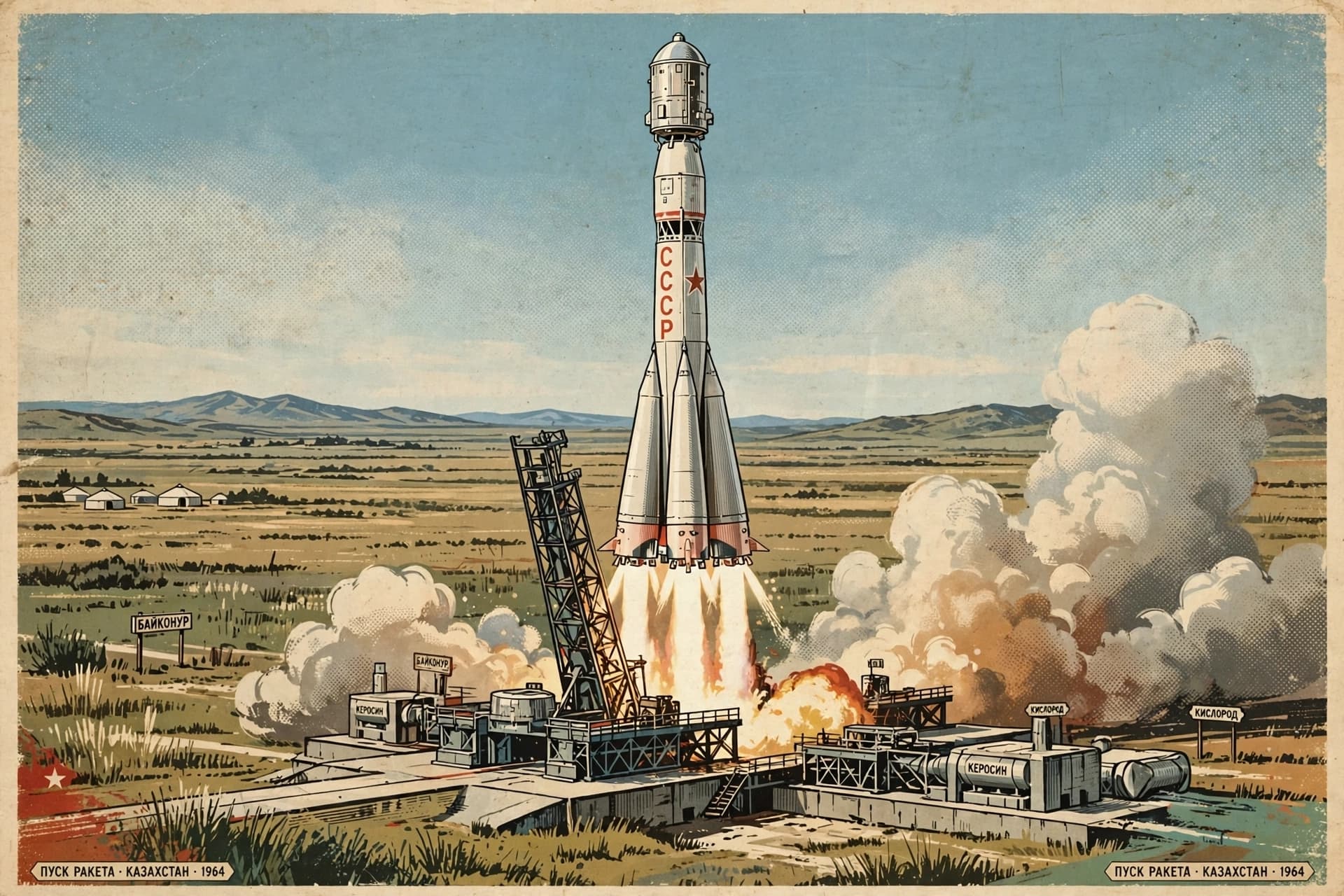
On a November morning in 1962, a rocket rose from the steppe of Kazakhstan carrying a spacecraft named for a planet it would never reach. Mars 1 was the Soviet Union's first attempt to send a probe to the Red Planet, launched on November 1, 1962, during the anxious, ambitious years of the Space Race . It was a machine of its time: a cylinder just over three meters long, with two solar panels unfolding like wings, carrying instruments to measure cosmic radiation, micrometeorites, magnetic fields, and the possibility of organic compounds . Its designers intended it to fly past Mars at a distance of about 11,000 kilometers, photographing the surface and transmitting data back to Earth .
The launch itself was successful. The spacecraft separated from its booster, its solar panels deployed, and it began its long cruise toward Mars. Early telemetry, however, revealed a leak in a gas valve in the orientation system. The spacecraft was switched to gyroscopic stabilization, a less precise method of maintaining its attitude . It continued to function for a time, transmitting data on the space environment between Earth and Mars. Sixty-one radio transmissions were received, initially at two-day intervals and later at five, as the probe reported on the solar wind and the radiation zones around Earth .
Then, on March 21, 1963, when Mars 1 was more than 106 million kilometers from Earth, communications ceased . The likely cause was a failure in the antenna orientation system, the same kind of mechanical frailty that had troubled the spacecraft from the start . The probe continued on its trajectory, silent, and on June 19, 1963, it passed within roughly 193,000 kilometers of Mars. It had traveled across the inner solar system only to arrive blind, unable to send back whatever it might have seen .
The Soviet Mars program of the early 1960s was a series of attempts, most of which met with failure. Mars 1 was the first, and its partial success—the data it returned about interplanetary space, the simple fact of reaching beyond Earth orbit—was a small triumph within a larger disappointment. The Space Race was not a gentle contest. It was a measure of national capability, a demonstration of technological prowess, and the pressure to succeed was immense. Mars 1 carried that pressure with it, a machine built to serve both science and statecraft.
There is a particular kind of loneliness in a silent spacecraft. Mars 1 continued its journey, a small metallic body falling through the dark, its instruments still recording perhaps, its transmitter dead. It passed Mars at a distance and entered a heliocentric orbit, circling the sun, a piece of human ambition and human fallibility moving through the void . It did not crash, nor did it land. It simply became a small object among many, a monument to an early attempt.
The scientific returns of Mars 1 were modest but real. It recorded micrometeorite strikes, measured magnetic field intensities in interplanetary space, and confirmed the existence of the solar wind . These were contributions to a picture of the space environment that was still being assembled, piece by piece, by probes from both superpowers. The data did not rewrite textbooks, but they added to the accumulating knowledge that would eventually make interplanetary travel routine.
More than six decades later, Mars is a busy place. Rovers crawl across its surface, orbiters map its atmosphere, and the question of ancient life drives missions of ever-increasing sophistication. The failures of the early Space Race are easy to forget, eclipsed by the successes that followed. But Mars 1 belongs to that lineage too—the long, imperfect, human effort to reach another world. It launched on a November day, fell silent four months later, and passed its destination unseen. It was not a triumph, but it was not nothing. It was a first step, and first steps are rarely graceful.
Image Disclaimer: This article's accompanying image is an AI-generated illustration, not a historical photograph.
Sources: NASA Jet Propulsion Laboratory (JPL), Roscosmos, Canadian archival records of Mars 1 mission data
Published by Banx Network. This article is part of the Banx decentralized media programme, powered by the BXE token on the XRP Ledger.