Sixty-three light-years away, in a young star system still dusted with the debris of its own violent becoming, there is a feature that astronomers have nicknamed with unexpected tenderness: the Cat's Tail. It is not a tail in any ordinary sense, but a vast ribbon of dark dust stretching across a distance that defies easy imagining—roughly a thousand times the span between Earth and the Sun, long enough, as one researcher put it, to be measured in trillions of house cats lined up nose to tail . For two years, since the James Webb Space Telescope first revealed it in infrared light, the Cat's Tail has puzzled scientists. Now, for the first time, they have seen it in visible light, and the view has clarified its origins in a way that feels almost like a story of cosmic consequence.
The system is Beta Pictoris, a star only a few million years old, surrounded by a debris disk that astronomers regard as a natural laboratory for studying the final stages of planet formation . The disk is seen nearly edge-on from Earth, and within it, previous observations had already identified clumps of carbon monoxide, a warp, and a curious asymmetry. The Cat's Tail appeared in 2024, an extended secondary disk in thermal emission, bent away from the plane of the main disk, and it seemed to connect to those other anomalies in ways that no one could fully explain .
The new observations, led by Arin Avsar at the University of Arizona and published in The Astrophysical Journal Letters, used the Hubble Space Telescope to capture the Cat's Tail in scattered visible light across multiple epochs between 2012 and 2025 . The reason it had remained invisible at shorter wavelengths, the team found, is its composition. The cloud is made almost entirely of organic refractory material—long chains of carbon atoms that absorb visible light and appear, to the human eye, quite black . It is not a bright plume but a shadow, silhouetted against the glow of the surrounding disk.
What could create such a thing? The answer, the researchers suggest, is a collision of bodies on the scale of Pluto, a cataclysm so violent that it reduced nascent dwarf planets to micron-sized grains of dust . The material's porosity and composition point to organic material from the interiors of the disrupted bodies, vaporized by the heat of impact and recondensed as they cooled . In the solar system, similar organic refractory material is found on Pluto's surface, a faint echo of the processes that may have shaped the Kuiper Belt in its youth.
The new analysis also revised the feature's geometry. Rather than extending a thousand astronomical units behind the star, as initially thought, the Cat's Tail may extend sideways relative to our line of sight, essentially in the same plane of the sky as the star, with no third dimension to it . This is not a small correction. It changes how astronomers model the disk's dynamics and the forces that shape its dust.
There is something quietly humbling in this. A structure so large that it dwarfs our entire solar system's inner reaches was made, in all likelihood, by an accident—two icy bodies meeting at the wrong speed, at the wrong angle, in the wrong moment of a young system's life. The Cat's Tail is the aftermath, a scar of dust that will disperse over millions of years, leaving perhaps a little more debris to be swept up by the growing planets around Beta Pictoris. It is a reminder that creation and destruction are not opposites in the cosmos but partners, working the same materials toward different ends.
The team's findings are published, the data are public, and the next step, Avsar has said, is to understand how dust grains can become so small and so fluffy—a question that current models do not fully answer . For now, the Cat's Tail remains what it was when first seen: a strange, dark plume in a young star's disk, telling a story of collision and consequence that we are only beginning to read.
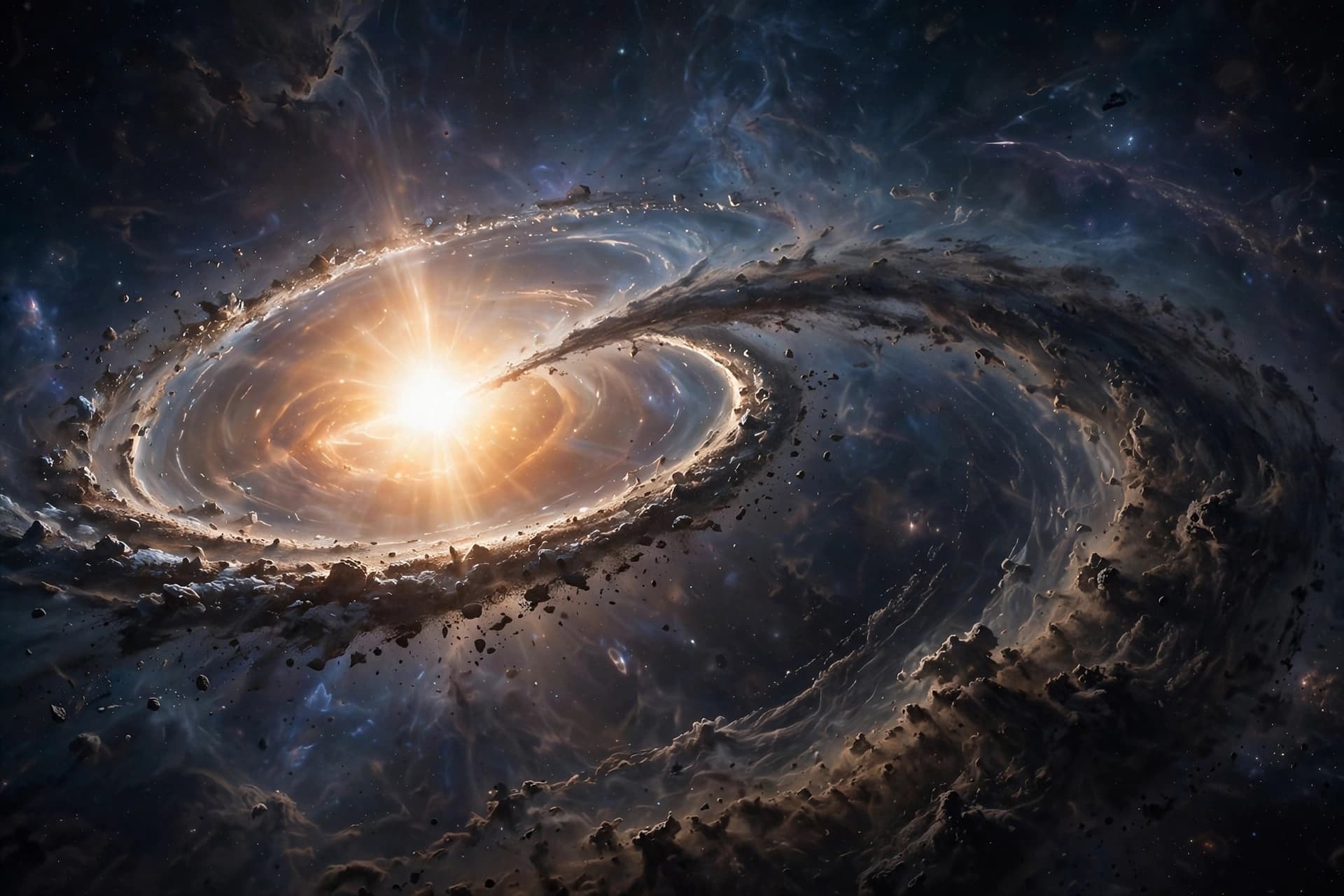
Image Disclaimer: The visual accompanying this article was generated by artificial intelligence and is not an actual astronomical photograph or artist's rendering from the research team.
Sources: Universe Today, University of Arizona News, EurekAlert, Scienmag
Published by Banx Network. This article is part of the Banx decentralized media programme, powered by the BXE token on the XRP Ledger.