There are moments when history does not announce itself with grandeur, but instead arrives softly, like breath on cold glass. Deep within the Siberian permafrost, where time itself seems to slow, a small and unexpected witness has endured. It is not a monument or a skeleton laid bare beneath museum lights, but something far humbler — the preserved remains of a meal, carried patiently through nearly fifteen thousand years of frozen silence.
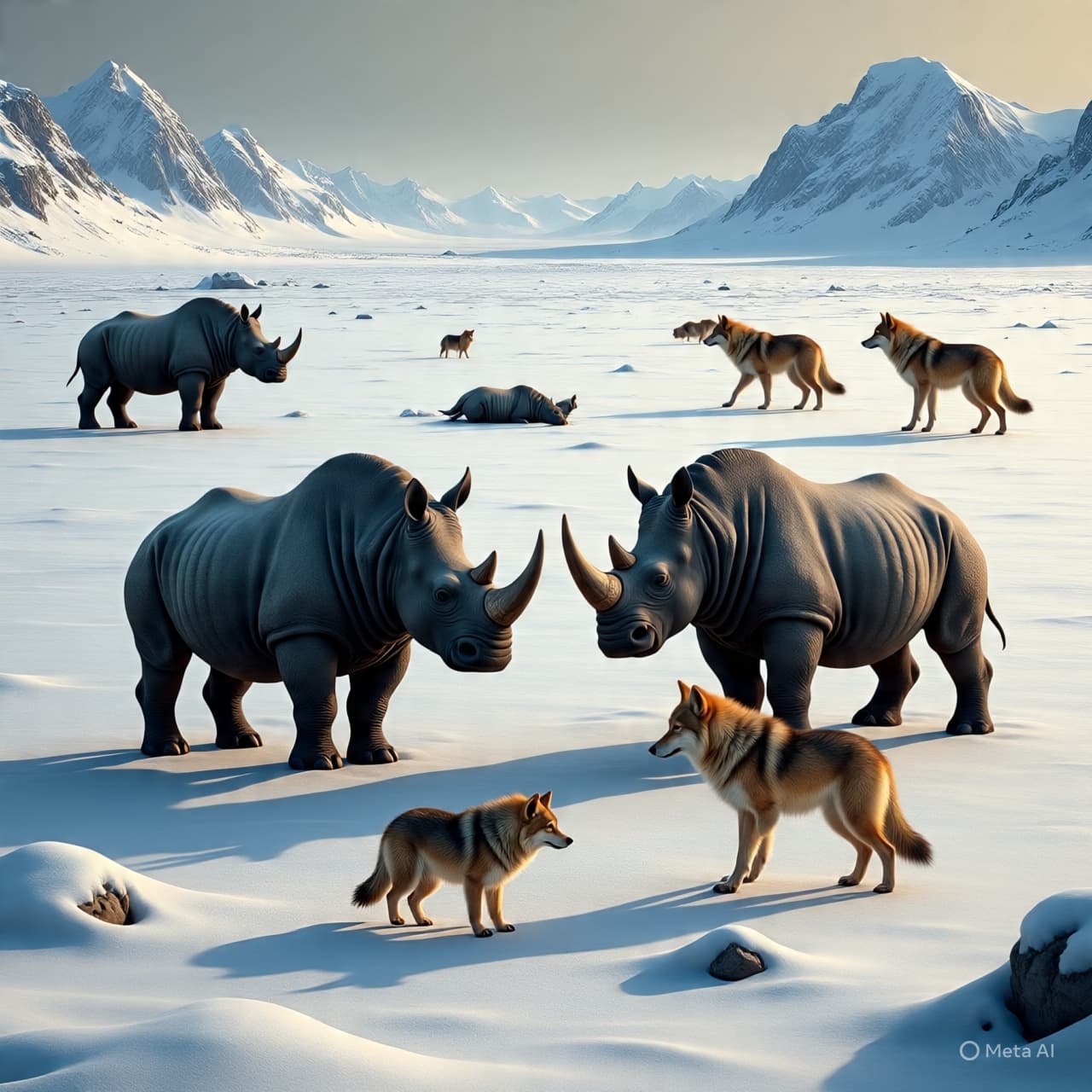
The discovery centers on a young wolf, its body locked in ice since the late Ice Age. Within it, researchers found remnants of its final feeding, astonishingly intact. This was no ordinary meal. The contents revealed traces of woolly rhinoceros tissue, offering a rare and intimate glimpse into the daily realities of a vanished world. Through this quiet preservation, an ancient interaction between predator and prey has resurfaced, not as drama, but as evidence.
In the Ice Age, survival was written in constant motion. Wolves, even young ones, were shaped early by necessity. The presence of woolly rhino remains suggests that these massive animals were not only part of the landscape, but part of the food web in ways still being understood. Whether scavenged or hunted in cooperation, the meal hints at complex behaviors unfolding against a backdrop of snow, wind, and endurance.
What makes this find remarkable is not only its age, but its clarity. Soft tissues rarely survive, and stomach contents even less so. Preserved by permafrost’s steady cold, the remains offer scientists a direct line to Ice Age ecology. From such evidence, researchers can begin to reconstruct how species interacted, how young predators were fed, and how entire ecosystems balanced themselves long before modern disruption.
The woolly rhinoceros, long extinct, often appears in scientific literature as bone and fossil. Here, however, it reemerges in a more immediate form, part of a living cycle rather than a museum exhibit. This transforms the animal from abstraction into presence, reminding us that extinction erases not just species, but relationships — the quiet exchanges that sustain life.
There is also an unspoken modern context surrounding the discovery. Permafrost, once reliably frozen, is thawing in places it never had before. As it releases long-held remnants of the past, it also raises questions about the future. Each find is both a gift of knowledge and a subtle signal of change, asking us to observe without haste, and to learn without assumption.
In the end, this wolf’s preserved dinner does not rewrite history, but it gently fills in its margins. It reminds us that science often advances not through spectacle, but through patience — by listening carefully to what the ice has chosen to keep. In that listening, a world long gone briefly stirs, offering insight without judgment, and then settles once more into silence.
AI Image Disclaimer Illustrations were produced with AI and serve as conceptual depictions, not real photographs.
Sources (Source Check Completed) The Guardian Reuters Gizmodo ScienceAlert Phys.org / EurekAlert!
Published by Banx Network. This article is part of the Banx decentralized media programme, powered by the BXE token on the XRP Ledger.