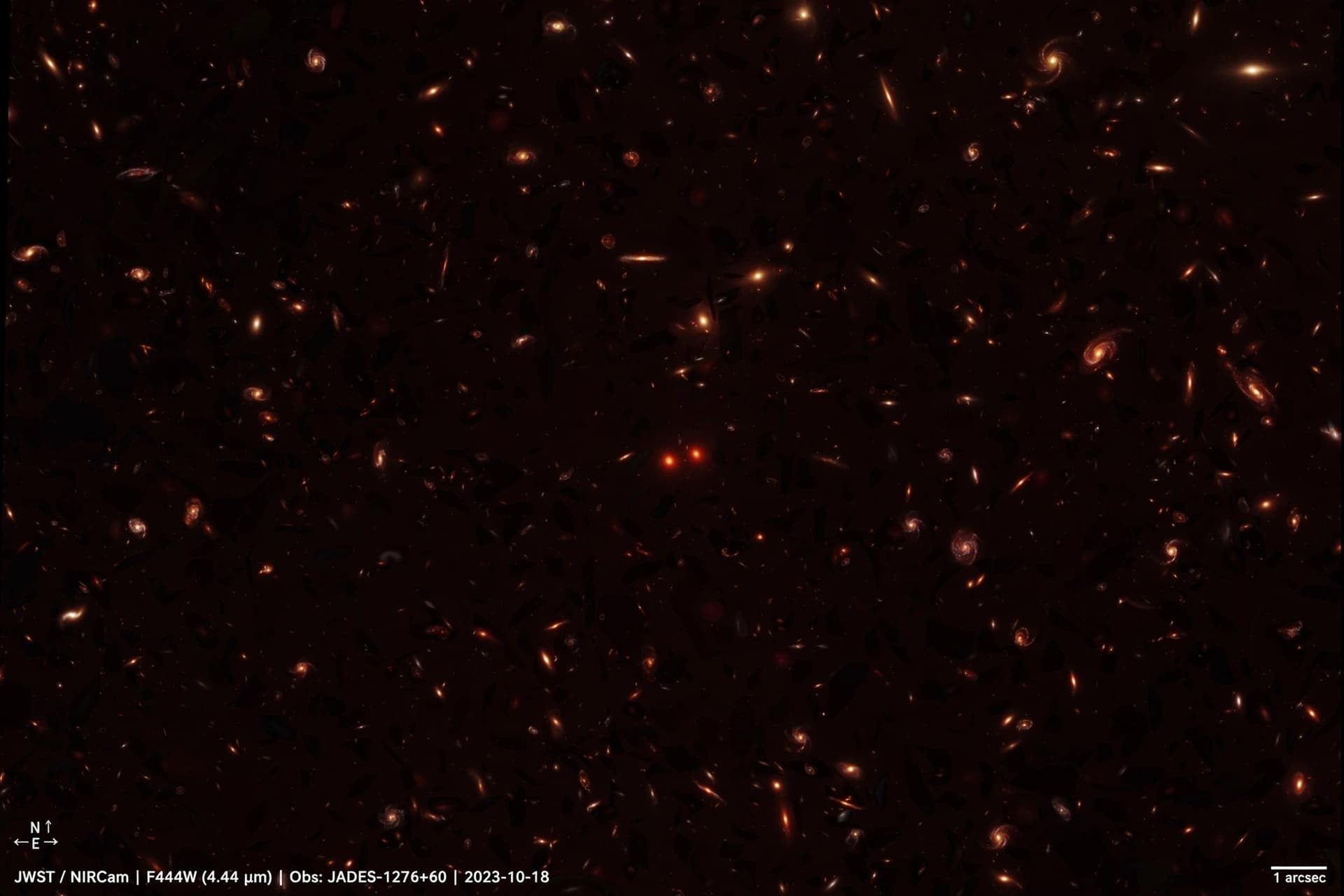
There is a particular kind of mystery that resides not in darkness but in redness—the faint, compact glow of objects so distant that their light has traveled for over twelve billion years to reach us. Among the most puzzling discoveries of the James Webb Space Telescope are the "Little Red Dots," tiny crimson specks scattered across the early universe that appeared within the first billion years after the Big Bang and then, just as mysteriously, seemed to fade from view. Now, astronomers believe they may have found something extraordinary: not single dots, but pairs—two red dots so close together that they may be on a collision course, with supermassive black holes at their hearts.
The discovery, led by Takumi Tanaka, a doctoral student at the Kavli Institute for the Physics and Mathematics of the Universe at the University of Tokyo, emerged from a new analytical approach. Traditional methods for identifying celestial objects relied on measuring their overall brightness and average color. When two Little Red Dots appear very close together, they can easily be mistaken for a single, more complex object. Tanaka's team developed a pixel-by-pixel color screening technique, examining each individual pixel in Webb's high-resolution infrared images rather than treating the object as a whole.
Applying this method to existing Webb observations, the researchers identified four pairs of Little Red Dots in the period roughly 1 billion to 1.3 billion years after the Big Bang. Within each pair, the two objects are separated by only a few thousand to tens of thousands of light-years—a distance significantly smaller than the diameter of our Milky Way, which spans about 100,000 light-years.
To rule out the possibility that these apparent pairs are merely chance alignments of objects at different distances, the team calculated the probability of such close pairings occurring randomly. The results indicated that the chance of all four pairs being visual coincidences is very low, suggesting that Little Red Dots tend to cluster on scales of thousands of light-years.
If each Little Red Dot indeed harbors a rapidly growing supermassive black hole—a leading hypothesis supported by simulations published in Nature in September 2026—then the two black holes within each pair may eventually spiral toward each other and merge. Galaxy mergers are thought to funnel vast amounts of gas toward galactic centers, feeding central black holes and accelerating their growth. The discovery of paired Little Red Dots may therefore indicate that galaxy mergers and black hole growth were intimately connected in the early universe.
Future gravitational wave observatories could potentially detect the mergers of such black hole pairs, offering a new way to test this scenario. The team plans to analyze the four pairs further and apply their method to larger observational samples. If more cases can be found and the rate of close pairings among massive black holes can be statistically measured, astronomers may be able to clarify just how important mergers were in the early evolution and growth of supermassive black holes.
The red dots, it seems, may not be solitary mysteries after all. They may be beginnings—the first tentative steps toward the giants that now anchor the centers of galaxies.
AI Image Disclaimer: The visuals accompanying this article were generated by artificial intelligence and are intended for illustrative purposes only, not as astronomical data or documentary records.
Sources: National Geographic (Chinese edition), Kavli IPMU, Nature, Futura
Published by Banx Network. This article is part of the Banx decentralized media programme, powered by the BXE token on the XRP Ledger.


.jpg&w=3840&q=75 "September 2026 Was the Second-Warmest on Record, With Global Temperatures Above 1.5°C for a Second Month")