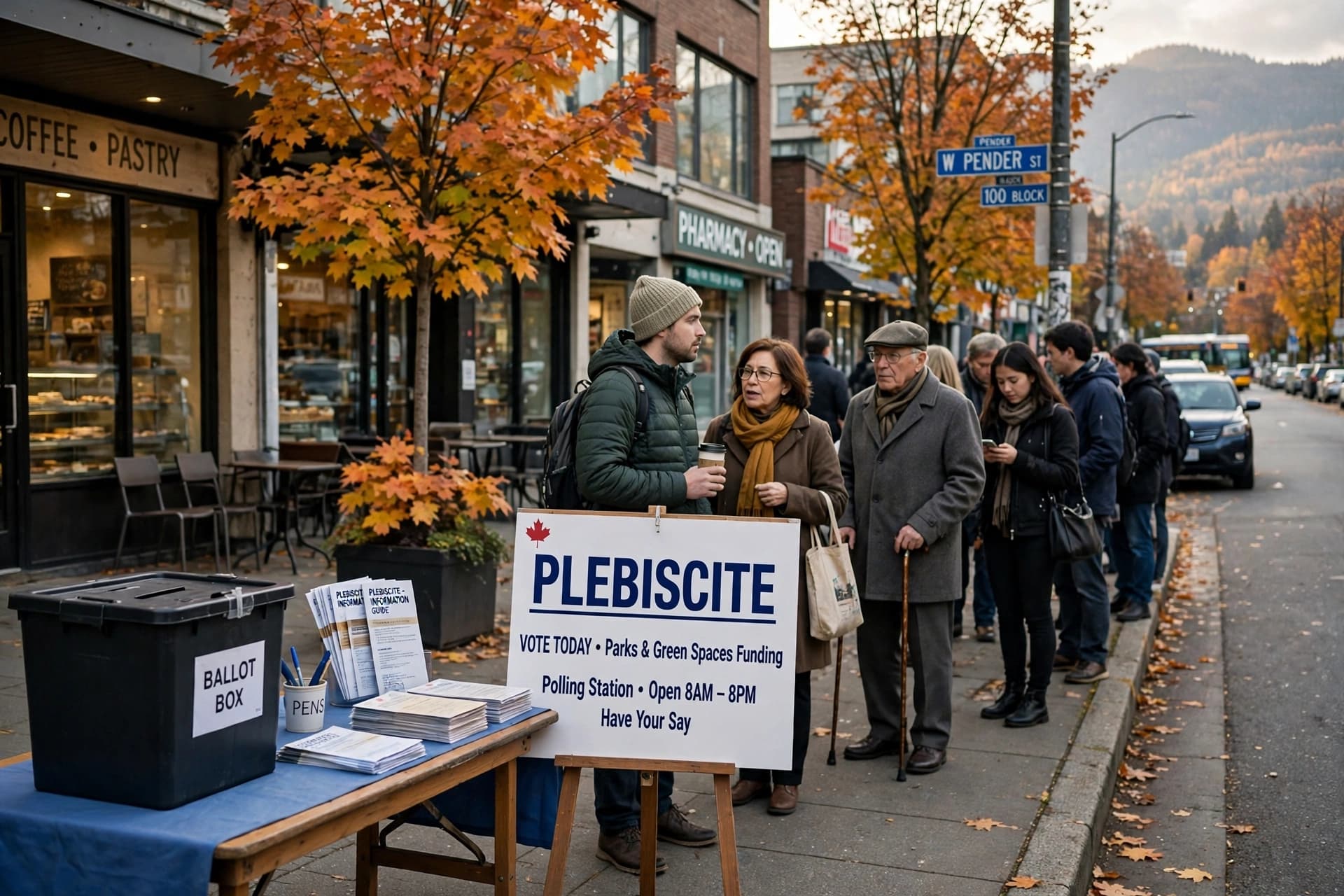
There is a particular kind of clarity that comes when a city asks its people a direct question, even if the answer cannot bind anyone to anything. In Vancouver, the question was whether the city should strengthen its laws to forbid open-air use of hard drugs in public spaces. Nearly seventy percent of those who voted said yes. The second question, whether the city should formally ask the province to create a secure facility with at least one hundred involuntary care beds, received the same overwhelming support .
The plebiscite was non-binding. It was placed on the ballot at the request of outgoing Mayor Ken Sim and his ABC Vancouver party, at a cost estimated between four hundred thousand and five hundred fifty thousand dollars . Of the 200,058 respondents to the first question, 68.6 percent voted in favor. On the second question, 68 percent of 199,231 respondents said yes . The numbers are unambiguous. The political context, however, is more complicated.
Sim's party was almost entirely wiped out in the municipal election held the same weekend. Pete Fry, the Green Party candidate, defeated Sim by more than thirty thousand votes and will become the next mayor. Fry had criticized the plebiscite as a cynical get-out-the-vote ploy, and he said after the results were released that he was not surprised by the outcome . "The issue of course is that the plebiscite is non-binding," Fry said. "In many respects, I feel like it was a cynical sort of get-out-the-vote election ploy" .
Fry's position is not a dismissal of the concern. He acknowledged that people are worried about open drug use and that he shares that concern. But his approach differs from Sim's. Rather than strengthening laws to forbid the practice, Fry has spoken of creating alternative places for people to go, reducing public consumption by directing people toward more appropriate environments . On the question of involuntary care beds, he noted that the provincial government has already committed to including more than one hundred such beds in the new St. Paul's Hospital currently under construction, and that a new facility for treatment, detox, and secure care is being built at Clark and First .
The plebiscite results reflect a public mood that is difficult to argue with. People are tired of seeing open drug use in their neighborhoods, in their parks, on their streets. The quality-of-life concerns are real, and they are not abstract. But the question of what to do about those concerns is where the consensus breaks down. Criminalization and enforcement are one path. Harm reduction and service provision are another. The plebiscite asked voters to endorse the first path, and they did, in large numbers. The election, held the same weekend, endorsed a mayor who favors the second.
There is no contradiction in that, necessarily. A voter can be troubled by open drug use and still prefer a candidate who promises services over sanctions. But the tension is worth naming. The plebiscite was advisory, a snapshot of opinion that carries no legal weight. The new council will decide what, if anything, to do with it. Fry has said he will not treat it as a mandate, but he has also acknowledged that it reflects genuine public concern . How he translates that acknowledgment into policy will be one of the defining tests of his early tenure.
For now, the results sit in the record as a statement of what Vancouver voters said when asked. Nearly seven in ten want stronger laws. Nearly seven in ten want involuntary care beds. The city has heard them. What it does next is a different question, and the answer will not be found on a ballot.
---
Image Disclaimer: The images in this article are generated by artificial intelligence and are not photographs of the individuals or locations mentioned.
Sources: The Province, Times Colonist, Radio-Canada, CityNews Vancouver
Published by Banx Network. This article is part of the Banx decentralized media programme, powered by the BXE token on the XRP Ledger.