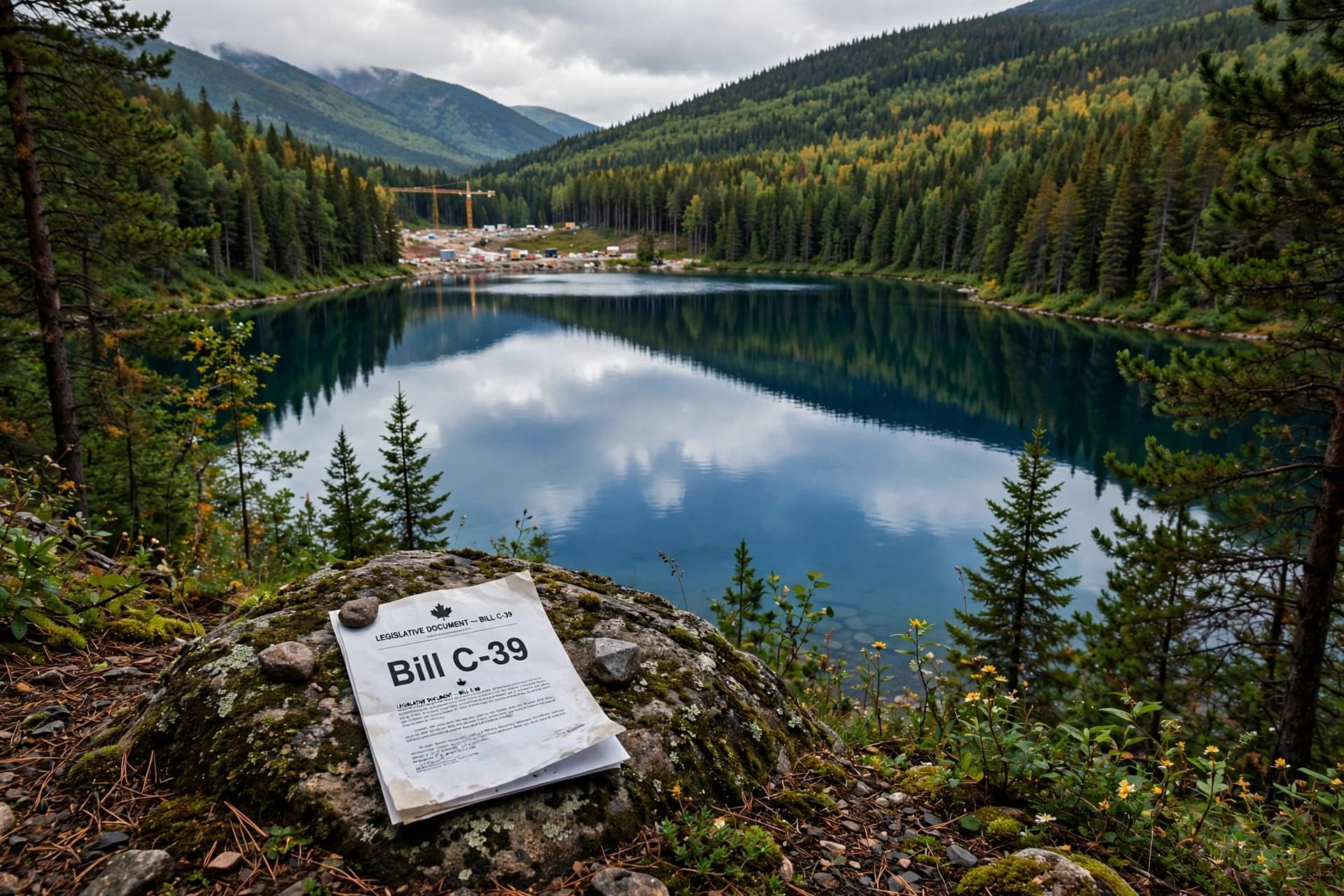
There is a particular responsibility that comes with speed, and a particular danger when speed is pursued without it. Bill C-39, the Building Canada Strong Act, is the signature legislation of Prime Minister Mark Carney's government, a 243-page omnibus bill designed to accelerate approvals for major infrastructure and energy projects by imposing a one-year review deadline and creating zones of "national interest" where certain projects can be pre-approved . The government calls it the most ambitious reform to Canada's ability to build in a generation . This week, fifty-six fellows of the Royal Society of Canada, some of the country's most distinguished scientists and scholars, sent an open letter urging Parliament to amend it, warning of "costly and potentially irreversible harm" to the environment .
The letter outlines six specific amendments. The fellows ask that Parliament retain the five-year sunset clause on the government's extraordinary powers under the earlier Building Canada Act, which Bill C-39 would eliminate. They want "regions of national interest" to be fully defined, rather than left to cabinet discretion. They want thorough reviews before shovels hit the ground, and they object to a provision that would allow the environment minister to approve "enabling activities" before a project is formally assessed, activities the bill does not define .
The scientists are careful to say they support the goal of building. Their objection is to the method. "Bill C-39 countermands the environmental protections currently in place in Canadian law, laws written to avoid irreparable harms," the letter states . Sarah Otto, a zoology professor at the University of British Columbia who initiated the letter, put it more sharply: "This is not a build Canada while protecting our environment act. It is a build Canada strong while damaging the environment [act]" . John Smol, a biology professor at Queen's University, offered an image that is difficult to forget: "What are you going to do? Put water back in? That's not how ecology works. The toothpaste is out of the tube" .
The bill also proposes changes to the Fisheries Act that would allow companies to pay fees instead of restoring fish habitat they damage, and it includes revisions to the Canada Labour Code that unions say will limit the right to strike . The government maintains that the bill upholds environmental standards and Indigenous rights, and that clearer timelines do not predetermine outcomes. Dominic LeBlanc, the minister responsible, said that "responsible developments and robust oversight can and should exist together" . The Impact Assessment Agency has said that early works approvals would still be subject to conditions and permits, and that approval does not guarantee a positive assessment outcome .
What concerns the scientists is not only the substance of the bill but the process. It is being studied by a specially constructed committee, and of its twelve members, eleven voted in favor at second reading . The scientists have requested to appear as witnesses and have not been invited . The letter was released as the bill moves through Parliament on an accelerated timeline, with the government using its majority to limit debate. For the fellows, the speed is part of the problem. The environmental protections the bill would alter were written over decades, and the consequences of weakening them will outlast the political cycle that produced the legislation.
There is no dispute that Canada needs to build. The housing shortage, the energy transition, the decaying infrastructure: these are real, and the frustration with slow approvals is legitimate. The question the scientists are asking is not whether to build but what to build on, and what to leave intact. "Political and industrial projects are by and large temporary, measured in years," Smol said. "Ecosystem damage can be permanent" . The bill will proceed. The amendments may or may not be adopted. What remains to be seen is whether the country will look back on this moment as one of necessary speed or of a speed it could not undo.
Image Disclaimer: The visuals in this article are AI-generated and are not actual photographs of Parliament, the scientists, or the locations mentioned.
Sources: CBC News, CTV News, The Globe and Mail, Government of Canada
Published by Banx Network. This article is part of the Banx decentralized media programme, powered by the BXE token on the XRP Ledger.