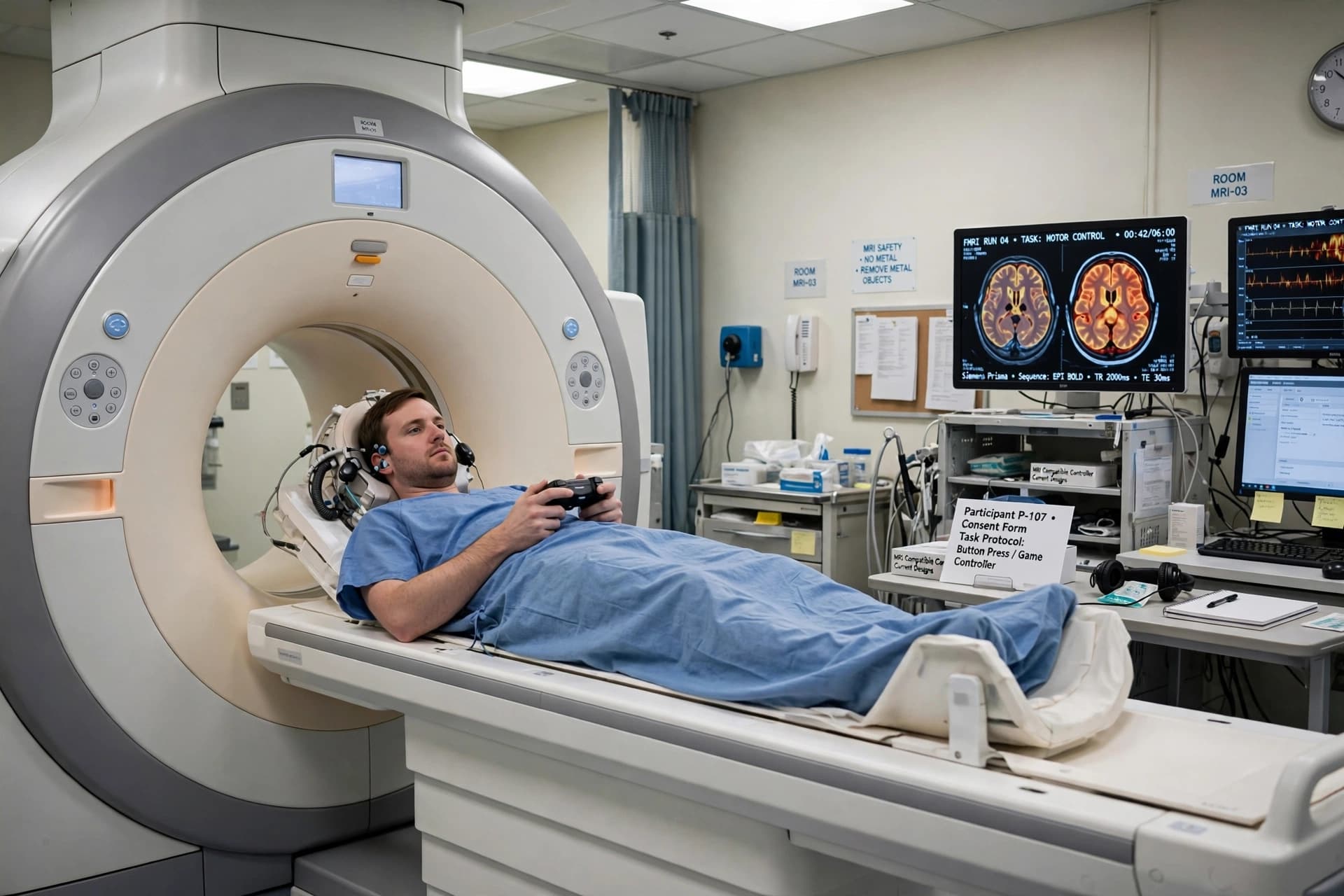
There is a particular poverty to the way the brain is often studied—a person lying still in a scanner, looking at pictures, pressing a button when they see a face or a shape. It is a method that has revealed much, but it leaves out the continuous, messy, improvisational quality of real life. Now, neuroscientists at Western University are trying to fill that gap by asking participants to do something far more natural: play video games.
The work is part of the Digital Brain Project, an international research initiative supported by Meta with $15 million in funding. The goal is to create a massive, openly shared dataset of human brain activity recorded while people engage in immersive, interactive environments—not isolated tasks .
Jörn Diedrichsen and Jody Culham, both faculty at Western's Institute for Neuroscience, are helping lead the effort. Diedrichsen has spent years developing ways to map brain activity across many different states, using a battery of more than 60 tasks performed during fMRI scans. Culham studies how the brain responds when people actively interact with changing environments .
Video games offered a way to combine both approaches. When someone plays a game like Pac-Man, they are constantly making predictions, taking actions, and receiving feedback. "A ghost is approaching, so they change direction. They move the controller, Pac-Man responds, the environment changes and the player immediately updates their plan," Culham explained. This continuous loop of prediction, action, and feedback is fundamentally different from passive viewing tasks .
The project will use a mix of conventional cognitive tasks and immersive video games, including kart-racing, action games, and digital puzzles. New tasks will be introduced throughout the project to expand the range of brain states sampled. The researchers are also upgrading Western's imaging infrastructure, including a 7-Tesla MRI scanner and a new 32-channel head coil designed to capture signals from deep brain structures like the cerebellum and thalamus .
The hope is that this approach will capture something conventional methods miss: the brain as it predicts, acts, and adapts in real time. "Think of brain activity as an enormous landscape," Diedrichsen said. "At any given moment, your brain is somewhere in that landscape, and different experiences, decisions and actions move you to different places." Video games allow researchers to explore that landscape more broadly than resting-state scans or single-task experiments .
The dataset will be openly shared, allowing researchers around the world to analyze brain activity in ways that have not been possible before. For a field that has often relied on constrained, artificial tasks, the Digital Brain Project represents a bet that the brain's complexity can only be understood by studying it in motion—engaged, active, and at play.
AI Image Disclaimer: The images accompanying this article are generated by artificial intelligence and are intended for illustrative purposes only.
Sources: Western University, Mirage News, Imaging Neuroscience, DevBytes
Published by Banx Network. This article is part of the Banx decentralized media programme, powered by the BXE token on the XRP Ledger.