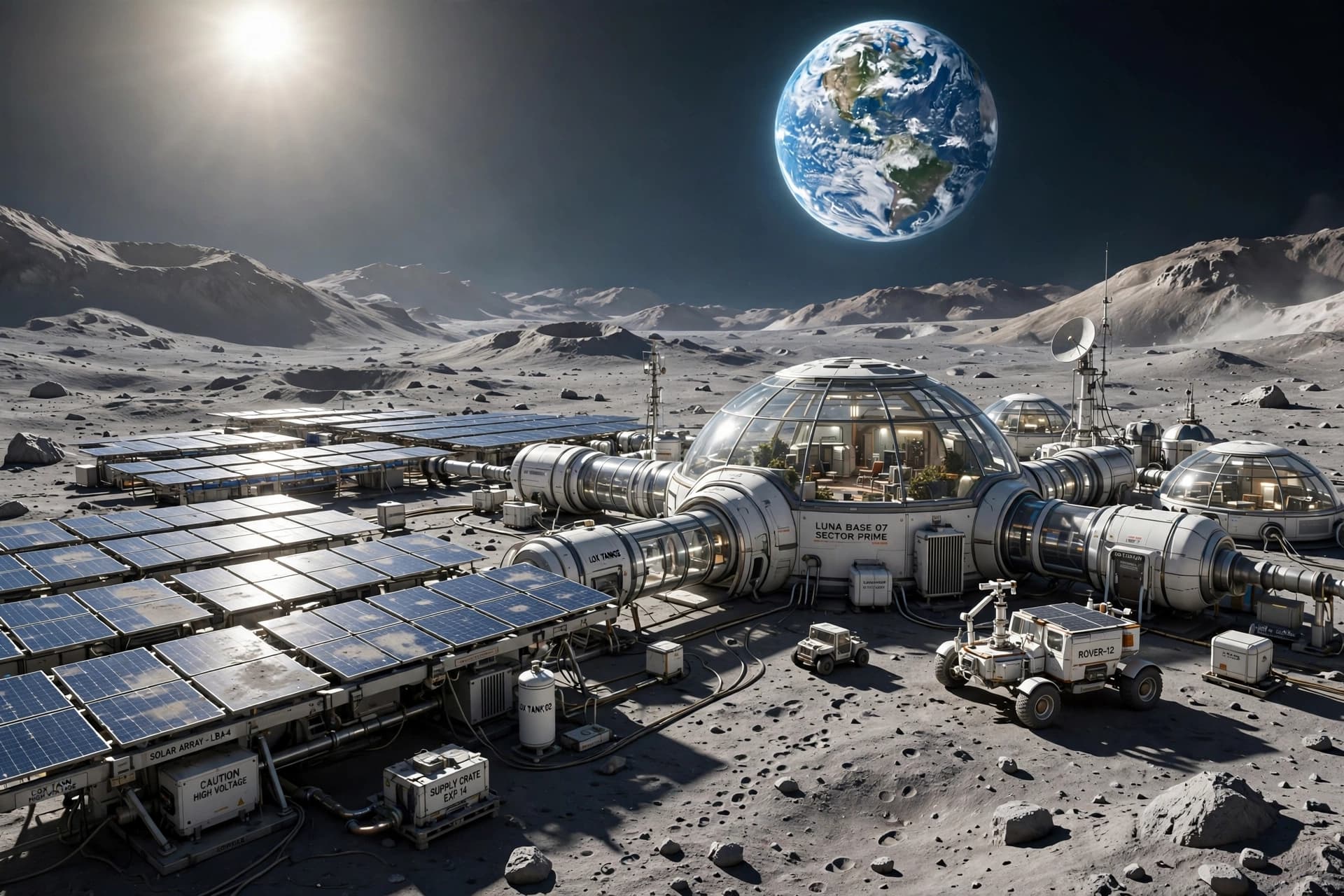
The dream of establishing bustling cities on the Moon has long captivated scientists and science fiction enthusiasts alike. However, a new study published in Frontiers in Space Technologies casts a sobering light on this ambition, suggesting that the Moon’s limited water resources may make large-scale colonization impossible. The research indicates that a city of one million people would exhaust the known water ice reserves in just 2.4 years, challenging the feasibility of self-sustaining lunar metropolises.
Water is essential for life, but on the Moon, it is also critical for producing oxygen and rocket fuel. The study, led by researchers who analyzed current estimates of lunar water ice in permanently shadowed craters, found that the total amount available is far less than what would be needed to support a large population. Even with highly efficient recycling systems, the demand for water in agriculture, industry, and daily consumption would quickly outstrip supply. This scarcity poses a fundamental barrier to the vision of a thriving lunar society.
The findings contrast with earlier optimism about the Moon’s potential as a stepping stone to Mars. Proponents of lunar colonization had hoped that local resources could support growth without constant resupply from Earth. However, this new data suggests that reliance on Earth for water imports would be necessary for any significant settlement, drastically increasing the cost and complexity of such missions. It forces a reevaluation of what is realistically achievable in the near future.
Experts propose that the solution may lie in finding new sources of water or developing more advanced extraction technologies. Some suggest looking beyond the poles to other regions where water might be trapped in mineral forms. Others advocate for smaller, specialized outposts rather than large cities, focusing on scientific research and resource processing rather than mass habitation. This shift in strategy could make lunar presence more sustainable, albeit on a smaller scale.
The study also highlights the importance of international cooperation in space exploration. Sharing data and resources could help maximize the use of available water, ensuring that scientific goals are met without depleting essential supplies. Collaborative efforts could also lead to breakthroughs in recycling and conservation technologies that benefit both lunar missions and life on Earth. Unity in space may be the key to overcoming these logistical hurdles.
For private companies like SpaceX, which have ambitious plans for lunar infrastructure, the results serve as a cautionary note. While innovation can overcome many challenges, physical limits are hard to bypass. The company’s vision of a "self-growing" city may need to be adjusted to account for the reality of resource scarcity. Adapting plans to fit the available data will be crucial for long-term success.
Despite the challenges, the desire to explore the Moon remains strong. The study does not rule out colonization entirely but rather defines its boundaries. Small, well-supported bases may still be viable, offering valuable insights into living off-world. These initial steps could pave the way for future advancements that make larger settlements possible, perhaps through the importation of water from asteroids or other celestial bodies.
In the end, the study is a reminder that space exploration is governed by the same physical laws as life on Earth. Resources are finite, and careful planning is essential. By understanding these limits, we can set realistic goals and work toward a future where humanity’s presence on the Moon is sustainable, even if it is smaller than we once dreamed.
AI Image Disclaimer: The visual aids included here are AI-generated illustrations of lunar landscapes and conceptual colonies, not actual photographs from the Moon.
Sources: ExtremeTech Forbes Frontiers in Space Technologies
Published by Banx Network. This article is part of the Banx decentralized media programme, powered by the BXE token on the XRP Ledger.