
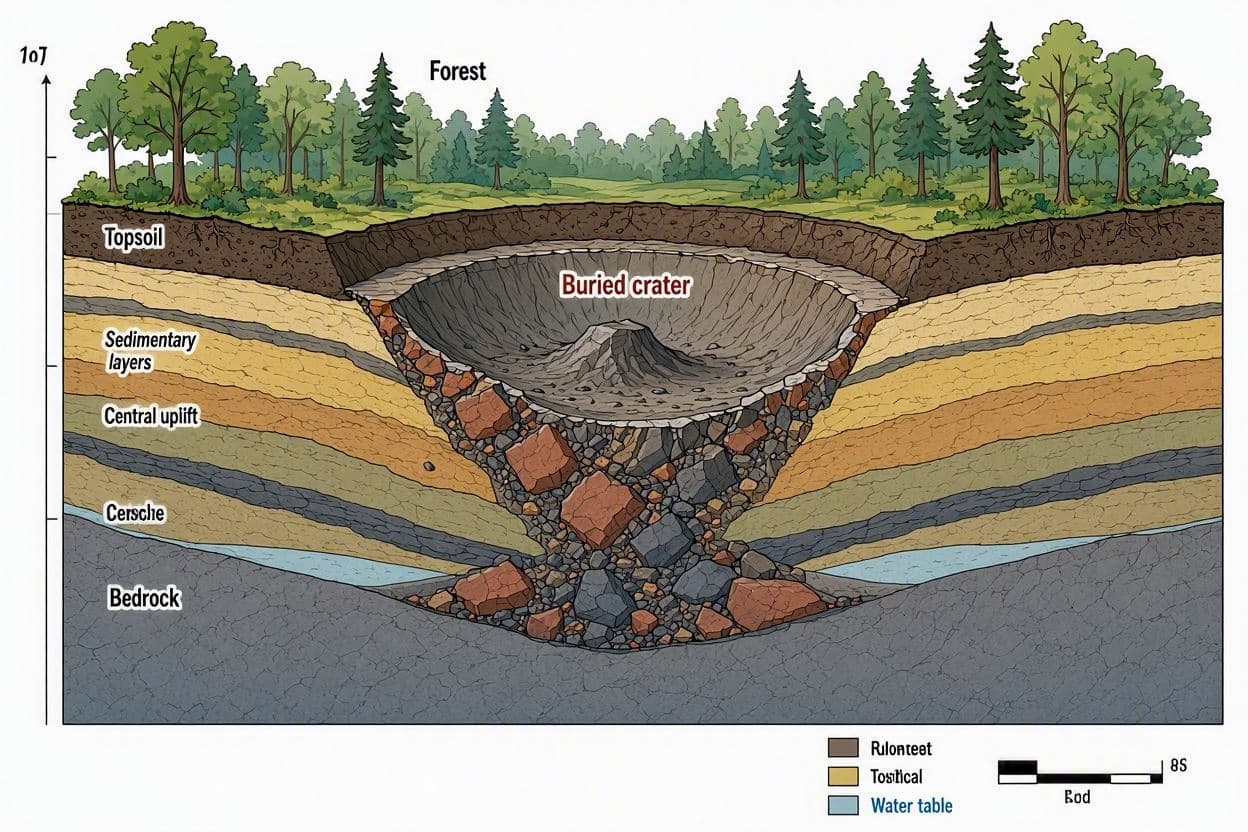
Beneath the dense forests and rolling hills of Quebec, a secret has lain hidden for nearly 400 million years. A massive impact crater, formed by a celestial body striking the Earth during the Devonian period, remained undetected until recently. This discovery, revealed through advanced geophysical surveys, adds a new chapter to the geological history of North America. It serves as a humble reminder that even in well-mapped regions, the Earth still holds surprises beneath its surface.
The crater, estimated to be several kilometers wide, was identified by analyzing gravity anomalies and magnetic data. Unlike fresh craters on the Moon or Mars, terrestrial impact sites are often erased by erosion, vegetation, and tectonic activity over millions of years. In this case, layers of sediment and rock had completely buried the structure, masking its presence from conventional geological mapping. It took modern technology to peel back these layers and reveal the scar beneath.
This finding highlights the power of indirect detection methods in geology. By measuring variations in the Earth’s gravitational field, scientists can infer the presence of underground structures without digging. These techniques are increasingly used to locate mineral deposits, oil reserves, and ancient impact sites. The discovery in Quebec demonstrates how non-invasive tools can uncover history that is invisible to the naked eye.
The impact event itself would have been catastrophic for the local environment at the time. The energy released would have vaporized rock, created shockwaves, and potentially triggered wildfires. However, because it occurred so long ago, there is no direct record of its immediate effects on life. Instead, the crater serves as a static monument to a violent moment in deep time, preserved in the rock record.
For geologists, the crater provides valuable insights into the frequency of large impacts on Earth. While many craters have been identified, the record is incomplete due to erosion and burial. Each new discovery helps refine models of impact rates, which are crucial for understanding planetary evolution and assessing current risks. It adds another data point to the story of Earth’s bombardment history.
The location of the crater in Quebec also has economic implications. Impact structures can sometimes concentrate valuable minerals, making them targets for exploration. While the primary interest here is scientific, the discovery may lead to further studies of the region’s geology and resource potential. It shows how pure research can have practical applications in unexpected ways.
Public interest in such discoveries reflects a fascination with cosmic events and earthly secrets. Knowing that a giant hole lies hidden beneath familiar landscapes changes how we perceive the ground beneath our feet. It invites a sense of wonder and curiosity, encouraging people to look beyond the surface and appreciate the deep history of their surroundings.
In the end, the unnoticed crater is a testament to the patience of science and the power of technology. It reminds us that the Earth is dynamic and layered, with stories waiting to be told. By uncovering these hidden chapters, we gain a richer understanding of our planet’s past and its ongoing evolution.
AI Image Disclaimer: The visual aids included here are AI-generated illustrations depicting geological surveys and impact crater concepts, not actual photographs of the specific site in Quebec.
Published by Banx Network. This article is part of the Banx decentralized media programme, powered by the BXE token on the XRP Ledger.



