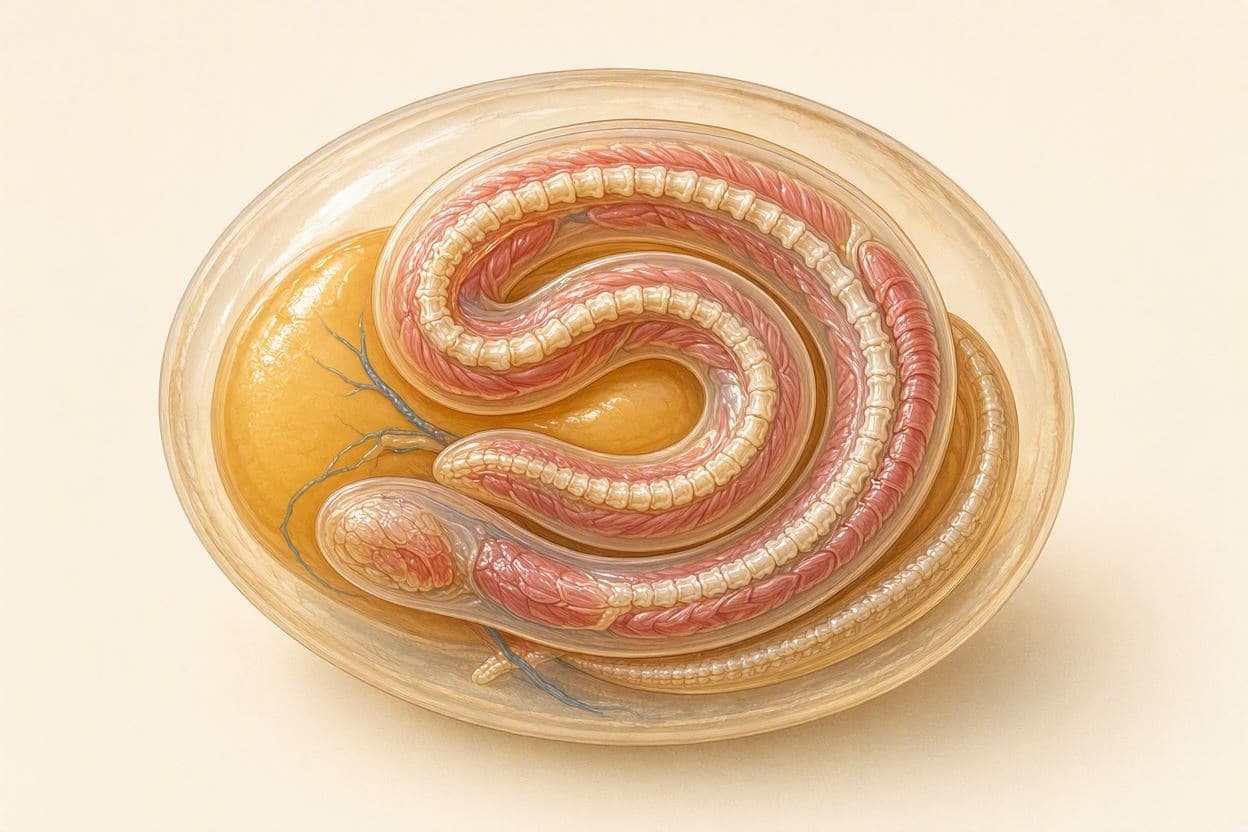
Nature often reveals its most profound secrets in the quietest moments of development. Within the egg of a snake, a transformation occurs that is both delicate and dramatic: the embryo twists into a tight spiral, defying the linear growth patterns seen in many other vertebrates. For centuries, this coiling has been a subject of curiosity, a biological puzzle wrapped in shell and membrane. Now, scientists have uncovered the mechanical and genetic reasons behind this unique formation, offering a glimpse into the elegant engineering that shapes life.
The discovery centers on the interplay between rapid tissue growth and physical constraints. As the snake embryo develops, its body elongates at a rate far exceeding that of its surrounding tissues. This differential growth creates a buildup of mechanical stress, much like a ribbon being pushed from one end while the other remains fixed. To relieve this pressure, the embryo naturally buckles and coils, finding the most efficient shape to accommodate its increasing length within the limited space of the egg.
Researchers used advanced imaging techniques to observe this process in real-time, tracking the movement of cells as they multiplied and shifted. They found that specific genes regulate the speed of axial elongation, ensuring that the spine and muscles grow in harmony. When these genetic controls are altered, the coiling pattern changes, demonstrating the precise biological programming that governs this developmental stage. It is a testament to the precision of evolutionary design.
This spiral formation is not merely a matter of fitting inside an egg; it also prepares the snake for its future mode of locomotion. The coiled structure helps organize the musculoskeletal system, aligning the vertebrae and ribs in a way that supports the flexible, sinuous movement characteristic of snakes. Thus, the embryonic twist is both a solution to a spatial problem and a foundation for adult function.
The findings have broader implications for understanding developmental biology across species. By studying how snakes manage extreme elongation, scientists can gain insights into congenital defects in other animals, including humans, where spinal development goes awry. The principles of mechanical stress and tissue growth are universal, offering lessons that transcend the specific case of serpents.
Moreover, this research highlights the importance of interdisciplinary approaches in science. Combining genetics, biomechanics, and computational modeling allowed researchers to see the whole picture, rather than isolated parts. It reminds us that biological phenomena are often complex systems where form and force are inextricably linked.
As we continue to explore the mysteries of embryogenesis, each discovery adds a piece to the vast puzzle of life. The snake’s spiral is a reminder that even the most unusual traits have logical, explainable origins. It invites us to look at the natural world with renewed wonder, appreciating the ingenuity hidden within every cell.
The revelation of why snake embryos twist into spirals underscores the intricate balance of genetics and physics in development. This discovery not only explains a unique biological trait but also offers valuable insights into the mechanics of growth. It is a gentle reminder of the sophisticated order underlying the diversity of life.
AI Image Disclaimer: The visual representations accompanying this article are AI-generated interpretations designed to illustrate embryonic development and biological structures, using abstract and scientific imagery.
Sources: Nature Science Daily
Published by Banx Network. This article is part of the Banx decentralized media programme, powered by the BXE token on the XRP Ledger.